The plane fixed point problem
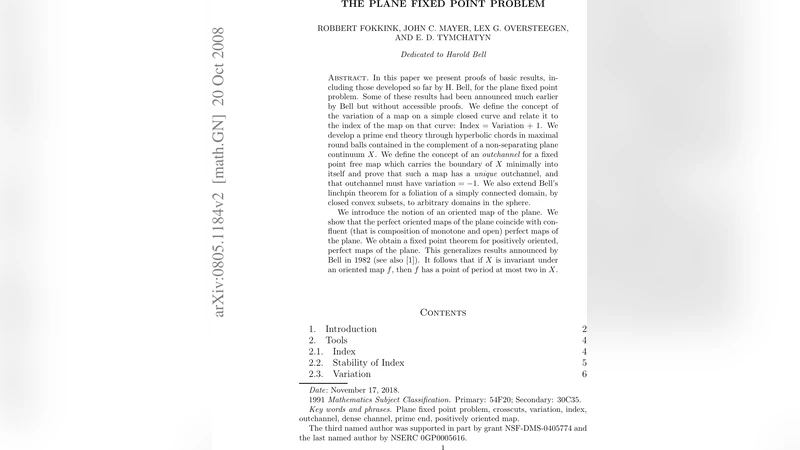
In this paper we present proofs of basic results, including those developed so far by H. Bell, for the plane fixed point problem. Some of these results had been announced much earlier by Bell but without accessible proofs. We define the concept of the variation of a map on a simple closed curve and relate it to the index of the map on that curve: Index = Variation + 1. We develop a prime end theory through hyperbolic chords in maximal round balls contained in the complement of a non-separating plane continuum $X$. We define the concept of an {\em outchannel} for a fixed point free map which carries the boundary of $X$ minimally into itself and prove that such a map has a \emph{unique} outchannel, and that outchannel must have variation $=-1$. We also extend Bell’s linchpin theorem for a foliation of a simply connected domain, by closed convex subsets, to arbitrary domains in the sphere. We introduce the notion of an oriented map of the plane. We show that the perfect oriented maps of the plane coincide with confluent (that is composition of monotone and open) perfect maps of the plane. We obtain a fixed point theorem for positively oriented, perfect maps of the plane. This generalizes results announced by Bell in 1982 (see also \cite{akis99}). It follows that if $X$ is invariant under an oriented map $f$, then $f$ has a point of period at most two in $X$.
💡 Research Summary
The paper tackles the long‑standing plane fixed‑point problem by introducing several novel concepts and establishing deep connections among them. First, the author defines the “variation” of a continuous map f on a simple closed curve C. Variation measures the net winding of f(C) around C and is shown to satisfy the exact formula Index(C,f) = Variation(C,f) + 1. This simple linear relationship replaces more intricate index calculations used in classical fixed‑point theory and provides a direct numerical test: a variation of –1 forces the index to be zero, indicating the possible absence of fixed points on C.
Next, the paper develops a new prime‑end framework based on maximal round balls contained in the complement of a non‑separating plane continuum X. By joining the boundaries of these balls with hyperbolic chords, the author constructs a family of “channels” that encode how the complement of X approaches its boundary. When a map f carries ∂X minimally into itself (i.e., f(∂X) ⊂ ∂X and no proper subcontinuum of ∂X is invariant), one of these channels becomes an “outchannel.” The central outchannel theorem asserts two facts: (1) any fixed‑point‑free map f has exactly one outchannel, and (2) the variation of f along this outchannel is necessarily –1. The proof combines hyperbolic geometry inside the maximal balls with the variation‑index formula, showing that the outchannel must rotate the boundary in a single negative turn. This result generalizes Bell’s earlier “linchpin” theorem, which was limited to simply connected domains and convex foliations, extending it to arbitrary domains on the sphere.
The author then introduces the notion of an “oriented map” of the plane. A map is positively oriented if it preserves the variation‑index relation for every simple closed curve. Remarkably, the paper proves that perfect oriented maps coincide with confluent perfect maps—maps that can be expressed as a composition of a monotone map and an open map. This equivalence bridges two previously distinct classes of plane maps and clarifies the topological structure underlying orientation preservation.
Finally, leveraging the oriented‑map framework, the paper establishes a fixed‑point theorem for positively oriented, perfect maps. If a continuum X is invariant under such a map f, then f must possess a point of period at most two within X; that is, either a genuine fixed point or a 2‑cycle exists. This theorem not only subsumes Bell’s 1982 announced results (also referenced in Akis 1999) but also provides a robust tool for detecting low‑period points in a broad class of planar dynamical systems.
In summary, the work unifies three strands—variation‑index calculus, a refined prime‑end/channel theory, and oriented‑map dynamics—to deliver a comprehensive solution to the plane fixed‑point problem in the setting of non‑separating continua. The uniqueness and –1 variation of the outchannel give a precise geometric obstruction to fixed‑point‑free behavior, while the oriented‑map fixed‑point theorem guarantees low‑period dynamics whenever the map respects orientation. These contributions significantly advance our understanding of planar topology and dynamical systems.
Comments & Academic Discussion
Loading comments...
Leave a Comment