📝 Original Info
- Title: Adaptive Hybrid Deflection and Retransmission Routing for Optical Burst-Switched Networks
- ArXiv ID: 0810.2837
- Date: 2008-10-17
- Authors: Researchers from original ArXiv paper
📝 Abstract
Burst contention is a well known challenging problem in Optical Burst Switching (OBS) networks. Deflection routing is used to resolve contention. Burst retransmission is used to reduce the Burst Loss Ratio (BLR) by retransmitting dropped bursts. Previous works show that combining deflection and retransmission outperforms both pure deflection and pure retransmission approaches. This paper proposes a new Adaptive Hybrid Deflection and Retransmission (AHDR) approach that dynamically combines deflection and retransmission approaches based on network conditions such as BLR and link utilization. Network Simulator 2 (ns-2) is used to simulate the proposed approach on different network topologies. Simulation results show that the proposed approach outperforms static approaches in terms of BLR and goodput.
💡 Deep Analysis
Deep Dive into Adaptive Hybrid Deflection and Retransmission Routing for Optical Burst-Switched Networks.
Burst contention is a well known challenging problem in Optical Burst Switching (OBS) networks. Deflection routing is used to resolve contention. Burst retransmission is used to reduce the Burst Loss Ratio (BLR) by retransmitting dropped bursts. Previous works show that combining deflection and retransmission outperforms both pure deflection and pure retransmission approaches. This paper proposes a new Adaptive Hybrid Deflection and Retransmission (AHDR) approach that dynamically combines deflection and retransmission approaches based on network conditions such as BLR and link utilization. Network Simulator 2 (ns-2) is used to simulate the proposed approach on different network topologies. Simulation results show that the proposed approach outperforms static approaches in terms of BLR and goodput.
📄 Full Content
Adaptive Hybrid Deflection and Retransmission Routing for
Optical Burst-Switched Networks
Martin L´evesque, Halima Elbiaze
Department of Computer Science
Universit´e du Qu´ebec `a Montr´eal
Montr´eal (QC), Canada
Email: elbiaze.halima@uqam.ca
Wael Hosny Fouad Aly
Department of Computer Engineering
Arab Academy for Science & Technology
Alexandria, Egypt
Email: drwaelhosny@aast.edu
Abstract—Burst contention is a well known challenging problem in
Optical Burst Switching (OBS) networks. Deflection routing is used to
resolve contention. Burst retransmission is used to reduce the Burst Loss
Ratio (BLR) by retransmitting dropped bursts. Previous works show that
combining deflection and retransmission outperforms both pure deflection
and pure retransmission approaches. This paper proposes a new Adaptive
Hybrid Deflection and Retransmission (AHDR) approach that dynamically
combines deflection and retransmission approaches based on network
conditions such as BLR and link utilization. Network Simulator 2 (ns-2) is
used to simulate the proposed approach on different network topologies.
Simulation results show that the proposed approach outperforms static
approaches in terms of BLR and goodput.
I. INTRODUCTION
Optical Burst Switching (OBS) [1] is a promising technology
to handling bursty and dynamic Internet Protocol traffic in optical
networks effectively.
In OBS networks, user data (IP for example) is assembled as a huge
segment called a data burst which is sent using one-way resource
reservation. The burst is preceded in time by a control packet, called
Burst Header Packet (BHP), which is sent on a separate control
wavelength and requests resource allocation at each switch. When
the control packet arrives at a switch, the capacity is reserved in the
cross-connect for the burst. If the needed capacity can be reserved
at a given time, the burst can then pass through the cross-connect
without the need of buffering or processing.
Since data bursts and control packets are sent out without waiting
for an acknowledgment, the burst could be dropped due to resource
contention or to insufficient offset time if the burst catches up the
control packet. Thus, it is clear that burst contention resolution
approaches play an essential role to reduce the Burst Loss Ratio
(BLR) in OBS networks [2].
Burst contention can be resolved using several approaches, such
as wavelength conversion, buffering based on fiber delay line (FDL)
or deflection routing. Another approach, called burst segmentation,
resolves contention by dividing the contended burst into smaller parts
called segments, so that a segment is dropped rather than the entire
burst.
Deflection routing is the most attractive solution to resolve the
contention in OBS networks, because it does not need added cost
in terms of physical components and uses the available spectral
domain. However, as the load increases, deflection routing could lead
to performance degradation and network instability. Since deflection
can not eradicate the burst loss, retransmission at the OBS layer has
been suggested by Torra et al. [3].
A static combination of deflection and retransmission has been
proposed by Son-Hong Ngo et. al. [4]. They have proposed a Hybrid
Deflection and Retransmission (HDR) algorithm [4] which combines
deflection routing and retransmission. Simulation results have shown
that HDR gives bad overall performance because it systematically
try deflection first. To overcome this shortcoming, the authors have
developed another mechanism called Limited Hybrid Deflection and
Retransmission (LHDR) that limits the deflection.
This paper introduces a novel algorithm to combine deflection
routing and retransmission called Adaptive Hybrid Deflection and
Retransmission (AHDR). A success probability threshold function is
used to dynamically make the decision of using either the deflection
or the retransmission based on local knowledge about network
conditions. In order to make this local knowledge feasible, AHDR
algorithm exploits sending and receiving of Positive Acknowledge-
ment (ACK) and Negative Acknowledgement (NACK) messages to
advertize useful statistics about the network conditions stored by all
nodes.
This paper is organized as follows. Section II describes the
proposed Adaptive Hybrid Deflection and Retransmission (AHDR)
algorithm. Section III presents simulation results. Finally, Section IV
contains the conclusion and future possible works.
II. ADAPTIVE HYBRID DEFLECTION AND RETRANSMISSION
In this section, we describe the proposed algorithm (AHDR).
AHDR optimizes the decision of doing either a deflection or a
retransmission. It also enhances the selection of an alternate route.
A. Transferring statistics between nodes
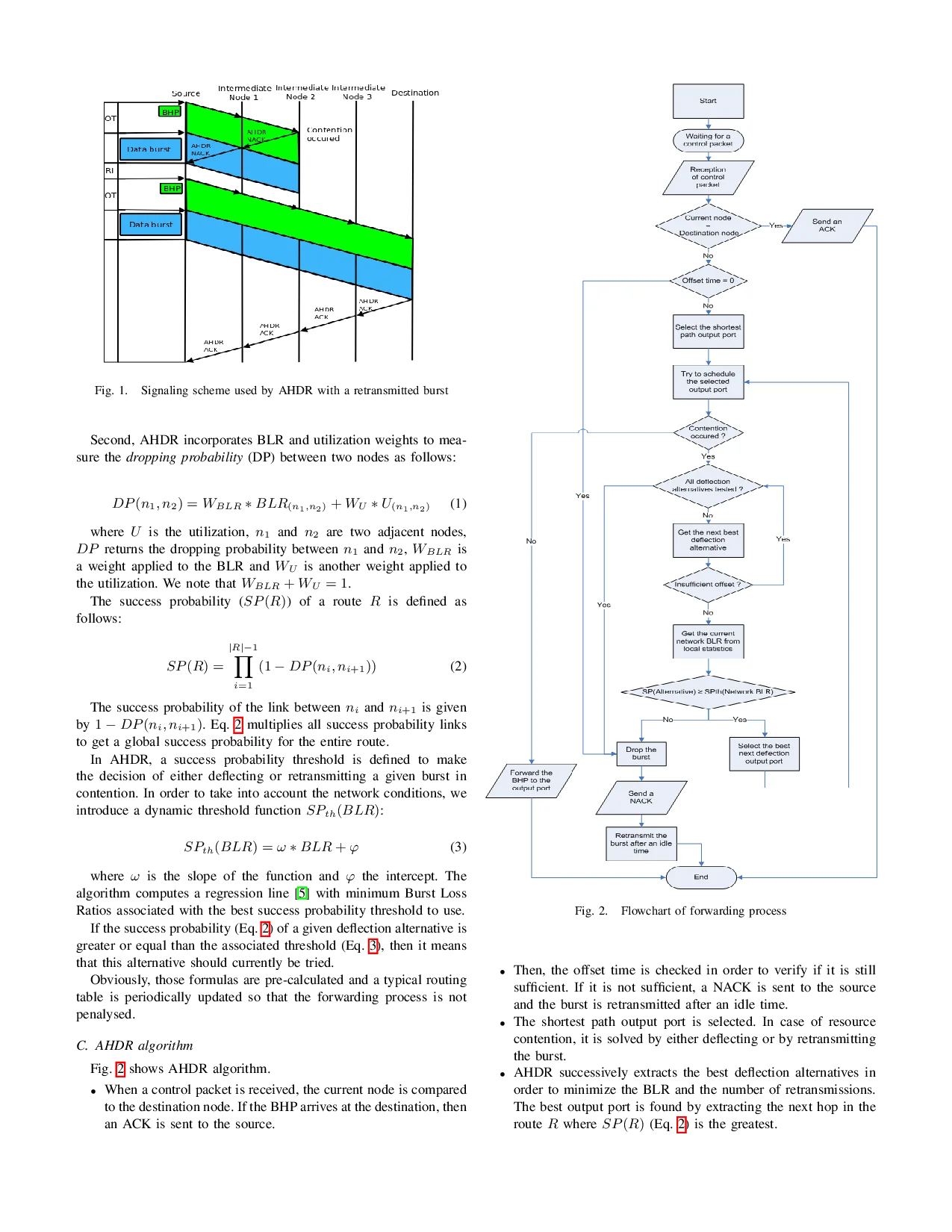
Once the control packet reaches the destination, an ACK is sent
to the source. If the control packet is dropped, then the proposed
algorithm uses a NACK to notify the source for burst retransmission.
AHDR does not only use the ACK and the NACK for notification
but it uses them also to transmit
…(Full text truncated)…
📸 Image Gallery
Reference
This content is AI-processed based on ArXiv data.