Adaptive Hybrid Deflection and Retransmission Routing for Optical Burst-Switched Networks
Burst contention is a well known challenging problem in Optical Burst Switching (OBS) networks. Deflection routing is used to resolve contention. Burst retransmission is used to reduce the Burst Loss Ratio (BLR) by retransmitting dropped bursts. Previous works show that combining deflection and retransmission outperforms both pure deflection and pure retransmission approaches. This paper proposes a new Adaptive Hybrid Deflection and Retransmission (AHDR) approach that dynamically combines deflection and retransmission approaches based on network conditions such as BLR and link utilization. Network Simulator 2 (ns-2) is used to simulate the proposed approach on different network topologies. Simulation results show that the proposed approach outperforms static approaches in terms of BLR and goodput.
💡 Research Summary
The paper addresses the persistent problem of burst contention in Optical Burst Switching (OBS) networks, where data bursts may be dropped because the control packet (Burst Header Packet, BHP) fails to reserve resources in time. Traditional contention‑resolution techniques include wavelength conversion, fiber‑delay‑line buffering, burst segmentation, pure deflection routing, and pure retransmission. While deflection routing avoids the need for extra hardware, its performance degrades under high load, and pure retransmission adds delay without guaranteeing success. Earlier hybrid approaches (HDR and LHDR) attempted to combine deflection and retransmission, but HDR always tried deflection first, leading to poor performance, and LHDR limited deflection with a static threshold, still lacking adaptability to changing traffic conditions.
The authors propose Adaptive Hybrid Deflection and Retransmission (AHDR), a dynamic algorithm that decides, on a per‑burst basis, whether to deflect the burst along an alternate route or to request retransmission. The decision is driven by two locally gathered metrics: the Burst Loss Ratio (BLR) and link utilization. These metrics are piggy‑backed onto ACK and NACK control messages, allowing every node to gradually build a network‑wide view without a centralized controller.
Key components of AHDR:
-
Statistics Dissemination – When a BHP reaches its destination, an ACK is sent back; if the BHP is dropped, a NACK is returned. Both messages embed the BLR and utilization of the link they traversed. Over time, each node aggregates these statistics, enabling a periodically refreshed routing table.
-
Dropping Probability (DP) – For any adjacent node pair (n1, n2), DP = WBLR·BLR(n1,n2) + WU·U(n1,n2), where WBLR and WU are weights that sum to 1. This formulation balances the impact of historical loss versus current congestion.
-
Success Probability of a Route (SP) – For a candidate route R with |R| hops, SP(R) = ∏_{i=1}^{|R|-1} (1 – DP(ni, ni+1)). This product yields the probability that a burst will traverse the entire route without being dropped.
-
Dynamic Threshold Function – A linear function SP_th(BLR) = ω·BLR + φ is derived through regression on simulation data that maps the observed minimum BLR to the optimal SP threshold. The parameters ω (slope) and φ (intercept) are recomputed periodically, allowing the threshold to shift as the overall network load changes.
-
Deflection Length Constraint – A parameter ξ limits the length of a deflection route relative to the primary shortest path: a candidate deflection is considered only if |Def| ≤ ξ·|Primary|. This prevents excessively long detours that would increase delay and offset‑time requirements.
-
Adaptive Offset Time – The offset time t_offset = t_conf + N_hops·t_p is recomputed using either the length of the shortest path or the length of the longest permissible deflection (|MaxDef|) depending on whether a deflection is predicted to be viable (i.e., SP(Def) ≥ SP_th).
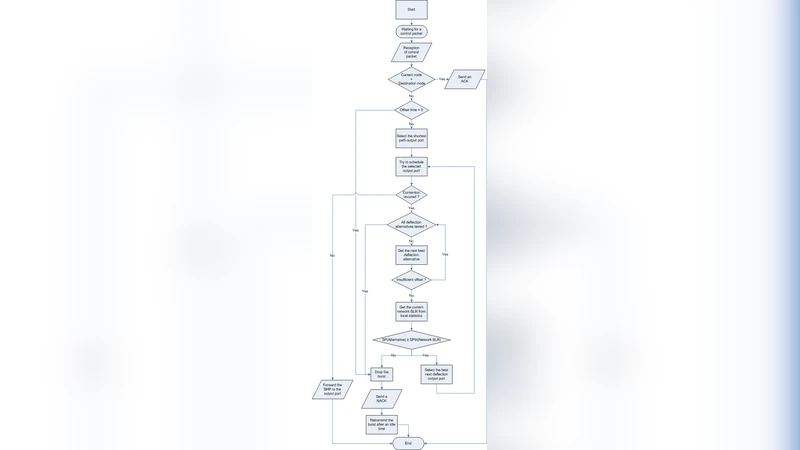
The AHDR forwarding process (Fig. 2 in the paper) proceeds as follows: upon receiving a BHP, the node checks whether it is the destination; if so, it sends an ACK. If the offset time is insufficient, a NACK is sent and the source will retransmit after a brief idle period. Otherwise, the node selects the shortest‑path output port. In case of contention, it evaluates all admissible deflection alternatives, computes SP for each, and selects the one with the highest SP. If this SP exceeds the dynamic threshold, the burst is deflected; otherwise, a NACK triggers retransmission.
Simulation Setup – The authors used ns‑2 with an OBS extension, employing the NSFNET topology (14 nodes, 21 links). Two traffic scenarios were examined:
- General scenario: traffic generators at every node sending to every other node (uniform distribution).
- Bottleneck scenario: traffic generated only at seven randomly chosen nodes, creating localized congestion.
Other parameters: 1 Gb/s per wavelength, 2 control channels + 4 data channels per link, mean burst size 400 KB, exponential inter‑arrival and size distributions, and a maximum of one retransmission (N_ret = 1) to keep delay low.
Results – In the general scenario, AHDR consistently outperformed LHDR. At low loads, AHDR performed many deflections, exploiting under‑utilized links and keeping BLR low. As load increased, the algorithm automatically reduced deflections and increased retransmissions, preventing BLR from rising sharply. Goodput (throughput of successfully delivered data) was 10–20 % higher than LHDR across the load range. In the bottleneck scenario, the advantage was even more pronounced: AHDR’s ability to select low‑utilization detour paths avoided the congested hotspot, yielding markedly lower BLR and higher Goodput than LHDR, which persisted in using the shortest (and heavily loaded) path.
A further analysis of the number of deflections versus retransmissions showed that AHDR’s adaptive policy kept retransmission counts modest even when deflections were frequent, indicating that most deflected bursts succeeded. Conversely, LHDR’s static policy either over‑deflected (causing unnecessary delay) or under‑deflected (causing higher loss) depending on the load.
Conclusions and Future Work – AHDR demonstrates that a success‑probability‑driven, dynamically tuned hybrid strategy can significantly improve OBS performance compared with static hybrid schemes. By leveraging ACK/NACK‑carried statistics, the algorithm remains fully distributed and scalable. The authors suggest extending the framework to incorporate additional contention‑resolution mechanisms such as burst segmentation and fiber‑delay‑line buffering. They are exploring probabilistic graphical models and reinforcement learning to make multi‑strategy decisions in real time, aiming to further reduce burst loss and latency in future high‑capacity optical networks.
Comments & Academic Discussion
Loading comments...
Leave a Comment