Three New Complexity Results for Resource Allocation Problems
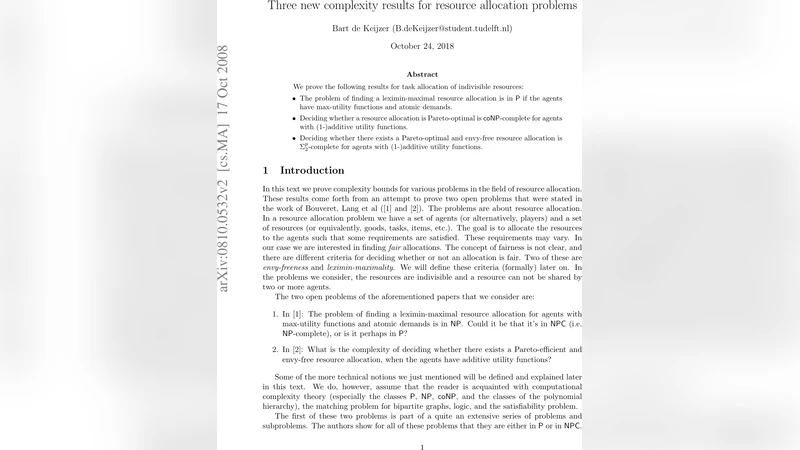
We prove the following results for task allocation of indivisible resources: - The problem of finding a leximin-maximal resource allocation is in P if the agents have max-utility functions and atomic demands. - Deciding whether a resource allocation is Pareto-optimal is coNP-complete for agents with (1-)additive utility functions. - Deciding whether there exists a Pareto-optimal and envy-free resource allocation is Sigma_2^p-complete for agents with (1-)additive utility functions.
💡 Research Summary
The paper investigates three distinct computational complexity results concerning the allocation of indivisible resources among agents. The first result addresses the Leximin‑maximal allocation problem under the restrictive setting where each agent’s utility function is a max‑utility function with atomic demands. In this setting, an agent’s utility for any bundle is determined solely by the highest demand among the single items it receives. The authors show that finding a Leximin‑maximal admissible allocation can be reduced to a minimum‑weight perfect matching in a complete bipartite graph. They construct a bipartite graph G = (L ∪ R, E) where the left side L corresponds to resources and the right side R to agents. For each edge (agent i, resource j) they assign a weight `{i,j} that reflects the rank of the demand r{i,j} among all demands: higher demands receive lower weights. By applying the Hungarian algorithm to obtain a minimum‑weight matching, the resulting assignment guarantees that the sorted vector of agents’ utilities is lexicographically maximal. The algorithm runs in polynomial time, specifically O((m+n)·log(m+n)+(m+n)·m²n²), where m is the number of resources and n the number of agents. Consequently, the decision version of the problem (whether there exists an allocation that lexicographically exceeds a given threshold) lies in P.
The second result concerns the decision problem of whether a given allocation is Pareto‑optimal when agents have additive (1‑additive) utility functions. A Pareto‑optimal allocation admits no other admissible allocation that strictly improves at least one agent’s utility without decreasing any other’s. The authors prove this problem to be coNP‑complete. The hardness is established by a reduction from the complement of a known NP‑complete problem (e.g., 3‑SAT), constructing an instance where a Pareto‑improvement exists if and only if the original formula is satisfiable. Verification that a proposed improvement exists can be performed in polynomial time, placing the problem in coNP, while the reduction shows coNP‑hardness even for the restricted additive case (previously known only for k‑additive utilities with k ≥ 2). Thus, checking Pareto‑optimality is computationally as hard as any problem in coNP.
The third result tackles the combined fairness‑efficiency question: does there exist an allocation that is both Pareto‑optimal and envy‑free (no agent prefers another’s bundle) under additive utilities? The authors demonstrate that this existence problem is Σ₂^p‑complete, placing it on the second level of the polynomial hierarchy. The proof proceeds via a many‑one reduction from the complement of the ∀∃‑3‑CNF problem, which is Π₂^p‑complete. By encoding the universal quantifiers as constraints on envy‑freeness and the existential quantifiers as choices of allocations, they construct a resource allocation instance where a Pareto‑optimal and envy‑free allocation exists precisely when the original quantified formula is true. Membership in Σ₂^p follows from a nondeterministic polynomial‑time algorithm that guesses an allocation and then verifies, using an NP oracle, that no Pareto‑improving envy‑free alternative exists. Hence, the problem sits squarely in Σ₂^p and is Σ₂^p‑hard.
Overall, the paper contributes a polynomial‑time algorithm for a special Leximin‑maximal allocation problem, and it establishes tight complexity classifications for two fundamental fairness‑related decision problems under additive utilities: coNP‑completeness for Pareto‑optimality verification and Σ₂^p‑completeness for the existence of allocations that are simultaneously Pareto‑optimal and envy‑free. These results clarify the computational boundaries of fairness and efficiency in discrete resource allocation, informing both theoretical investigations and practical algorithm design in domains such as task scheduling, cloud resource management, and market design.
Comments & Academic Discussion
Loading comments...
Leave a Comment