📝 Original Info
- Title: Front Propagation with Rejuvenation in Flipping Processes
- ArXiv ID: 0808.0159
- Date: 2008-10-16
- Authors: Researchers from original ArXiv paper
📝 Abstract
We study a directed flipping process that underlies the performance of the random edge simplex algorithm. In this stochastic process, which takes place on a one-dimensional lattice whose sites may be either occupied or vacant, occupied sites become vacant at a constant rate and simultaneously cause all sites to the right to change their state. This random process exhibits rich phenomenology. First, there is a front, defined by the position of the left-most occupied site, that propagates at a nontrivial velocity. Second, the front involves a depletion zone with an excess of vacant sites. The total excess D_k increases logarithmically, D_k ~ ln k, with the distance k from the front. Third, the front exhibits rejuvenation -- young fronts are vigorous but old fronts are sluggish. We investigate these phenomena using a quasi-static approximation, direct solutions of small systems, and numerical simulations.
💡 Deep Analysis
Deep Dive into Front Propagation with Rejuvenation in Flipping Processes.
We study a directed flipping process that underlies the performance of the random edge simplex algorithm. In this stochastic process, which takes place on a one-dimensional lattice whose sites may be either occupied or vacant, occupied sites become vacant at a constant rate and simultaneously cause all sites to the right to change their state. This random process exhibits rich phenomenology. First, there is a front, defined by the position of the left-most occupied site, that propagates at a nontrivial velocity. Second, the front involves a depletion zone with an excess of vacant sites. The total excess D_k increases logarithmically, D_k ~ ln k, with the distance k from the front. Third, the front exhibits rejuvenation – young fronts are vigorous but old fronts are sluggish. We investigate these phenomena using a quasi-static approximation, direct solutions of small systems, and numerical simulations.
📄 Full Content
arXiv:0808.0159v1 [cond-mat.stat-mech] 1 Aug 2008
Front Propagation with Rejuvenation in Flipping Processes
T. Antal,1 D. ben-Avraham,2 E. Ben-Naim,3 and P. L. Krapivsky3, 4
1Program for Evolutionary Dynamics, Harvard University, Cambridge, Massachusetts, 02138 USA
2Physics Department, Clarkson University, Potsdam, New York 13699 USA
3Theoretical Division and Center for Nonlinear Studies,
Los Alamos National Laboratory, Los Alamos, New Mexico 87545 USA
4Department of Physics, Boston University, Boston, Massachusetts 02215 USA
We study a directed flipping process that underlies the performance of the random edge simplex
algorithm. In this stochastic process, which takes place on a one-dimensional lattice whose sites may
be either occupied or vacant, occupied sites become vacant at a constant rate and simultaneously
cause all sites to the right to change their state. This random process exhibits rich phenomenology.
First, there is a front, defined by the position of the left-most occupied site, that propagates at a
nontrivial velocity. Second, the front involves a depletion zone with an excess of vacant sites. The
total excess ∆k increases logarithmically, ∆k ≃ln k, with the distance k from the front. Third, the
front exhibits rejuvenation — young fronts are vigorous but old fronts are sluggish. We investigate
these phenomena using a quasi-static approximation, direct solutions of small systems, and numerical
simulations.
PACS numbers: 02.50.-r, 05.40.-a, 05.70.Ln, 89.20.Ff
I.
INTRODUCTION
The simplex algorithm [1] is the fastest general algo-
rithm for solving linear problems. While efficient in the
typical case, the deterministic simplex algorithm requires
an exponential time in the worst cases [2, 3]. Randomized
versions of the simplex algorithm have an improved run-
ning time that is quadratic in the number of inequalities.
The performance of the random edge simplex algorithm
on Klee-Minty cubes [2] ultimately reduces to a simple
asymmetric flipping process in one dimension [4]. In this
process, an infinite sequence of 0 and 1 bits evolves by
flipping randomly chosen 1 bits and simultaneously flip-
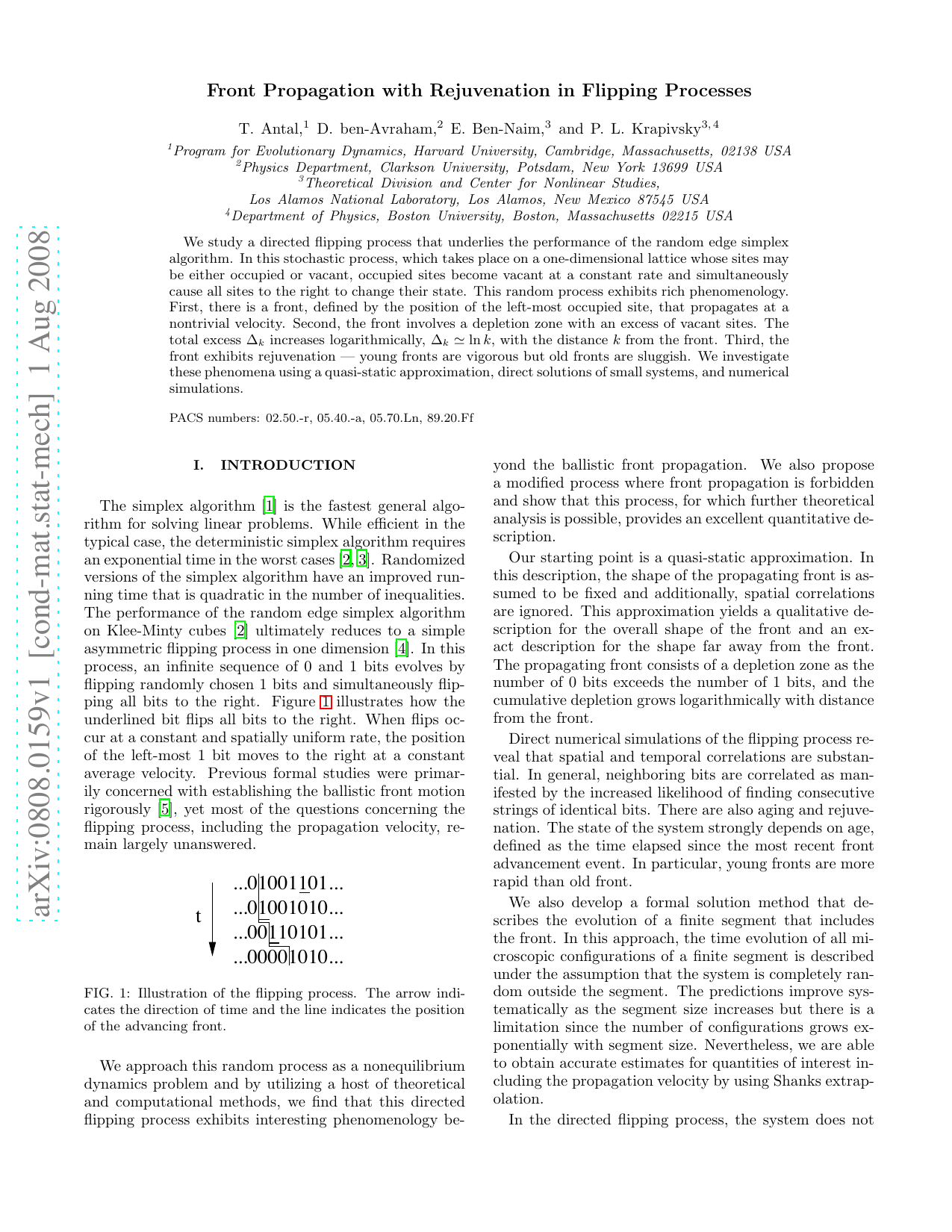
ping all bits to the right. Figure 1 illustrates how the
underlined bit flips all bits to the right. When flips oc-
cur at a constant and spatially uniform rate, the position
of the left-most 1 bit moves to the right at a constant
average velocity. Previous formal studies were primar-
ily concerned with establishing the ballistic front motion
rigorously [5], yet most of the questions concerning the
flipping process, including the propagation velocity, re-
main largely unanswered.
...00110101...
...00001010...
...01001010...
...01001101...
t
FIG. 1: Illustration of the flipping process. The arrow indi-
cates the direction of time and the line indicates the position
of the advancing front.
We approach this random process as a nonequilibrium
dynamics problem and by utilizing a host of theoretical
and computational methods, we find that this directed
flipping process exhibits interesting phenomenology be-
yond the ballistic front propagation.
We also propose
a modified process where front propagation is forbidden
and show that this process, for which further theoretical
analysis is possible, provides an excellent quantitative de-
scription.
Our starting point is a quasi-static approximation. In
this description, the shape of the propagating front is as-
sumed to be fixed and additionally, spatial correlations
are ignored. This approximation yields a qualitative de-
scription for the overall shape of the front and an ex-
act description for the shape far away from the front.
The propagating front consists of a depletion zone as the
number of 0 bits exceeds the number of 1 bits, and the
cumulative depletion grows logarithmically with distance
from the front.
Direct numerical simulations of the flipping process re-
veal that spatial and temporal correlations are substan-
tial. In general, neighboring bits are correlated as man-
ifested by the increased likelihood of finding consecutive
strings of identical bits. There are also aging and rejuve-
nation. The state of the system strongly depends on age,
defined as the time elapsed since the most recent front
advancement event. In particular, young fronts are more
rapid than old front.
We also develop a formal solution method that de-
scribes the evolution of a finite segment that includes
the front. In this approach, the time evolution of all mi-
croscopic configurations of a finite segment is described
under the assumption that the system is completely ran-
dom outside the segment. The predictions improve sys-
tematically as the segment size increases but there is a
limitation since the number of configurations grows ex-
ponentially with segment size. Nevertheless, we are able
to obtain accurate estimates for quantities of interest in-
cluding the propagation velocity by using Shanks extrap-
olation.
In the directed flipping process, the system does not
2
reach a steady state because of the
…(Full text truncated)…
📸 Image Gallery
Reference
This content is AI-processed based on ArXiv data.