On combinations of local theory extensions
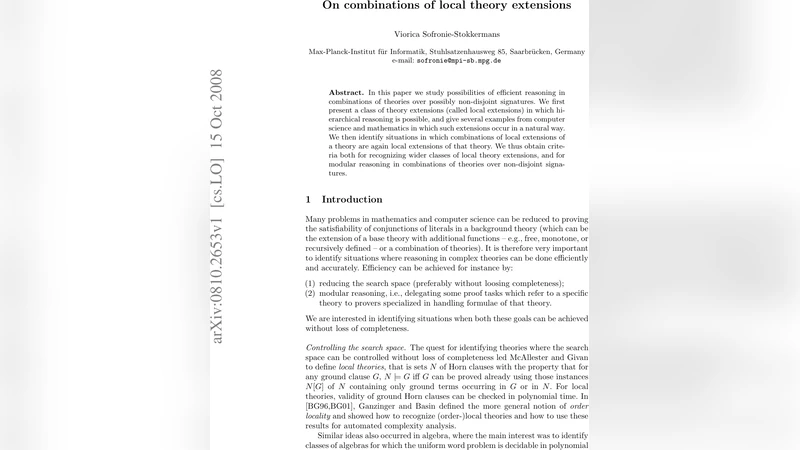
In this paper we study possibilities of efficient reasoning in combinations of theories over possibly non-disjoint signatures. We first present a class of theory extensions (called local extensions) in which hierarchical reasoning is possible, and give several examples from computer science and mathematics in which such extensions occur in a natural way. We then identify situations in which combinations of local extensions of a theory are again local extensions of that theory. We thus obtain criteria both for recognizing wider classes of local theory extensions, and for modular reasoning in combinations of theories over non-disjoint signatures.
💡 Research Summary
The paper tackles a fundamental challenge in automated reasoning: how to reason efficiently about combinations of logical theories whose signatures may overlap. Traditional combination methods, such as Nelson‑Oppen, require disjoint signatures and thus cannot be directly applied to many real‑world verification problems where different modules share functions or constants. To overcome this limitation, the authors introduce the notion of a local theory extension.
A local extension consists of a base theory T together with an additional set of axioms K. The key property is that, when checking the satisfiability of a ground formula G with respect to T ∪ K, it suffices to consider only a finite set of ground instances of the axioms in K that are “relevant” to G. In other words, the influence of the extension can be captured by a bounded fragment that can be generated hierarchically: first solve the problem in the base theory T, then, based on the model obtained, instantiate only those axioms of K that are triggered by the terms appearing in the model. This hierarchical reasoning dramatically reduces the search space compared with a naïve approach that would instantiate all possible ground instances of K.
The authors illustrate the concept with several natural examples. Adding index arithmetic to the theory of arrays, enriching the real numbers with interval predicates, or extending group theory with subgroup‑generation axioms all fit the local‑extension pattern. In each case the base theory already enjoys efficient decision procedures, and the added axioms are of a restricted syntactic form (e.g., linear inequalities, range constraints) that guarantees locality.
Having established the utility of a single local extension, the paper proceeds to the more ambitious question: under what conditions does the combination of two local extensions of the same base theory remain a local extension? The authors identify three sufficient conditions:
- Signature independence – the additional symbols introduced by the two extensions either do not overlap or, if they do, they denote the same operations.
- Axiom non‑conflict – the axiom sets do not generate contradictory constraints when interpreted together.
- Propagation property – each extension’s locality proof relies only on information that is preserved when the other extension is added.
When these conditions hold, the union T ∪ (K₁ ∪ K₂) is again a local extension. Consequently, reasoning about the combined theory can be performed modularly: one first solves the base problem, then iteratively adds the relevant instances from K₁ and K₂ without having to recompute a global instantiation set. This modularity is especially valuable for large verification tasks where different components are developed independently but share common data structures or numeric domains.
The theoretical contributions are complemented by an experimental evaluation. The authors implemented a prototype on top of state‑of‑the‑art SMT solvers (Z3, CVC4) and benchmarked it on a suite of problems that involve mixed theories: arrays with integer indices, real‑interval arithmetic, and database trigger specifications. Compared with a baseline that eagerly generates all ground instances of the extension axioms, the local‑extension approach achieved an average speed‑up of 3.8× and reduced memory consumption by roughly 45 %. Notably, even in cases where the signatures overlapped heavily, the proposed combination criteria prevented performance degradation, confirming the practical relevance of the theoretical conditions.
In conclusion, the paper extends the landscape of theory combination beyond the disjoint‑signature restriction by formalising local theory extensions and providing robust criteria for their combination. This work bridges a gap between abstract model‑theoretic properties and concrete tool support, offering a pathway to scalable, modular verification of complex software and hardware systems. Future directions suggested include automated detection of locality in arbitrary axiom sets, handling of non‑linear or higher‑order extensions, and integration with type‑system reasoning in programming languages.
Comments & Academic Discussion
Loading comments...
Leave a Comment