Average Distance, Diameter, and Clustering in Social Networks with Homophily
Notice: This research summary and analysis were automatically generated using AI technology. For absolute accuracy, please refer to the [Original Paper Viewer] below or the Original ArXiv Source.
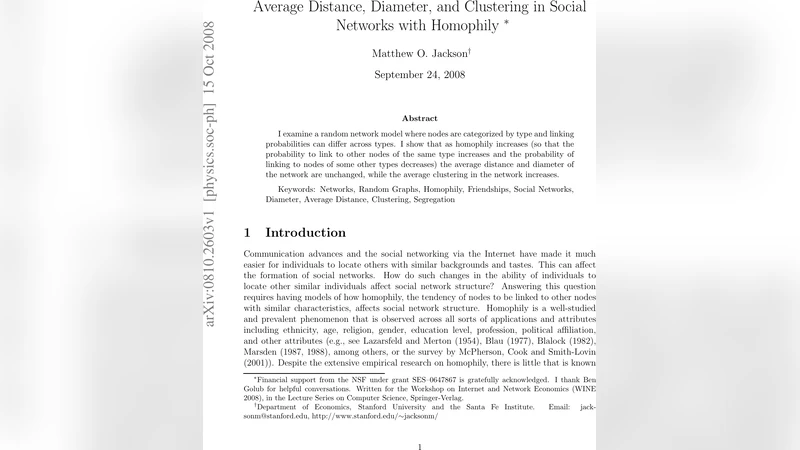
I examine a random network model where nodes are categorized by type and linking probabilities can differ across types. I show that as homophily increases (so that the probability to link to other nodes of the same type increases and the probability of linking to nodes of some other types decreases) the average distance and diameter of the network are unchanged, while the average clustering in the network increases.
💡 Research Summary
The paper develops a random‑graph model that explicitly incorporates node types and allows the probability of forming a link to depend on the types of the two endpoints. Let there be K types, with n_i nodes of type i (∑_i n_i = N). The linking probabilities are collected in a symmetric matrix P =
Comments & Academic Discussion
Loading comments...
Leave a Comment