RCF3: Map-Code Interpretation via Closure
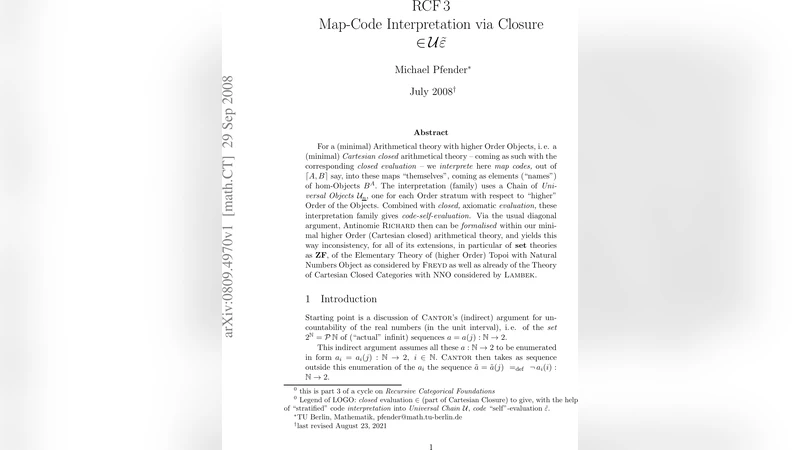
For a (minimal) Arithmetical theory with higher Order Objects, i.e. a (minimal) Cartesian closed arithmetical theory – coming as such with the corresponding closed evaluation – we interprete here map codes, out of [A,B] say,into these maps “themselves”, coming as elements (“names”) within hom-Objects B^A. The interpretation (family) uses a Chain of Universal Objects U_n, one for each Order stratum with respect to “higher” Order of the Objects. Combined with closed, axiomatic evaluation, this interpretation family gives code-self-evaluation. Via the usual diagonal argument, Antinomie RICHARD then can be formalised within minimal higher Order (Cartesian closed) arithmetical theory, and yields this way inconsistency for all of its extensions, in particular for set theories as ZF, of the Elementary Theory of (higher Order) Topoi with Natural Numbers Object as considered by FREYD, as well as already for the Theory of Cartesian Closed Categories with NNO considered by LAMBEK and SCOTT.
💡 Research Summary
The paper investigates a minimal arithmetical theory equipped with higher‑order objects, i.e. a minimal Cartesian‑closed arithmetic (MCCA). In such a setting every function space B^A exists and a closed evaluation map
eval_{A,B} : B^A × A → B
is taken as a primitive axiom. The author’s central contribution is a systematic “map‑code interpretation”: codes that traditionally live outside the theory (for example, Gödel numbers of functions) are internalised as elements of the corresponding hom‑objects B^A.
To achieve this, a hierarchy of universal objects U₀, U₁, …, Uₙ is introduced. The base U₀ is the natural numbers object N. Recursively one sets
U_{k+1} = (U_k)^{U_k}.
Consequently every k‑th‑order object embeds into U_k, and every function space of k‑order objects lives inside U_{k+1}. This “universal chain” supplies a uniform ambient space in which any code can be represented as a concrete object.
Given a concrete function f : A → B, its code ⟦f⟧ ∈
Comments & Academic Discussion
Loading comments...
Leave a Comment