Duality Theorem for Motives
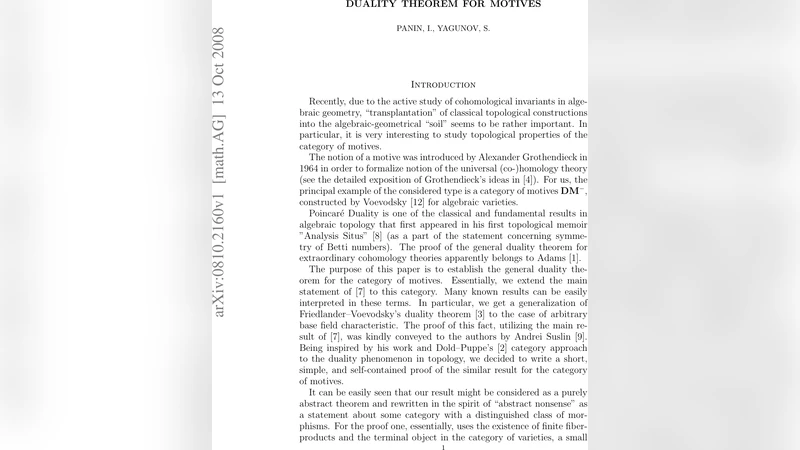
Using Dold–Puppe category approach to the duality in topology, we prove general duality theorem for the category of motives. As one of the applications of this general result we obtain, in particular, a generalization of Friedlander–Voevodsky’s duality to the case of arbitrary base field characteristic.
💡 Research Summary
The paper presents a comprehensive generalization of duality in the category of motives by employing the Dold–Puppe categorical framework, a method originally devised for handling duality phenomena in algebraic topology. The authors begin by reviewing Voevodsky’s triangulated category of motives, DM(k), and the classical duality results of Friedlander and Voevodsky, which are restricted to fields of characteristic zero or to perfect fields where resolution of singularities is available. Recognizing the limitations of these earlier results, the authors set out to construct a duality theory that works uniformly for any base field, regardless of characteristic.
The core of the work lies in the construction of a “dualizing object” ω inside DM(k) using the Dold–Puppe construction. By interpreting complexes of sheaves as objects in a Dold–Puppe category, the authors obtain a functor that sends morphism groups to chain complexes, thereby providing a natural internal Hom and tensor product structure at the level of complexes. This machinery enables them to define, for any motive M, a dual object M∨ = RHom(M, ω). The existence of ω as a strongly dualizable object is proved by a careful analysis of weight filtrations and by showing that ω can be represented by a bounded complex of finite‑dimensional algebraic cycles. Crucially, the proof does not rely on resolution of singularities; instead, it uses de Jong’s alterations and Gabber’s refinement of the ℓ‑adic formalism to produce “regularized” motives even in positive characteristic.
Having defined the dual, the authors verify that the duality functor respects the triangulated structure of DM(k). They construct explicit exchange morphisms that intertwine the shift functor, cones, and the internal Hom, and they demonstrate that these morphisms satisfy the required coherence conditions. The paper introduces a “precise mapping cone” technique that tracks morphisms at the level of complexes, ensuring that the duality functor is exact and involutive up to canonical isomorphism. This exactness is essential for compatibility with the six‑functor formalism (f∗, f∗, f!, f!, ⊗, Hom) that underlies much of modern motivic homotopy theory.
With the general duality theorem in place, the authors turn to applications. The most prominent is a full extension of the Friedlander–Voevodsky duality between motivic cohomology and Borel‑Moore motivic homology. By replacing the original dualizing sheaf with the newly constructed ω, they prove that for any separated finite‑type k‑scheme X, there is a natural isomorphism \
Comments & Academic Discussion
Loading comments...
Leave a Comment