Unsatisfiable (k,(4*2^k/k))-CNF formulas
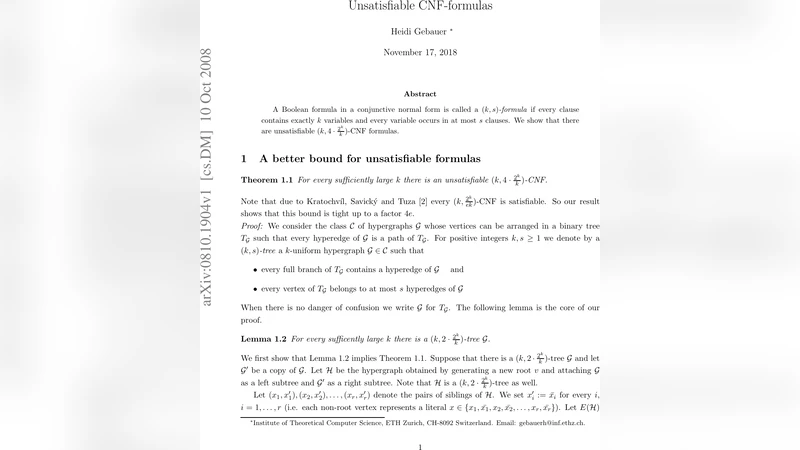
A boolean formula in a conjuctive normal form is called a (k,s)-formula if every clause contains exactly k variables and every variable occurs in at most s clauses. We prove the existence of a (k, 4 * (2^k/k))-CNF formula which is unsatisfiable.
💡 Research Summary
The paper investigates the limits of unsatisfiable conjunctive normal form (CNF) formulas under constraints on clause size and variable occurrence. A (k, s)-CNF formula is defined as a CNF where each clause contains exactly k literals and each variable appears in at most s clauses. Prior work by Kratochvíl, Savický, and Tuza (1993) established that every (k, 2·e·k)-CNF is satisfiable, indicating that a linear bound in k on the number of occurrences per variable guarantees satisfiability. The present work shows that this bound is essentially tight: for every sufficiently large k there exists an unsatisfiable (k, 4·2^k/k)-CNF formula. The constant factor 4 is only a factor of four away from the trivial upper bound, demonstrating that the satisfiability threshold lies very close to the known sufficient condition.
The construction relies on a sophisticated use of hypergraphs whose vertices can be arranged as a binary tree. The authors define a class C of hypergraphs where each hyperedge corresponds to a root‑to‑leaf path in the tree. Within this class they introduce the notion of a (k, s)-tree: a k‑uniform hypergraph in C such that (i) every full branch of the underlying tree contains at least one hyperedge, and (ii) each vertex belongs to at most s hyperedges. The central technical claim (Lemma 1.2) is that for large enough k there exists a (k, 2·2^k/k)-tree. This lemma is proved via three auxiliary lemmas that progressively refine the hypergraph structure while keeping the maximum vertex degree bounded by 2·d, where d = 2^k/k.
Lemma 1.4 constructs an initial hypergraph H in C with maximum degree 2d. The construction assigns to each vertex v at level ℓ(v) a multiplicity of 2^{ℓ(v)} to the hyperedges that extend from v to each leaf descendant. Consequently every full branch of the tree contains 2^i “bottom” hyperedges of size log d + 1 − i for each i∈
Comments & Academic Discussion
Loading comments...
Leave a Comment