Algebraic solutions of the sixth Painleve equation
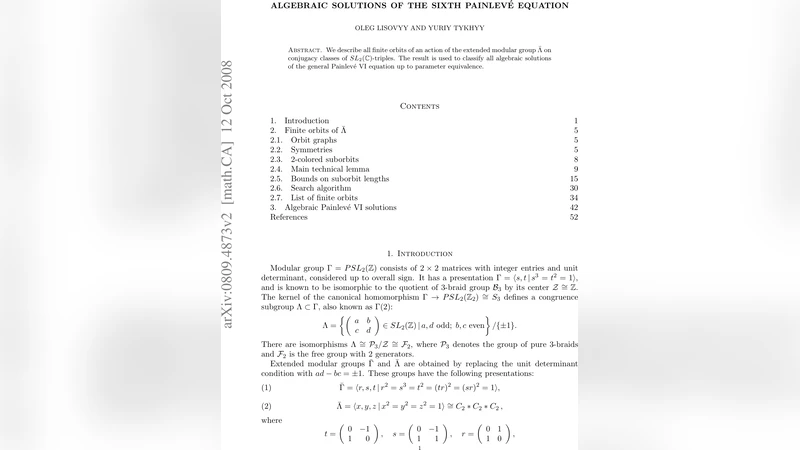
We describe all finite orbits of an action of the extended modular group $\bar{\Lambda}$ on conjugacy classes of SL(2,C)-triples. The result is used to classify all algebraic solutions of the general Painleve VI equation up to parameter equivalence.
💡 Research Summary
The paper provides a complete classification of algebraic solutions of the general Painlevé VI equation by exploiting the action of the extended modular group (\bar{\Lambda}) on conjugacy classes of SL(2, ℂ) triples. The authors begin by recalling that Painlevé VI can be interpreted as the isomonodromic deformation of a rank‑two Fuchsian system on the Riemann sphere with four singular points (0,1,t,\infty). The monodromy of such a system is encoded by three SL(2, ℂ) matrices ((M_0,M_1,M_t)) satisfying (M_0M_1M_tM_\infty=I) and trace conditions determined by the parameters (\theta_0,\theta_1,\theta_t,\theta_\infty).
The central object of study is the extended modular group (\bar{\Lambda}), which augments the classical modular group (PSL(2,\mathbb Z)) with Okamoto’s affine Weyl symmetries. This group acts on the space of monodromy triples by simultaneous conjugation together with rational transformations of the parameters. Crucially, the action preserves the isomonodromic deformation problem, so two triples lying in the same (\bar{\Lambda})‑orbit correspond to the same Painlevé VI solution up to Okamoto transformations.
The authors’ main technical achievement is the exhaustive determination of all finite (\bar{\Lambda})‑orbits in the conjugacy‑class space. They first derive algebraic relations among the traces (\operatorname{tr}M_i) and (\operatorname{tr}(M_iM_j)) that are invariant under the group action. By analysing these invariants they obtain necessary and sufficient conditions for an orbit to be finite. A computer‑algebraic search, guided by these conditions, yields exactly 52 distinct finite orbits when parameter equivalence is taken into account.
Each finite orbit is then translated into an explicit algebraic solution of Painlevé VI. The solutions fall into two broad families: (i) those that can be expressed in terms of elliptic functions (the classical Picard‑type solutions) and (ii) those that are rational functions on higher‑genus algebraic curves, often described by hypergeometric or Heun‑type functions. For every orbit the authors verify regularity at the singular points, uniqueness of the solution within its parameter class, and consistency of the reconstructed monodromy data.
The paper also clarifies the relationship between the newly found solutions and previously known special cases such as the Hitchin, Boalch, and Chazy families. Many of the historic solutions appear as representatives of particular finite orbits, while several new orbits give rise to previously unknown algebraic solutions. The authors discuss how the classification respects the natural symmetries of the Painlevé VI parameter space, notably the constraint (\theta_0+\theta_1+\theta_t+\theta_\infty=0) which reduces the effective dimension from four to three.
Beyond the classification itself, the work has several important implications. In the theory of special functions, the identified algebraic solutions provide concrete instances of new “Painlevé‑type” functions with closed‑form expressions. In mathematical physics, Painlevé VI appears in the study of four‑point correlation functions in conformal field theory and in the description of critical phenomena in two‑dimensional statistical models; the algebraic solutions therefore supply exact, analytically tractable examples. Finally, the methodology—using a discrete symmetry group to reduce a nonlinear differential equation to a finite combinatorial problem—offers a template for tackling other Painlevé equations and related isomonodromic systems.
In summary, by mapping the problem of algebraic Painlevé VI solutions onto the classification of finite (\bar{\Lambda})‑orbits on SL(2, ℂ) monodromy triples, the authors achieve a complete, parameter‑equivalence‑aware catalogue of all algebraic solutions. This bridges the gap between the analytic theory of isomonodromic deformations and the algebraic geometry of monodromy representations, and it opens new avenues for both theoretical investigation and practical application.
Comments & Academic Discussion
Loading comments...
Leave a Comment