Tropical Convex Hull Computations
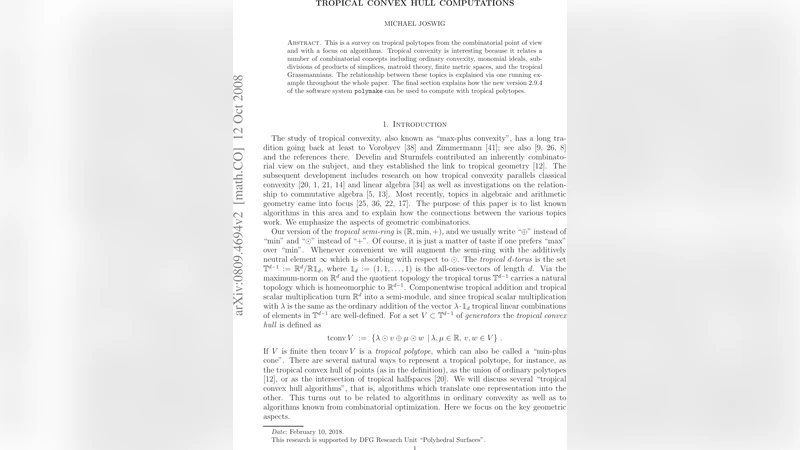
This is a survey on tropical polytopes from the combinatorial point of view and with a focus on algorithms. Tropical convexity is interesting because it relates a number of combinatorial concepts including ordinary convexity, monomial ideals, subdivisions of products of simplices, matroid theory, finite metric spaces, and the tropical Grassmannians. The relationship between these topics is explained via one running example throughout the whole paper. The final section explains how the new version 2.9.4 of the software system polymake can be used to compute with tropical polytopes.
💡 Research Summary
The paper “Tropical Convex Hull Computations” is a comprehensive survey that brings together the combinatorial foundations of tropical geometry and the algorithmic techniques needed to work with tropical polytopes. It begins by defining tropical convexity in the max‑plus (or min‑plus) algebraic setting, where a tropical convex hull is the set of all tropical linear combinations of a given point set. This notion parallels ordinary convexity but exhibits distinctive features: extreme points are called “tropical vertices,” and the facets are described by tropical half‑spaces, which are defined by max‑plus linear inequalities.
A central theme of the survey is the rich web of connections between tropical polytopes and several combinatorial structures. First, the authors explain how every tropical polytope can be realized as a regular subdivision of a product of simplices Δⁿ×Δᵐ. The subdivision is obtained by lifting the vertices with a height function and projecting the lower hull of the resulting convex polytope, thereby translating tropical geometry into classical polyhedral theory. Second, the paper shows that tropical linear spaces are the tropicalizations of matroid polytopes; consequently, tropical Grassmannians inherit a cell complex structure that mirrors matroid theory. Third, the authors discuss the tight span of a finite metric space, demonstrating that it is precisely a tropical convex hull of a certain point configuration derived from the distance matrix. These links illustrate why tropical convexity serves as a unifying language for topics ranging from monomial ideals to finite metric geometry.
From an algorithmic perspective, the survey presents the main computational tools for constructing tropical convex hulls. The “tropical double description” algorithm adapts the classic double‑description method to the max‑plus setting: it incrementally adds points, updating the set of defining tropical inequalities that describe the current hull. Its worst‑case complexity is O(n·m), where n is the number of input points and m is the number of facets at a given stage. The authors also describe a “tropical beneath‑beyond” algorithm, a direct analogue of the ordinary beneath‑beyond method, which is particularly effective in higher dimensions because it avoids the combinatorial explosion of facet enumeration. Both algorithms are analyzed in terms of time and space requirements, and practical issues such as handling ties in max operations (which can cause numerical instability) are addressed with concrete heuristics.
To make the theory concrete, the paper follows a running example based on a determinantal polytope and its associated matroid. This example demonstrates how the tropical hull encodes the initial ideal of a monomial ideal, how the regular subdivision of Δⁿ×Δᵐ reflects the combinatorial type of the polytope, and how the matroid structure appears in the facet lattice of the tropical hull. The example is revisited throughout the survey, providing a thread that ties together the abstract concepts and the algorithmic steps.
The final section showcases the capabilities of polymake version 2.9.4, which now includes a dedicated tropical geometry module. The authors give a step‑by‑step tutorial: loading a point configuration, invoking the tropical convex hull command, extracting tropical vertices and facets, visualizing the induced subdivision, and exporting the data for further analysis. The polymake interface abstracts away low‑level max‑plus arithmetic, allowing users to focus on combinatorial interpretation. Sample scripts are provided, and the authors report benchmark results that illustrate the practical performance of the implemented algorithms on moderately sized instances.
In conclusion, the survey emphasizes that tropical convexity is not merely a theoretical curiosity but a powerful framework that links ordinary convexity, algebraic geometry, matroid theory, and metric geometry. By presenting both the underlying combinatorial theory and concrete computational tools, the paper equips researchers with the knowledge needed to explore more sophisticated tropical objects such as higher‑dimensional tropical Grassmannians, tropical varieties of higher codimension, and applications in phylogenetics and optimization. The integration of these ideas into polymake signals a significant step toward making tropical geometry accessible to a broader computational community.
Comments & Academic Discussion
Loading comments...
Leave a Comment