A DCCP Congestion Control Mechanism for Wired- cum-Wireless Environments
Existing transport protocols, be it TCP, SCTP or DCCP, do not provide an efficient congestion control mechanism for heterogeneous wired-cum-wireless networks. Solutions involving implicit loss discrimination schemes have been proposed but were never implemented. Appropriate mechanisms can dramatically improve bandwidth usage over the Internet, especially for multimedia transport based on partial reliability. In this paper we have implemented and evaluated a congestion control mechanism that implicitly discriminates congestion and wireless losses in the datagram congestion control protocol (DCCP) congestion control identification (CCID) framework. The new CCID was implemented as a NS-2 module. Comparisons were made with the TCP-like CCID and showed that the bandwidth utilization was improved by more than 30% and up to 50% in significant setups.
💡 Research Summary
The paper addresses the inefficiency of congestion control mechanisms in heterogeneous wired‑and‑wireless networks, where traditional transport protocols such as TCP, SCTP, and DCCP treat all packet losses as congestion signals. Existing proposals for explicit loss discrimination require router or base‑station support, making them impractical for real‑world deployment. To overcome this, the authors design and implement an implicit loss discrimination scheme directly within the DCCP Congestion Control Identification (CCID) framework, requiring no changes to intermediate network elements.
The core of the solution adapts the Zig‑Zag loss classification method, but moves the decision logic to the sender side. The sender continuously measures the round‑trip time (RTT) already available in the DCCP/TCPlike CCID and treats half of this value as the Round‑Trip Time of the acknowledgment (ROTT). Using an exponential moving average, the sender maintains the mean and standard deviation of ROTT. When a packet loss is detected, the current ROTT is compared against the mean ± k·standard deviation (with k≈1). If ROTT falls within this interval, the loss is classified as a wireless‑induced burst loss; otherwise it is deemed a congestion loss.
Based on this classification, the congestion window (CWND) is halved only for congestion losses. Wireless losses leave CWND unchanged, thereby avoiding unnecessary rate reduction that would otherwise occur in standard DCCP or TCP‑like CCID behavior. This approach requires no explicit loss notification from the receiver, preserving the end‑to‑end nature of the protocol while keeping implementation overhead low.
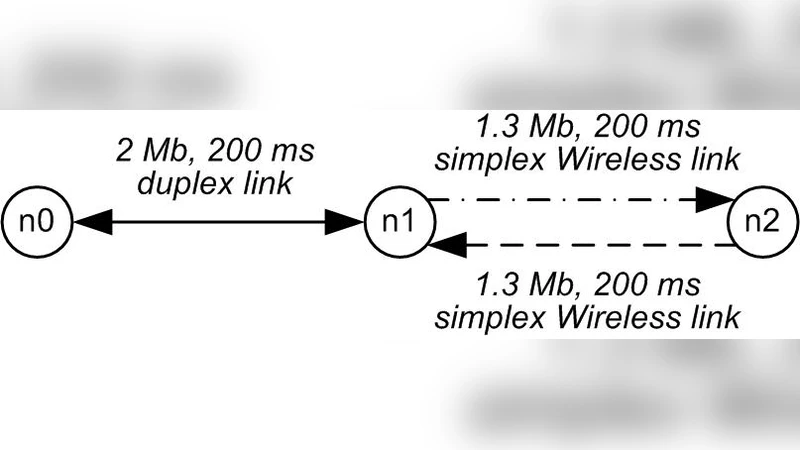
The authors implemented the new CCID as a plug‑in module for the NS‑2 network simulator, extending the existing DCCP implementation (version 2.29.3). The experimental topology consists of three nodes: a sender (n0), a bottleneck node (n1), and a receiver (n2). The wired segment (n0‑n1) provides 2 Mbps bandwidth with 100 ms delay, while the wireless segment (n1‑n2) offers 1.3 Mbps bandwidth with 200 ms delay. To emulate realistic wireless errors, a two‑state Gilbert‑Elliott model is used, with parameters p (probability of staying in the good state) and q (probability of staying in the bad state) varied to produce overall packet loss rates ranging from 0.2 % to nearly 20 %.
Two main scenarios are evaluated: (1) a congestion‑free environment where the aggregate traffic is limited to 1 Mbps, and (2) a congested environment where traffic is increased to 1.5 Mbps, creating a bottleneck at n1. For each scenario, the number of concurrent flows is varied to stress the bottleneck, and the performance of the new Zig‑Zag‑based CCID is compared against the standard TCP‑like CCID (CCID2).
Results show that, in the presence of wireless burst losses, the proposed scheme achieves a 30 %–50 % increase in bandwidth utilization compared with the TCP‑like CCID. The improvement is most pronounced when wireless losses dominate, as the sender avoids unnecessary CWND reductions. Even under congestion, the new CCID maintains higher throughput because it only reacts to genuine congestion signals. The classification accuracy, while not perfect, results in a low rate of misclassifying congestion losses as wireless; such misclassifications cause only a modest delay in CWND reduction and do not significantly degrade fairness.
The paper’s contributions are threefold: (i) it demonstrates that implicit, sender‑side loss discrimination can be integrated into DCCP without requiring network‑wide support, (ii) it leverages existing RTT measurements to keep implementation simple and backward‑compatible, and (iii) it provides an open‑source NS‑2 module that can be reused by the research community.
Limitations include the reliance on static thresholds for ROTT deviation, which may not adapt optimally to highly dynamic wireless conditions, and the possibility that persistent wireless bursts could still cause increased latency if CWND is never reduced. Future work suggested by the authors includes combining the sender‑side scheme with explicit loss notifications for higher accuracy, applying machine‑learning techniques to adapt the classification thresholds in real time, and validating the approach on physical wireless testbeds to confirm the simulation findings.
Comments & Academic Discussion
Loading comments...
Leave a Comment