Set theory for category theory
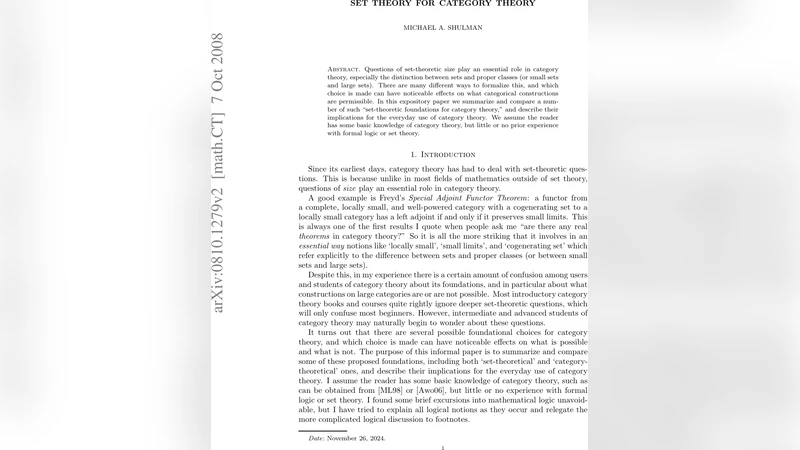
Questions of set-theoretic size play an essential role in category theory, especially the distinction between sets and proper classes (or small sets and large sets). There are many different ways to formalize this, and which choice is made can have noticeable effects on what categorical constructions are permissible. In this expository paper we summarize and compare a number of such “set-theoretic foundations for category theory,” and describe their implications for the everyday use of category theory. We assume the reader has some basic knowledge of category theory, but little or no prior experience with formal logic or set theory.
💡 Research Summary
The paper surveys and compares several set‑theoretic foundations that are commonly employed to handle size issues in category theory. It begins by explaining why the distinction between “small” and “large” collections—often phrased as sets versus proper classes—is indispensable for defining fundamental categorical constructions such as functor categories, exponentials, limits, and adjoints. In the standard Zermelo‑Fraenkel set theory (ZFC) this distinction is not built into the language, so additional devices are required.
The first major approach discussed is ZFC augmented with Grothendieck universes. A universe V is a set that is closed under the usual set‑forming operations; all elements of V are declared “small”. By fixing a universe, one can treat any V‑small category as a genuine small object, while categories that are not V‑small are regarded as large. This method is widely used in algebraic geometry, homological algebra, and higher‑category theory because it allows the formation of functor categories Fun(C,D) whenever C is V‑small, without further meta‑theoretic complications. The paper notes, however, that the existence of a universe is a strong additional axiom (equivalent to the existence of an inaccessible cardinal) and therefore raises consistency considerations.
Next, the authors turn to class theories: von Neumann–Bernays–Gödel (NBG) set theory and its stronger cousin Morse‑Kelley (MK). Both extend ZFC by introducing a separate sort for classes, together with axioms governing their interaction with sets. NBG is a conservative extension of ZFC, meaning any theorem about sets provable in NBG is already provable in ZFC. Its main advantage is the ability to talk about proper classes directly, which makes the definition of large categories and class‑level functor categories immediate. MK adds a stronger comprehension scheme for classes, allowing more expressive class constructions at the cost of a higher consistency strength. The paper illustrates how NBG/MK simplify the treatment of large limits, colimits, and the construction of the category of all groups, all of which are problematic in pure ZFC.
The third line of development is the categorical set theory known as the Elementary Theory of the Category of Sets (ETCS). ETCS axiomatizes the category of sets as a well‑pointed topos with a natural numbers object, thereby encoding the usual set‑theoretic axioms in categorical language. In this framework the “size” distinction is expressed by working inside a small topos versus a larger ambient topos, eliminating the need for a separate class notion. The authors argue that ETCS provides a very natural setting for category‑theoretic work, especially when the goal is to keep everything within a single categorical universe, but they also point out that translating results from classical ZFC‑based mathematics can require additional effort.
Finally, the paper surveys more recent homotopy‑type‑theoretic foundations, such as Homotopy Type Theory (HoTT) and Univalent Foundations. Types of h‑level 0 correspond to sets, while higher‑level types can be viewed as “large” collections. This approach internalizes equivalence and higher‑dimensional structure, offering a promising but still developing alternative to classical set‑theoretic foundations for category theory.
To evaluate the alternatives, the authors introduce four criteria: (1) proof‑theoretic strength and consistency requirements, (2) the range of categorical constructions that can be defined without extra meta‑theoretic work, (3) practical usability for working mathematicians, and (4) the necessity of additional axioms such as inaccessible cardinals or choice. A comparative table summarises how each system fares on these criteria. The conclusion is nuanced: for most algebraic and topological applications, ZFC + Grothendieck universes offers a good balance of familiarity and expressive power; for work that routinely manipulates truly large categories (e.g., the category of all categories, class‑level adjunctions), NBG or MK provides a cleaner formalism; ETCS is attractive for those who wish to stay entirely within a categorical language; and HoTT/Univalent Foundations may become the preferred foundation for future higher‑category theory once their toolbox matures.
Overall, the paper equips the reader with a clear map of the landscape of set‑theoretic foundations, explains the concrete impact of each choice on everyday categorical practice, and guides researchers toward the foundation that best matches their specific needs and philosophical preferences.
Comments & Academic Discussion
Loading comments...
Leave a Comment