Constructing dynamical twists over a non-abelian base
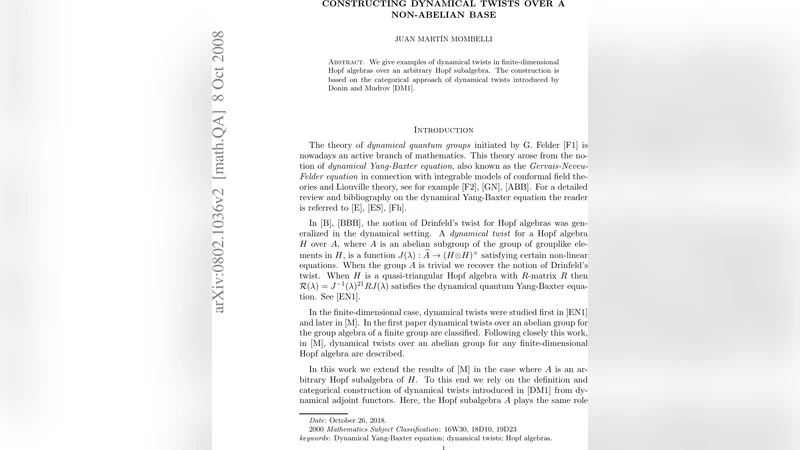
We give examples of dynamical twists in finite-dimensional Hopf algebras over an arbitrary Hopf subalgebra. The construction is based on the categorical approach of dynamical twists introduced by Donin and Mudrov.
💡 Research Summary
The paper develops a general construction of dynamical twists for finite‑dimensional Hopf algebras H over an arbitrary Hopf subalgebra A, without assuming that A is abelian or commutative. The authors build on the categorical framework introduced by Donin and Mudrov, which treats dynamical twists as 2‑cocycles in the “dynamical extension” M ⋉ C of a tensor category C by a module category M.
The first part of the work reviews stabilizers for Hopf actions (Yan‑Zhu) and establishes basic facts about H‑simple comodule algebras K. When K is H‑simple (i.e., it has no non‑trivial H‑costable ideals) and its coinvariants K^{co A}=k, the category K‑Mod becomes an indecomposable exact module category over Rep(H). Moreover, a dimension formula links dim K, dim Stab_K(V,W), and dim H. If A⊂H is a Hopf‑Galois extension, stabilizers can be identified with Hom_A(H, Hom_R(V,W)), where R=K^{co A}.
The second section recalls the Donin‑Mudrov construction. For a tensor category C and a left C‑module category M, the dynamical extension M ⋉ C has objects given by functors X↦X⊗– on M. A dynamical twist is a family J_{X,Y,M} of isomorphisms (X⊗Y)⊗M→(X⊗Y)⊗M satisfying the usual pentagon and unit equations, together with the commutation condition J_{Z,W} ∘ (η_f⊗η_g)= (η_f⊗η_g) ∘ J_{X,Y} for all morphisms f,g in C. Such a J modifies the associativity constraints of M, producing a new module category M(J); moreover (M⋉C)_J is tensor‑equivalent to M(J)⋉C.
The core of the paper (Section 3) introduces the notion of a dynamical datum (K,T) for the pair (H,A). Here K is an H‑simple left H‑comodule algebra with trivial coinvariants, and T:Rep(A)→K‑Mod is a k‑linear functor satisfying a stabilizer isomorphism
Stab_K(T(V),T(W)) ≅ Ind_H^A(V⊗W^*)
natural in V,W∈Rep(A). Under these hypotheses, the restriction functor R:Rep(H)→Rep(A) together with T form a pair of dynamical adjoint functors in the sense of Donin‑Mudrov. Applying the general machinery, one obtains a dynamical twist J in the extension K‑Mod ⋉ Rep(H). The authors also prove the converse: any dynamical twist over the base A for H arises from some dynamical datum (K,T).
The final section supplies explicit examples. For H equal to the Drinfeld double D(G) of a finite group G and A the group algebra kG, the construction reproduces the known abelian dynamical twists classified by Etingof–Nikshych. For non‑abelian bases, the authors treat the Taft algebra T_n(q) with its non‑commutative Hopf subalgebra generated by the group‑like element, obtaining a q‑exponential type twist. Another example uses the quantum group U_q(sl_2) and its Borel subalgebra B_q; here K is taken as the B_q‑comodule algebra of functions on the quantum Borel, and T is the induction functor from B_q‑modules to K‑modules. In each case the explicit form of J is computed and shown to satisfy the dynamical Yang‑Baxter equation.
Overall, the paper extends the theory of dynamical twists from abelian to arbitrary Hopf subalgebras, providing a clean categorical construction that unifies previous results and opens the way for applications to non‑abelian quantum symmetries, such as those appearing in integrable models with non‑commutative symmetry algebras.
Comments & Academic Discussion
Loading comments...
Leave a Comment