We derive a "master" perturbation expansion for the quantum transition amplitude in a light field between the field-free initial and final atomic states in the minimal-coupling (MC) "velocity" gauge. The result is used to prove that the traditional "velocity" and "length" gauge perturbation series are equivalent infinite series representations or branches of the same amplitude function, that are equal but in a common domain of convergence (if it exists). More generally, we show that they constitute only two members of a one-parameter family of infinitely many branches of the given transition amplitude.
Deep Dive into Equivalence of the velocity and length gauge perturbation series.
We derive a “master” perturbation expansion for the quantum transition amplitude in a light field between the field-free initial and final atomic states in the minimal-coupling (MC) “velocity” gauge. The result is used to prove that the traditional “velocity” and “length” gauge perturbation series are equivalent infinite series representations or branches of the same amplitude function, that are equal but in a common domain of convergence (if it exists). More generally, we show that they constitute only two members of a one-parameter family of infinitely many branches of the given transition amplitude.
arXiv:0810.0788v1 [physics.atom-ph] 4 Oct 2008
Equivalence of the velocity and length gauge perturbation series
F.H.M. Faisal
Fakult¨at f¨ur Physik, Universit¨at Bielefeld, Postfach 100131, D-33501 Bielefeld, Germany
We derive a “master” perturbation expansion for the quantum transition amplitude in a light
field between the field-free initial and final atomic states in the minimal-coupling (MC) “velocity”
gauge. The result is used to prove that the traditional “velocity” and “length” gauge perturbation
series are equivalent infinite series representations or branches of the same amplitude function, that
are equal but in a common domain of convergence (if it exists). More generally, we show that they
constitute only two members of a one-parameter family of infinitely many branches of the given
transition amplitude.
PACS numbers: 32.80.Rm,32.80.Fb,34.50.Fk,42.50.Hz
A long-standing unresolved problem of the quantum
mechanical perturbation theory of light-matter interac-
tion is the existence of two distinct infinite perturba-
tion series for a given transition amplitude in the so-
called “velocity” and “length” gauges, that have hitherto
resisted a demonstration of their mathematical equiva-
lence. In addition, numerical calculations of the transi-
tion probability based on the two series (albeit, for prac-
tical reasons, only in their truncated forms) have fre-
quently shown a significant discrepancy between them
and/or with various experimental data. These and re-
lated difficulties have led some authors to argue in favor
of the length gauge (e.g. [1, 2]) as opposed to the velocity
gauge, since the former is based manifestly on a physi-
cally “true” energy operator [3]. Nevertheless, the princi-
ple of gauge invariance in quantum theory (e.g. [3, 4, 5])
requires that they aught to be equivalent.
The purpose of this Letter is to derive a “master” per-
turbation expansion of the quantum mechanical transi-
tion amplitude in the minimal-coupling (MC) “velocity”
gauge, and to use the result to demonstrate that the two
perturbation series, that are traditionally obtained in the
“velocity” and “length” gauges, are two branches of the
same amplitude function and, hence, they are equal but
in a common domain of convergence (if there is any).
More generally, our result shows that they belong to a
one-parameter family of infinitely many equivalent series
representations (or branches) of the transition amplitude
for a given transition process.
The Schr¨odinger equation of an atomic system inter-
acting with an electromagnetic field, in the minimal-
coupling (MC) transverse gauge is given by:
(i¯h ∂
∂t −HMC(t))ΨMC(t) = 0
(1)
where, the total Hamiltonian of the interacting system is
HMC(t) = (pop −e
cA(t))2
2m
+ eA0(r)
(2)
with the four-potential Aµ ≡(A0(r), A(t)) where, the
scalar potential can be used to define the “atomic” po-
tential, eA0(r) = Va(r), and A(t) is the transverse vec-
tor potential of the light field. In the usual electric dipole
approximation (e.g. Bohr-radius/ wavelength << 1), the
vector potential A(t) depends only on t. As usual, the
“atomic” Hamiltonian
Ha ≡p2
op
2m + Va(r)
(3)
provides a complete set of eigen-states
X
allj
|φa
j >< φa
j | = 1
(4)
and eigen-energies, Ea
j , which satisfy the eigenvalue equa-
tion:
Ha|φa
j >= Ej|φa
j >, all j.
(5)
We define the “atomic” Green’s function Ga(t, t′) by the
equation
(i¯h ∂
∂t −Ha(t))Ga(t, t′) = δ(t −t′).
(6)
Its solution is given by,
Ga(t, t′) = −i
¯hθ(t −t′)e−i
¯h Ha(t−t′)
= −i
¯hθ(t −t′)
X
allj
|φa
j > e−i
¯h Ej(t−t′) < φa
j |
(7)
This can be easily verified by its substitution in Eq. (6)
and noting that the derivative of the theta-function is the
delta function. Finally, we define, for later use, the total
Green’s function (or propagator) GMC(t, t′) associated
with the minimal-coupling Hamiltonian HMC(t), by the
inhomogeneous differential equation:
(i¯h ∂
∂t −HMC(t))GMC(t, t′) = δ(t −t′).
(8)
The total Hamiltonian HMC(t) can always be written
as a sum of two terms, in infinitely many ways:
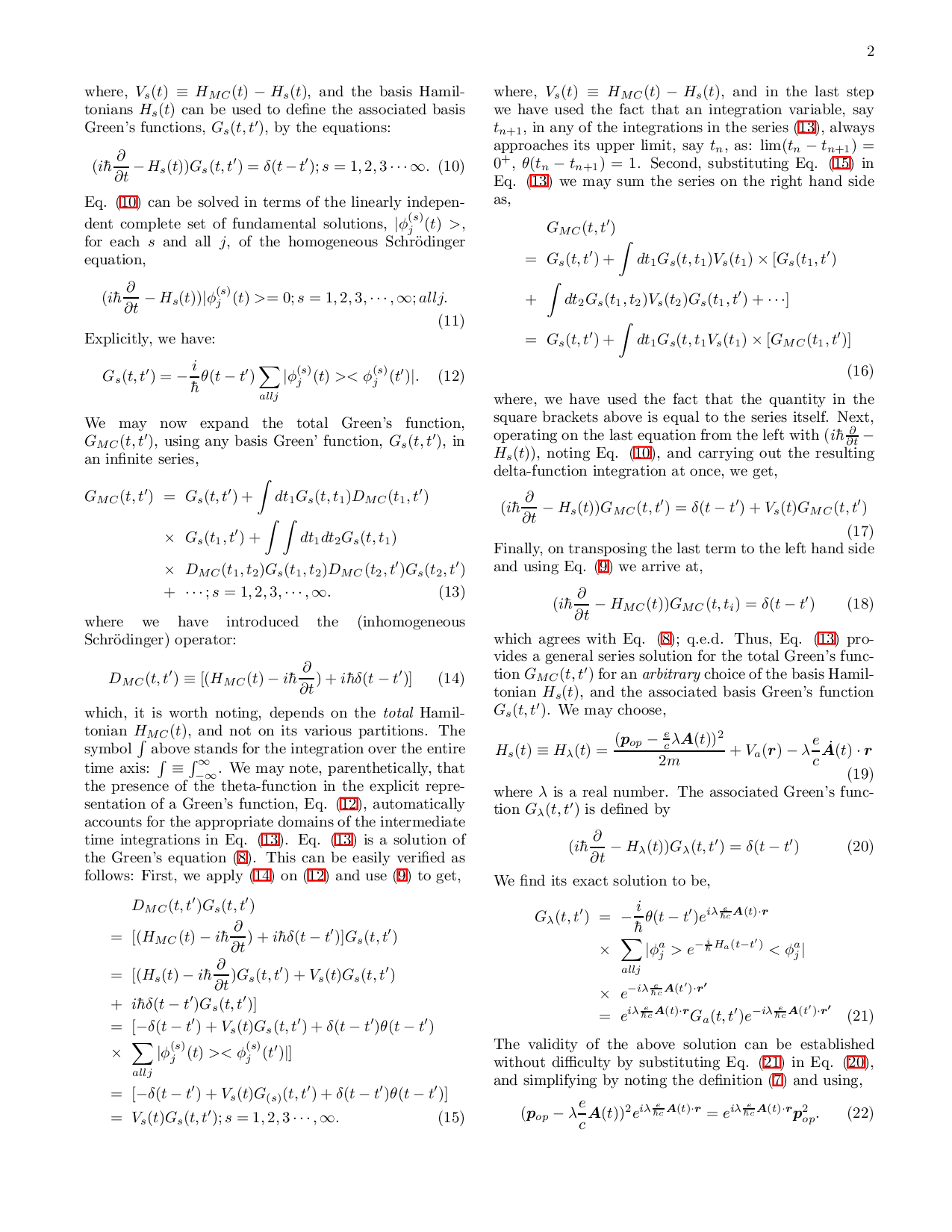
HMC(t) = Hs(t) + Vs(t); s = 1, 2, 3, · · ·∞
(9)
2
where, Vs(t) ≡HMC(t) −Hs(t), and the basis Hamil-
tonians Hs(t) can be used to define the associated basis
Green’s functions, Gs(t, t′), by the equations:
(i¯h ∂
∂t −Hs(t))Gs(t, t′) = δ(t−t′); s = 1, 2, 3 · · ·∞. (10)
Eq. (10) can be solved in terms of the linearly indepen-
dent complete set of fundamental solutions, |φ(s)
j (t) >,
for each s and all j, of the homogeneous Schr¨odinger
equation,
(i¯h ∂
∂t −Hs(t))|φ(s)
j (t) >= 0; s = 1, 2, 3, · · ·, ∞; allj.
(11)
Explicitly, we have:
Gs(t, t′) = −i
¯hθ(t −t′)
X
allj
|φ(s)
j (t) >< φ(s)
j (t′)|.
(12)
We
may
now
expand
the
total
Green’s
function,
GMC(t, t′), using any basis Green’ function, Gs(t, t′), in
an infinite series,
GMC(t, t′) = Gs(t, t′) +
Z
dt1Gs(t, t1)DMC(t1, t′)
× Gs(t1, t′) +
Z Z
dt1dt2Gs(t, t1)
× DMC(t1, t2)Gs(t1, t2)DMC(t2, t′)Gs(t2, t′)
+ · · · ; s = 1, 2, 3, · · ·, ∞.
(13)
where
we
have
introduced
the
(inhomogeneous
Schr¨odinger) operator:
DMC(t, t′) ≡[(HMC(t) −i¯h ∂
∂t
…(Full text truncated)…
This content is AI-processed based on ArXiv data.