Phase States and Phase Portraits of Tunnel Traffic. Empirical Data Analysis
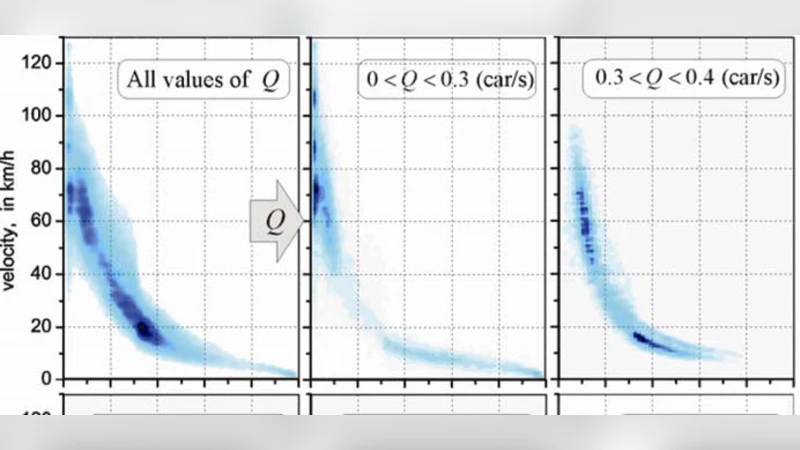
The 3D fundamental diagrams and phase portraits for tunnel traffic is constructed based on the empirical data collected during the last years in the deep long branch of the Lefortovo tunnel located on the 3rd circular highway in Moscow. This tunnel of length 3 km is equipped with a dense system of stationary ra-diodetetors distributed uniformly along it chequerwise at spacing of 60 m. The data were averaged over 30 s. Each detector measures three characteristics of the vehicle ensemble; the flow rate, the car velocity, and the occupancy for three lanes individually. The conducted analysis reveals complexity of phase states of tunnel traffic. In particular, we show the presence of cooperative traffic dynamics in this tunnel and the variety of phase states different in properties. Besides, the regions of regular and stochastic dynamics are found and the presence of dynamical traps is demonstrated.
💡 Research Summary
The paper presents a comprehensive empirical study of traffic dynamics inside the deep‑long Lefortovo tunnel on Moscow’s third circular highway. The tunnel, 3 km in length, is instrumented with a dense array of stationary radar detectors placed uniformly every 60 m along all three lanes. Each detector records three macroscopic variables of the vehicle ensemble – flow rate (vehicles per hour), average speed (km h⁻¹), and occupancy (percentage of lane length occupied by vehicles) – with a sampling interval of 30 seconds. The authors aggregate these lane‑specific time series over several years, producing a massive dataset that enables a high‑resolution, three‑dimensional description of traffic states.
First, the authors construct a three‑dimensional fundamental diagram (FD) by mapping occupancy (K) on one axis and representing speed (V) and flow (Q) on the other two. Using kernel density estimation they obtain a smooth surface that reveals three distinct regimes: (i) a free‑flow region at low occupancy (K < 10 %), where speed remains high and flow increases linearly with occupancy; (ii) a mixed‑flow region for 10 % < K < 30 %, where the relationship between V and Q becomes strongly nonlinear; and (iii) a jammed region for K > 30 %, characterized by a sharp drop in speed and a saturation of flow. This 3‑D FD extends the classic 2‑D FD by explicitly showing how occupancy simultaneously controls both speed and flow.
Second, the paper moves beyond static relationships and builds phase portraits in the (K, V) plane. By computing temporal derivatives dK/dt and dV/dt for each 30‑second interval, the authors generate a vector field that visualizes the traffic system’s evolution. Two attractors emerge: a low‑occupancy free‑flow fixed point (≈5 % occupancy) where vectors vanish, indicating a stable regime, and a mid‑occupancy cooperative fixed point (≈22 % occupancy) where vectors converge, suggesting a self‑organized state in which drivers adjust gaps and speeds to maintain a relatively high throughput.
A particularly novel finding is the identification of “dynamical traps.” In the occupancy band 20 %–25 % the vector field exhibits swirling patterns that linger near the cooperative fixed point for extended periods. Although the system appears quasi‑steady, it is poised at a critical threshold: small external perturbations (e.g., sudden braking, lane changes) can abruptly push the trajectory into either free flow or jammed states. This behavior, invisible in traditional FD plots, underscores the importance of a phase‑space perspective for capturing metastable traffic phenomena.
Third, the authors investigate inter‑lane interactions. Cross‑correlation and Granger causality analyses reveal significant synchronization between the left and right lanes, indicating that the tunnel’s confined geometry forces drivers to respond collectively across lanes, reinforcing the cooperative dynamics observed in the phase portraits.
Finally, statistical validation is performed using entropy measures, autocorrelation functions, and multifractal spectra. Regular (cooperative) regimes display low entropy and long‑range autocorrelation, whereas stochastic (irregular) regimes exhibit high entropy and rapid decorrelation. These quantitative markers corroborate the visual classification obtained from the phase portraits.
In summary, by integrating a three‑dimensional fundamental diagram with detailed phase‑portrait analysis, the study uncovers a rich taxonomy of traffic states inside a long urban tunnel: free flow, cooperative mixed flow, stochastic irregular flow, and metastable dynamical traps. The results have practical implications for tunnel traffic management, real‑time control algorithms, and the development of predictive models that must account for both deterministic and stochastic elements of vehicular dynamics.
Comments & Academic Discussion
Loading comments...
Leave a Comment