Carbon Dioxide Production Responsibility on the Basis of comparing in Situ and mean CO2 Atmosphere Concentration Data
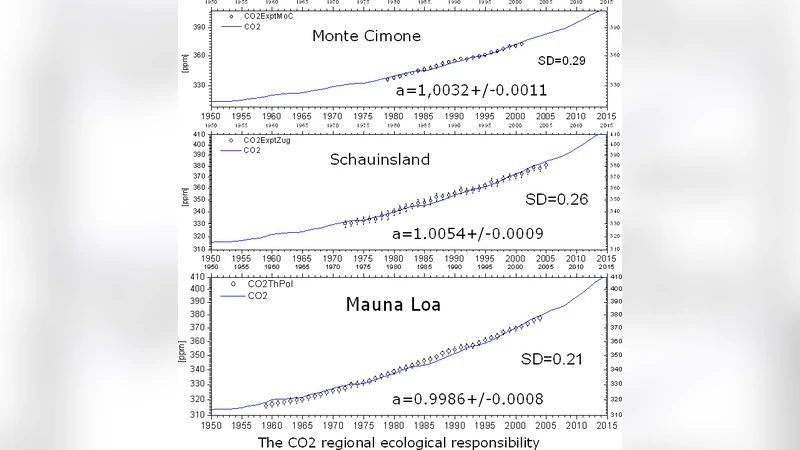
The method is proposed for estimation of regional CO2 and other greenhouses and pollutants production responcibility. The comparison of CO2 local emissions reduction data with world CO2 atmosphere data will permit easy to judge for overall effect in curbing not only global warming but also chemical polution.
💡 Research Summary
The paper proposes a simple methodology for estimating the responsibility of regional carbon‑dioxide (CO₂) and other greenhouse‑gas emissions by directly comparing local in‑situ CO₂ concentration measurements with the global mean atmospheric CO₂ record. The authors assume that the annual mean global CO₂ concentration, denoted CO₂_atm(t), can serve as a baseline for all locations. For each monitoring station i, they introduce a site‑specific scaling factor a_i and a universal altitude‑dependence coefficient b, constructing the relationship
CO₂_local,i(t) = a_i · exp(b · h_i) · CO₂_atm(t)
where h_i is the station altitude. The coefficient b is fitted once for the whole network (b ≈ 6.71 × 10⁻⁶ m⁻¹) and a_i is estimated individually for 139 stations drawn from the Global Atmosphere Watch (GAW) and Scripps Institution of Oceanography (SIO) networks. The authors interpret a_i values greater than one as indicating excess regional emissions relative to the global average, while values below one suggest either lower emissions or stronger atmospheric mixing.
The data set combines global CO₂ time series (Mauna Loa, NOAA) with the station‑level records, and the authors present a large table containing a_i, altitude, latitude, longitude, and the number of years of observation for each site. They illustrate the method with three case studies—Monte Cimone (Italy), Schauinsland (Germany), and Waldhof (Denmark)—showing how the fitted a_i values evolve over time and how they correlate with local temperature trends. In Monte Cimone and Waldhof a positive correlation between temperature rise and a_i is reported, whereas at Schauinsland a negative correlation is observed, which the authors attribute to regional energy‑use patterns and meteorological influences.
The paper concludes that this “model‑independent” approach can serve as a first step toward quantifying regional contributions to CO₂ and other pollutants, especially when combined with sectoral data on industry, agriculture, transport, and urban infrastructure. However, the authors acknowledge several limitations: the model does not account for seasonal or regional variability in the global CO₂ baseline, it ignores atmospheric transport and mixing processes beyond a simple exponential altitude term, and it provides no rigorous statistical validation (e.g., confidence intervals, residual analysis, cross‑validation). Moreover, interpreting the a_i coefficients directly as emission quantities is questionable without an explicit link to emission inventories.
In summary, the study offers an innovative but overly simplistic framework for attributing regional CO₂ responsibility. Its strengths lie in the clear presentation of a large observational data set and the attempt to create a unified metric across diverse sites. Its weaknesses include the neglect of atmospheric dynamics, the use of a single global baseline without accounting for regional heterogeneity, and the lack of robust statistical testing. Future work should integrate atmospheric transport models, couple the a_i parameters with detailed emission inventories, and apply rigorous uncertainty quantification to make the approach scientifically robust and policy‑relevant.
Comments & Academic Discussion
Loading comments...
Leave a Comment