Products of straight spaces
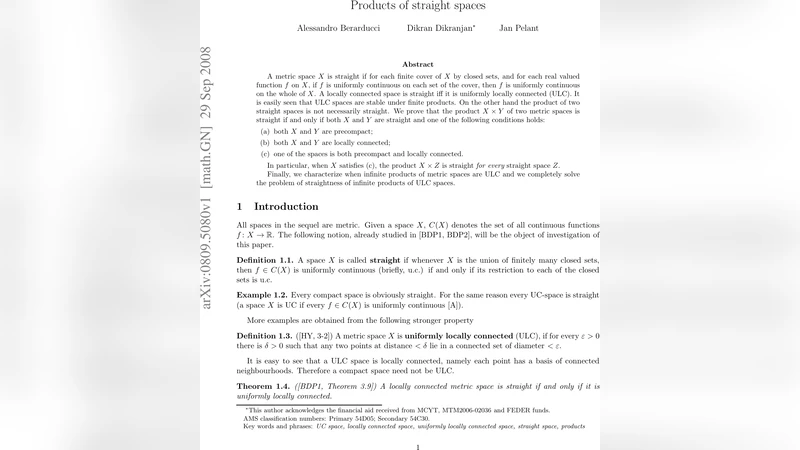
A metric space X is straight if for each finite cover of X by closed sets, and for each real valued function f on X, if f is uniformly continuous on each set of the cover, then f is uniformly continuous on the whole of X. A locally connected space is straight if it is uniformly locally connected (ULC). It is easily seen that ULC spaces are stable under finite products. On the other hand the product of two straight spaces is not necessarily straight. We prove that the product X x Y of two metric spaces is straight if and only if both X and Y are straight and one of the following conditions holds: (a) both X and Y are precompact; (b) both X and Y are locally connected; (c) one of the spaces is both precompact and locally connected. In particular, when X satisfies (c), the product X x Z is straight for every straight space Z. Finally, we characterize when infinite products of metric spaces are ULC and we completely solve the problem of straightness of infinite products of ULC spaces.
💡 Research Summary
The paper introduces and studies a property of metric spaces called “straightness”. A metric space (X) is defined to be straight if for every finite closed cover ({F_{1},\dots ,F_{n}}) of (X) and for every real‑valued function (f) on (X), the condition that (f) is uniformly continuous on each (F_{i}) implies that (f) is uniformly continuous on the whole space. This definition can be viewed as a uniform‑continuity analogue of the classical pasting lemma, but it is considerably stronger because the covering sets are closed and the uniform modulus must be the same for all of them.
The authors first observe that uniformly locally connected (ULC) spaces are straight, and that the class of ULC spaces is closed under finite products. However, straightness itself is not stable under products in general; a simple counterexample shows that the product of two straight spaces may fail to be straight. The main result of the paper gives a precise characterisation of when the product of two metric spaces is straight.
Theorem (main). Let (X) and (Y) be metric spaces. Then (X\times Y) is straight if and only if both (X) and (Y) are straight and one of the following three conditions holds:
- Both are precompact. That is, each space has a totally bounded completion; equivalently, each can be covered by finitely many balls of any prescribed radius.
- Both are locally connected. In this case each point has arbitrarily small connected neighbourhoods.
- One factor is both precompact and locally connected. The other factor needs only to be straight.
The proof proceeds by analysing the uniform continuity of a function (f\colon X\times Y\to\mathbb R) on basic rectangles (A\times B) where (A\subseteq X) and (B\subseteq Y) are closed. When both factors are precompact, one can cover each factor by finitely many small balls; the uniform continuity on each rectangle then yields a global modulus via the straightness of the factors. When both factors are locally connected, the authors exploit the existence of arbitrarily small connected neighbourhoods to glue local moduli together. The mixed case (c) uses the factor that is simultaneously precompact and locally connected as a “bridge”: its precompactness supplies a finite covering, while its local connectedness guarantees that the pieces of the covering are connected, allowing the uniform continuity on the other factor to be transferred across the product.
Several corollaries follow immediately. In particular, if a space (X) satisfies condition (c), then for any straight space (Z) the product (X\times Z) is straight. This shows that a single factor with the combined precompact‑and‑locally‑connected property protects straightness under arbitrary product with straight spaces.
The paper then turns to infinite products. The authors first characterise when an infinite product of ULC spaces remains ULC. They introduce the notion of uniform precompactness (a uniform bound on the diameters of the factors) and prove that an infinite product (\prod_{i\in I}X_{i}) is ULC iff each (X_{i}) is ULC and the family ({X_{i}}) is uniformly precompact. Using this, they obtain a complete description of straightness for infinite products of straight spaces: an infinite product is straight precisely when each factor is straight and either (i) all but finitely many factors are both precompact and locally connected, or (ii) there exists at least one factor that is precompact and locally connected and the remaining factors are merely straight. The proofs adapt the finite‑product arguments, but require careful diagonalisation to handle the infinitely many coordinates.
Throughout the paper the authors provide explicit examples and counterexamples that illustrate the sharpness of the conditions. For instance, they exhibit two straight spaces whose product fails to be straight because neither factor is precompact nor locally connected, and they construct infinite products where the lack of a uniformly bounded precompactness constant destroys ULC (and consequently straightness).
In conclusion, the work gives a thorough taxonomy of when straightness is preserved under finite and infinite products. It shows that straightness is tightly linked to two classical topological notions—precompactness and local connectedness—and that the combination of these two properties in at least one factor is sufficient to guarantee stability under products. The results extend the known closure properties of ULC spaces and open the way for further investigations of straightness in non‑metric settings, in function spaces, and in the context of other uniform continuity‑type properties.
Comments & Academic Discussion
Loading comments...
Leave a Comment