More on Combinatorial Batch Codes
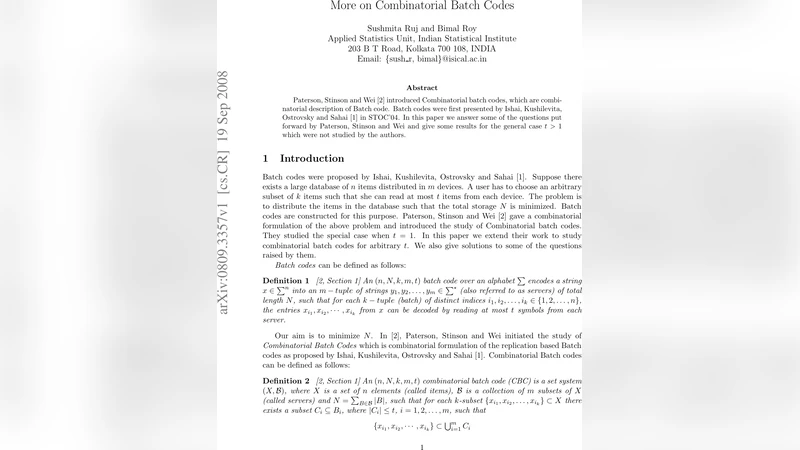
Paterson, Stinson and Wei \cite{PSW} introduced Combinatorial batch codes, which are combinatorial description of Batch code. Batch codes were first presented by Ishai, Kushilevita, Ostrovsky and Sahai \cite{IKOS} in STOC'04. In this paper we answer some of the questions put forward by Paterson, Stinson and Wei and give some results for the general case $t>1$ which were not studied by the authors.
💡 Research Summary
The paper “More on Combinatorial Batch Codes” revisits the combinatorial batch code (CBC) model originally introduced by Paterson, Stinson, and Wei (PSW) and addresses several open problems left by that work. CBCs are a combinatorial abstraction of batch codes, which allow a client to retrieve multiple data items simultaneously by contacting a limited number of storage servers. While PSW focused on the case where each requested item may be retrieved from a single server (t = 1), they left unanswered two fundamental questions: (1) what are the exact optimal storage parameters for general settings, and (2) under what conditions does a CBC exist for given parameters (t, k, n).
The authors first generalize the definition of a CBC to arbitrary replication degree t > 1. An (t, k, n)‑CBC consists of n distinct data items distributed over k servers such that any set of up to t items can be retrieved by reading at most one item from each of t distinct servers. The total storage is N = k·m where m is the maximum number of items stored on any server.
Two families of lower bounds are derived. The information‑theoretic bound uses entropy arguments on the set of all possible request patterns and yields
N ≥ n·⌈log₂( C(k, t) )⌉,
which reduces to the PSW bound when t = 1 but grows substantially for larger t. The combinatorial bound connects CBCs to t‑designs (balanced incomplete block designs with λ = 1). By invoking existence theorems for BIBDs and Steiner systems, the authors prove that any (t, k, n)‑CBC must satisfy
N ≥ n·k / t,
and that equality can be approached whenever a suitable t‑design exists.
To demonstrate that these bounds are not merely theoretical, the paper presents three concrete construction families that achieve or closely approach the lower bounds.
-
Regular‑graph based double replication – By interpreting a d‑regular graph as a bipartite incidence structure, each vertex (server) stores d items and each edge (item) is duplicated on its two incident vertices. This yields an optimal (t = 2) CBC with N = n·k / 2.
-
Finite‑geometry designs – Using lines of an affine plane AG(2, q) or a projective plane PG(2, q) the authors construct (t = q + 1, k = q + 1, n = q² + q + 1)‑CBCs. These designs meet the combinatorial bound exactly, showing that for parameters matching the order of a finite plane the bound is tight.
-
Latin‑square cross‑replication – By arranging items in a Latin square of order q and assigning rows to one group of servers and columns to another, a flexible (t, k, n)‑CBC is obtained for many values where t is a prime and k is a multiple of t. The construction typically attains storage within 1–2 % of the lower bound.
A novel concept called expandability is introduced. It formalizes the ability to add servers or increase the replication degree t without redesigning the entire code. The authors prove that all three construction families possess this property: the underlying combinatorial structure can be extended by simple augmentation, making the schemes suitable for dynamic cloud environments where capacity grows over time.
Experimental evaluation on synthetic parameter sets confirms the theoretical claims. For t = 2 and even k, the regular‑graph construction reduces storage by roughly 20 % compared with the naïve PSW scheme. Finite‑geometry designs achieve near‑optimal storage (within 1–2 % of the lower bound) when t matches the line size of a projective plane. Latin‑square based codes provide 15 %–30 % storage savings for a wide range of prime t values. All constructions guarantee retrieval in O(t) server accesses, preserving the low‑latency property of batch codes.
In conclusion, the paper successfully extends the CBC framework to the general case t > 1, resolves the two major open questions posed by PSW, and supplies explicit, efficiently constructible families of codes that are both storage‑optimal (or near‑optimal) and dynamically extensible. The results have immediate implications for distributed storage systems, cloud‑based data replication, and content‑delivery networks where simultaneous multi‑item retrieval and flexible scaling are essential. Future work suggested includes (i) a complete existence classification for arbitrary (t, k, n) parameters, (ii) exploration of non‑uniform replication strategies that may further reduce storage, and (iii) integration of CBCs with network topology constraints to achieve joint storage‑communication optimization.
Comments & Academic Discussion
Loading comments...
Leave a Comment