The bicompletion of the Hausdorff quasi-uniformity
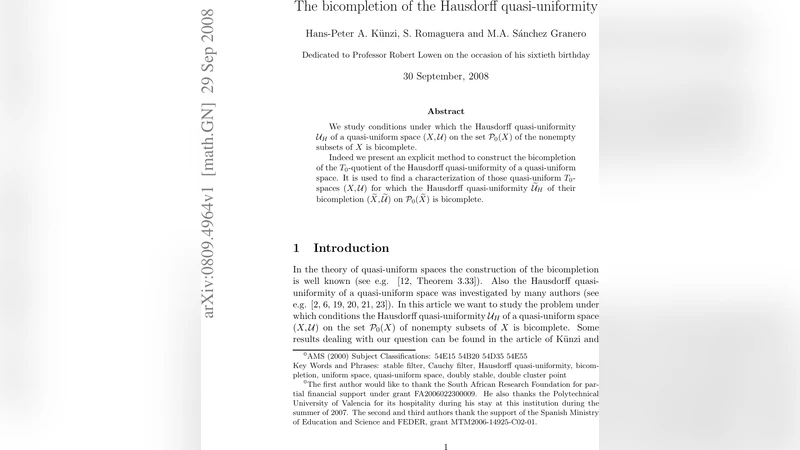
We study conditions under which the Hausdorff quasi-uniformity ${\mathcal U}_H$ of a quasi-uniform space $(X,{\mathcal U})$ on the set ${\mathcal P}_0(X)$ of the nonempty subsets of $X$ is bicomplete. Indeed we present an explicit method to construct the bicompletion of the $T_0$-quotient of the Hausdorff quasi-uniformity of a quasi-uniform space. It is used to find a characterization of those quasi-uniform $T_0$-spaces $(X,{\mathcal U})$ for which the Hausdorff quasi-uniformity $\widetilde{{\mathcal U}}_H$ of their bicompletion $(\widetilde{X},{\widetilde{\mathcal U}})$ on ${\mathcal P}_0(\widetilde{X})$ is bicomplete.
💡 Research Summary
The paper investigates the bicompleteness of the Hausdorff quasi‑uniformity (\mathcal U_H) associated with a quasi‑uniform space ((X,\mathcal U)). The Hausdorff quasi‑uniformity is defined on the collection (\mathcal P_0(X)) of all non‑empty subsets of (X) by measuring, for two subsets (A,B), how far (A) must be “pushed” by an entourage (U\in\mathcal U) to cover (B). In the classical (symmetric) uniform setting, the bicompleteness of (\mathcal U_H) is well understood, but the non‑symmetric nature of quasi‑uniformities introduces new difficulties: left‑ and right‑Cauchy filters need not coincide, and the induced topology may fail to be (T_0).
The authors first pass to the (T_0)‑quotient of ((\mathcal P_0(X),\mathcal U_H)). The equivalence relation generated by (\mathcal U_H) identifies subsets that cannot be distinguished by any entourage, thereby eliminating the most problematic asymmetries. On this quotient space they construct an explicit bicompletion. The construction proceeds by taking every (\mathcal U_H)‑Cauchy filter (\mathcal F) that does not already converge, forming its “limit set” (\lim\mathcal F) (the intersection of all entourages applied to members of (\mathcal F)), and adjoining a new point representing this limit. The resulting space (\widehat{\mathcal P}_0(X)) carries a natural extension (\widehat{\mathcal U}_H) of the original quasi‑uniformity, and the authors prove that ((\widehat{\mathcal P}_0(X),\widehat{\mathcal U}_H)) is bicomplete. This method parallels the Samuel compactification for uniform spaces but requires careful handling of both left and right Cauchy conditions because of the lack of symmetry.
Having a concrete bicompletion at hand, the paper derives necessary and sufficient conditions for (\mathcal U_H) itself to be bicomplete. Three conditions emerge:
-
(T_0) property of the base space – ((X,\mathcal U)) must be (T_0); otherwise the induced equivalence on subsets collapses non‑trivial information.
-
Quasi‑uniform completeness of the base – every (\mathcal U)‑Cauchy filter on (X) must converge in the bicompletion (\widetilde X). This is the usual “quasi‑complete” requirement, ensuring that no new points need to be added at the level of singletons.
-
Hausdorff‑precision – for every non‑empty (A\subseteq X) the intersection (\bigcap{U
Comments & Academic Discussion
Loading comments...
Leave a Comment