16 Propositions to Reconsider the Organization of a Scientific Workshop
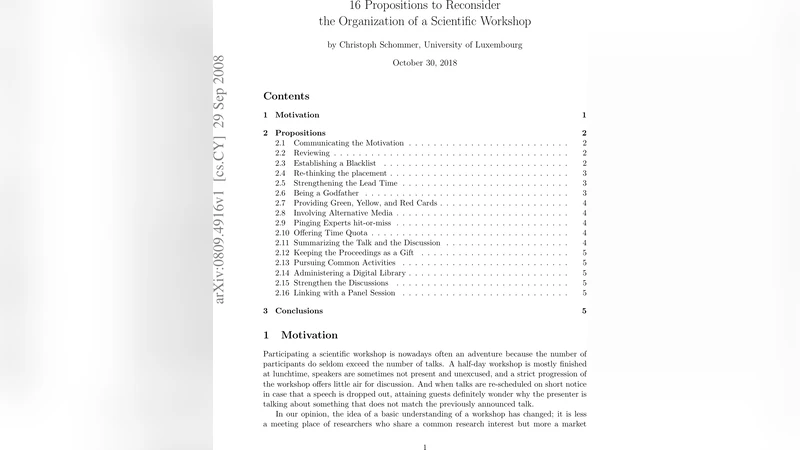
Participating a scientific workshop is nowadays often an adventure because the number of participants do seldom exceed the number of talks. A half-day workshop is mostly finished at lunchtime, speakers are sometimes not present and unexcused, and a strict progression of the workshop offers little air for discussion. And when talks are re-scheduled on short notice in case that a speech is dropped out, attaining guests definitely wonder why the presenter is talking about something that does not match the previously announced talk. In this respect, we believe that the organization of a workshop in the classical sense must be reconsidered. It is not enough of compelling the presenters to pay the registration fee only and to let the participants being impassive or taken away mentally. With this work, we address several propositions to become implemented in the future workshop organization. With that, we hope to contribute to the identification of scientific workshops as a place of interaction.
💡 Research Summary
The paper opens by diagnosing a set of chronic shortcomings that have become typical of modern scientific workshops. The authors note that the number of attendees often exceeds the number of talks, that half‑day events usually end abruptly at lunch, that presenters frequently fail to appear, and that the rigid, pre‑planned schedule leaves little room for spontaneous discussion. When a talk is cancelled at short notice, the audience is forced to listen to material that does not match the advertised program, creating confusion and diminishing the perceived value of the event. The authors argue that these symptoms indicate a deeper structural problem: workshops are being run as simple lecture series rather than as interactive forums for scientific exchange.
To address this, the paper proposes sixteen concrete measures that together constitute a redesign of workshop organization. The first two recommendations focus on the macro‑level structure: (1) enforce a minimum participant‑to‑speaker ratio (e.g., at least two attendees per talk) during the registration phase, and (2) replace fixed two‑hour blocks with modular 45‑minute presentation slots followed by 15‑minute discussion periods. This creates a predictable rhythm that guarantees time for questions and reduces the likelihood of “talk‑only” sessions.
The next set of proposals tackles human‑resource risk. The authors suggest a formal presenter‑commitment contract that obliges speakers to attend or to provide a pre‑approved substitute, and they recommend maintaining a “reserve speaker pool” of one or two backup presenters per session. These mechanisms dramatically lower the probability that a sudden absence will derail the schedule.
Digital tools are then introduced as enablers of flexibility. A real‑time scheduling app would push instant updates to participants, allow them to bookmark sessions of interest, and display any last‑minute changes. Coupled with a pre‑event survey that captures attendees’ topical preferences, organizers can match speakers to the most demanded subjects, thereby aligning expectations with actual content.
To preserve interaction even when a presenter is missing, the authors advocate parallel poster sessions and round‑table discussions, which can serve as fallback activities that still promote networking and idea exchange. A built‑in ten‑minute buffer between slots is recommended to absorb overruns without cascading delays.
Immediate feedback mechanisms are also emphasized. After each talk, a short digital questionnaire would collect audience reactions and questions, which are then shared with the speaker and the broader group in real time. This not only enriches the discussion but also creates a data set for post‑event analysis.
Recognizing the growing importance of hybrid formats, the paper calls for a virtual backup system that enables speakers to join remotely if they cannot be physically present. A professional moderator should be assigned to each session to keep discussions on track and to enforce the time limits.
The authors further suggest diversifying presentation formats—such as “speed talks,” hands‑on demos, and mini‑workshops—to cater to different learning styles and to keep the program dynamic. Incentives for active participation (e.g., points, certificates) are proposed to motivate attendees to ask questions and contribute to discussions.
All presentation materials, along with concise discussion summaries, should be uploaded to an online repository after the event, ensuring that the knowledge generated remains accessible. The paper also stresses inclusivity: providing translation services for international participants and deliberately designing sessions that span multiple disciplines.
Finally, a continuous improvement loop is recommended. After each workshop, a comprehensive evaluation—including quantitative metrics (attendance ratios, feedback scores, number of questions asked) and qualitative comments—should be conducted, and the findings fed into the planning of the next event. The authors suggest piloting these measures in a small‑scale workshop to assess feasibility before broader adoption.
In conclusion, the authors argue that implementing the sixteen recommendations will transform scientific workshops from static lecture series into vibrant, interactive ecosystems. By balancing rigorous scheduling with built‑in flexibility, leveraging digital tools, and fostering a culture of active participation, workshops can become genuine platforms for scientific dialogue, networking, and collaborative problem solving. The paper calls for the community to experiment with these ideas, measure their impact, and evolve workshop design as an integral part of modern scientific communication.
Comments & Academic Discussion
Loading comments...
Leave a Comment