Counting the Closed Subgroups of Profinite Groups
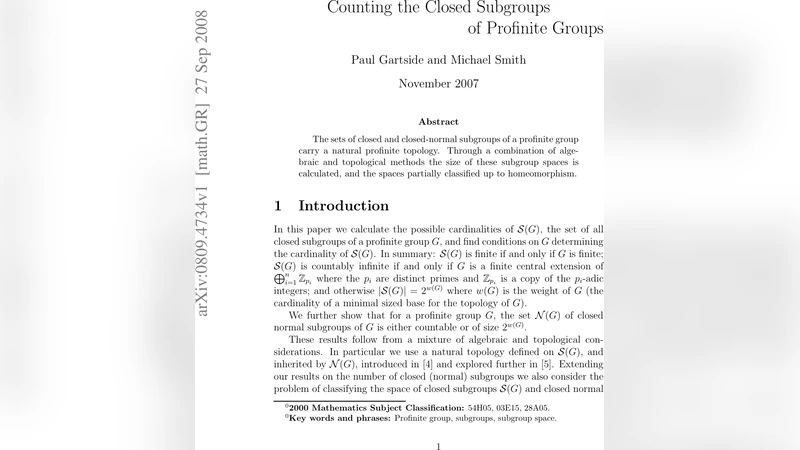
The sets of closed and closed-normal subgroups of a profinite group carry a natural profinite topology. Through a combination of algebraic and topological methods the size of these subgroup spaces is calculated, and the spaces partially classified up to homeomorphism.
💡 Research Summary
The paper investigates two natural topological spaces associated with a profinite group (G): the set (\mathcal{S}(G)) of all closed subgroups and the set (\mathcal{N}(G)) of all closed normal subgroups, each equipped with the profinite topology induced by the inverse‑limit description of (G). The authors begin by defining a basis of open sets for these spaces: for any open normal subgroup (U) of (G), the collection ({H\leq G\mid H\supseteq U}) is declared open. This construction makes both (\mathcal{S}(G)) and (\mathcal{N}(G)) themselves profinite groups, allowing the use of standard tools from profinite group theory and compact zero‑dimensional topology.
A central methodological contribution is the “decomposition‑sum principle”. By invoking the structure theorem for profinite groups, the authors write any profinite group as a (possibly infinite) direct product of basic factors—finite cyclic groups, pro‑(p) groups, and free profinite groups. They prove that the subgroup spaces decompose accordingly: \
Comments & Academic Discussion
Loading comments...
Leave a Comment