A diatribe on expanding space
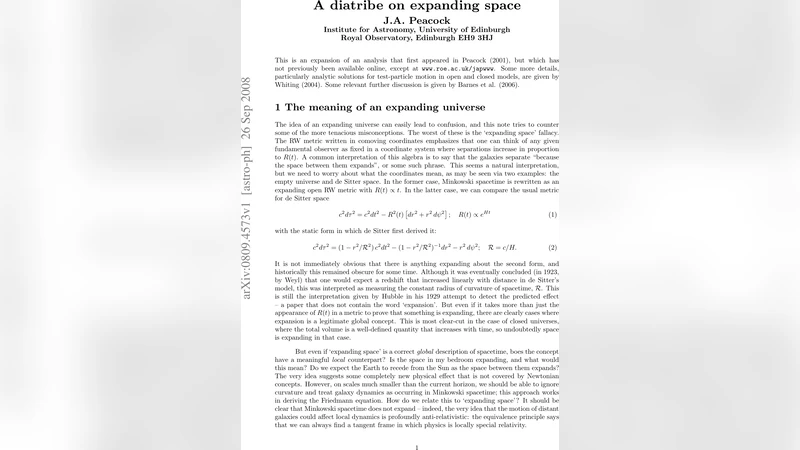
Some comments are made on the usefulness or otherwise of the concept of `expanding space’ in cosmology. These notes are an expanded version of material first published in 2001 but not previously available online except at www.roe.ac.uk/japwww. Since that personal webpage has been referred to in published work, it seems sensible to give these notes a more permanent home.
💡 Research Summary
The paper offers a critical examination of the widely used phrase “expanding space” in contemporary cosmology, questioning its pedagogical usefulness and physical accuracy. Beginning with a historical overview, the author traces the evolution of the concept from early interpretations of Hubble’s observations—where galaxies were simply described as receding—to the adoption of the Friedmann‑Lemaître‑Robertson‑Walker (FLRW) metric, which introduced the notion that space itself stretches. While this metaphor has proven effective for popular explanations, the author argues that it obscures the underlying geometry of general relativity and can lead to two principal misconceptions.
First, treating space as a material substrate invites the false image of a “rubber sheet” that physically expands, suggesting that space possesses its own dynamics independent of the matter‑energy content that actually determines curvature. This viewpoint complicates discussions of vacuum energy, dark energy, and energy conservation, because it implies an autonomous expansion mechanism rather than a coordinate‑dependent description. Second, the metaphor can be misread as implying a self‑driven, “self‑propelling” expansion, especially in the context of inflationary theory. Inflation is driven by the dynamics of a scalar field with a specific potential; describing it merely as space “stretching on its own” neglects the essential physics of the field and its coupling to gravity.
To resolve these ambiguities, the author proposes replacing “expanding space” with the more precise term “coordinate expansion.” In this framework, the scale factor a(t) is understood as a time‑dependent rescaling of the coordinate grid rather than a physical stretching of a medium. Observable quantities—redshifts, luminosity distances, angular diameter distances, and the pattern of cosmic microwave background anisotropies—are all consistently described by the FLRW metric when interpreted as arising from this coordinate rescaling. For instance, the cosmological redshift is not photons losing energy because space stretches, but rather a consequence of the photon’s wavelength being measured against a coordinate system whose scale factor has increased between emission and observation.
The paper proceeds to compare this coordinate‑centric view with a broad range of observational data. Supernova Type Ia distance‑modulus measurements, baryon acoustic oscillation (BAO) scale determinations, and the temperature fluctuations of the CMB all fit the standard ΛCDM model when the scale factor’s evolution is treated as a coordinate effect. Consequently, the empirical success of modern cosmology does not depend on the literal notion of a physical space that expands.
Beyond the theoretical analysis, the author emphasizes the educational implications. Current textbooks and popular‑science outlets frequently retain the phrase “the universe expands,” which can cement the erroneous intuition that space is a tangible entity undergoing motion. The author recommends that instructors foreground the idea that “the distance‑measuring standard changes with time” and employ visual tools that illustrate the evolution of the scale factor rather than relying on rubber‑sheet analogies. Animated plots of a(t) versus cosmic time, or diagrams showing how comoving coordinates remain fixed while proper distances grow, convey the same physics without invoking a misleading material metaphor.
In conclusion, the paper asserts that while the “expanding space” metaphor has historical value, it is increasingly counterproductive for precise scientific discourse and for teaching the next generation of cosmologists. By adopting the terminology of coordinate expansion and restructuring pedagogical materials accordingly, the community can preserve the mathematical rigor of general relativity, avoid conceptual pitfalls, and present a clearer, more accurate picture of cosmic evolution.
Comments & Academic Discussion
Loading comments...
Leave a Comment