Lagrangians for dissipative nonlinear oscillators: the method of Jacobi Last Multiplier
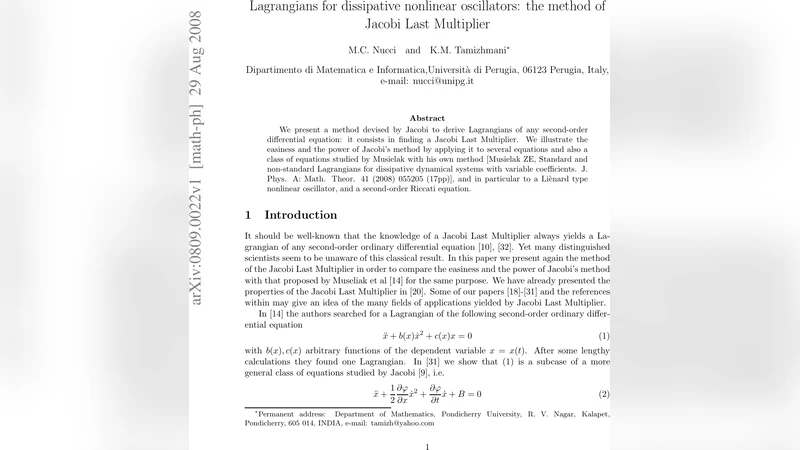
We present a method devised by Jacobi to derive Lagrangians of any second-order differential equation: it consists in finding a Jacobi Last Multiplier. We illustrate the easiness and the power of Jacobi’s method by applying it to several equations and also a class of equations studied by Musielak with his own method [Musielak ZE, Standard and non-standard Lagrangians for dissipative dynamical systems with variable coefficients. J. Phys. A: Math. Theor. 41 (2008) 055205 (17pp)], and in particular to a Li`enard type nonlinear oscillator, and a second-order Riccati equation.
💡 Research Summary
The paper revisits a classical construction due to Carl Gustav Jacob Jacobi – the Jacobi Last Multiplier (JLM) – and demonstrates that it provides a systematic, algorithmic route to Lagrangians for any second‑order ordinary differential equation (ODE), including dissipative and non‑conservative systems. The authors begin by recalling that a Lagrangian (L(t,x,\dot x)) is not unique; any total time derivative can be added without changing the Euler–Lagrange equations. The JLM, denoted (M(t,x,\dot x)), is defined as a function satisfying
\
Comments & Academic Discussion
Loading comments...
Leave a Comment