Differential Twisted K-theory and Applications
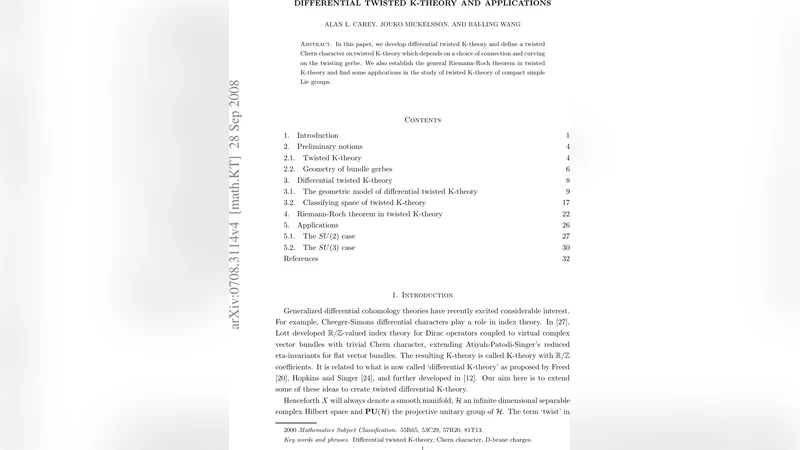
In this paper, we develop differential twisted K-theory and define a twisted Chern character on twisted K-theory which depends on a choice of connection and curving on the twisting gerbe. We also establish the general Riemann-Roch theorem in twisted K-theory and find some applications in the study of twisted K-theory of compact simple Lie groups.
💡 Research Summary
The paper develops a comprehensive framework for differential twisted K‑theory, extending the classical topological K‑theory to incorporate geometric data associated with a twisting gerbe. Starting from a gerbe class τ ∈ H³(X,ℤ), the authors equip it with a connection (a 1‑form A) and a curving (a 2‑form B) whose curvature is the closed 3‑form H = dB. This geometric refinement allows the definition of a differential twisted K‑group (\widehat{K}^{\tau}(X)) that fits into an exact sequence
(0 → Ω^{odd}(X)/im d → \widehat{K}^{\tau}(X) → K^{\tau}(X) → 0).
The construction uses smooth stacks and Deligne cohomology to model the twisted vector bundles together with differential form data, ensuring functoriality, product structures, and naturality under pull‑back.
A central achievement is the definition of a twisted Chern character
(\operatorname{ch}{\tau}: \widehat{K}^{\tau}(X) → H^{even}{\tau}(X)),
where the target is the H‑twisted de Rham cohomology defined by the differential (d_H = d + H∧). The character depends on the chosen connection and curving but is independent of these choices up to cohomology, and it reduces to the ordinary Chern character when τ = 0. The authors verify that (\operatorname{ch}_{\tau}) respects the product and is compatible with the curvature map to differential forms.
The paper then proves a generalized Riemann‑Roch theorem for twisted K‑theory. For a proper smooth map f: X → Y equipped with a spinᶜ structure and a compatible twist transfer τ_X → τ_Y, there exists a push‑forward map (f_{!}: \widehat{K}^{\tau_X}(X) → \widehat{K}^{\tau_Y}(Y)). The theorem states that the twisted Chern character intertwines push‑forward and integration on twisted de Rham cohomology:
(\operatorname{ch}{\tau_Y}(f{!}(x)) = f_{*}\bigl(\operatorname{Td}(Tf) ∧ \operatorname{ch}_{\tau_X}(x)\bigr)).
The proof adapts the Atiyah‑Singer index theorem to the twisted setting, using Bismut‑Freed connections and superconnection techniques to handle the H‑twist.
In the final substantive section, the authors apply the theory to compact simple Lie groups G. They consider the basic 3‑form class (the Cartan 3‑form) as the twist and compute (\widehat{K}^{\tau}(G)) explicitly for groups such as SU(n), Spin(2n+1), and the exceptional group G₂. The calculations reveal that the twisted K‑groups decompose into a free part together with finite torsion, and that the twisted Chern character maps the torsion to zero, mirroring the physical picture where D‑brane charges in a background B‑field are classified by twisted K‑theory. The authors also derive a twisted index theorem for these groups, showing how the push‑forward along the group multiplication map reproduces known representation‑theoretic formulas.
The conclusion outlines open problems: extending the differential twisted K‑theory diagram to a full differential cohomology square, integrating with higher categorical structures, and exploring applications to M‑theory where the C‑field provides a degree‑4 twist. The paper positions differential twisted K‑theory as a unifying language bridging topology, geometry, and quantum field theory, and suggests that further development could illuminate the role of higher twists in both mathematics and physics.
Comments & Academic Discussion
Loading comments...
Leave a Comment