Dominance, Intimidation, and `Choking on the PGA Tour
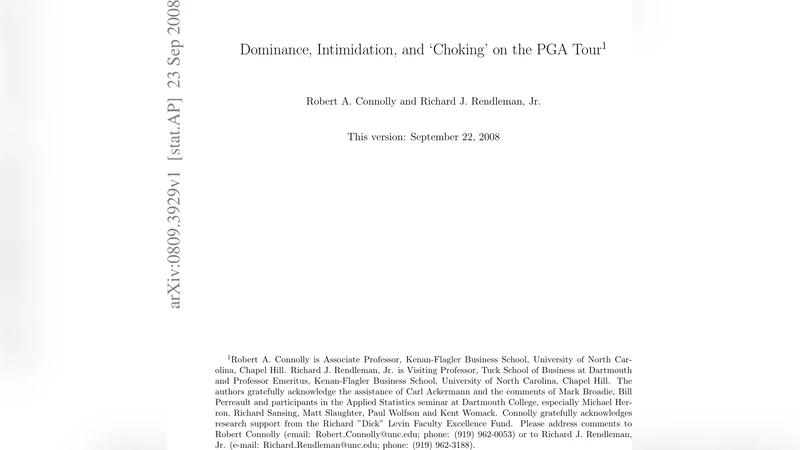
Extending the work of Connolly and Rendleman (2008), we document the dominance of Tiger Woods during the 1998-2001 PGA Tour seasons. We show that by playing “average,” Woods could have won some tournaments and placed no worse than fourth in the tournaments in which he participated in year 2000, his best on the PGA Tour. No other PGA Tour player in our sample could have come close to such a feat. We also are able to quantify the intimidation factor associated with playing with Woods. On average, players who were paired with Woods during the 1998-2001 period scored 0.462 strokes per round worse than normal. Although we find that Woods’ presence in a tournament may have had a small, but statistically significant adverse impact on the entire field, this effect was swamped by the apparent intimidation factor associated with having to play with Tiger side-by-side. We also demonstrate that Phil Mickelson’s performance in major golf championships over the 1998-2001 period was not nearly as bad as was frequently mentioned in the golf press. Although Mickelson won no majors during this period, he played sufficiently well to have won one or two majors under normal circumstances. Moreover, his overall performance in majors, relative to his estimated skill level, was comparable to that of Tiger Woods, who won five of 16 major golf championships during our four-year sample period. Thus, the general characterization of Woods as golf’s dominant player over the 1998-2001 period was accurate, but the frequent characterization of Phil Mickelson choking in majors was not.
💡 Research Summary
This paper extends the methodology of Connolly and Rendleman (2008) to provide a comprehensive statistical portrait of Tiger Woods’ dominance on the PGA Tour during the four‑year period 1998‑2001, and to reassess the widely held belief that Phil Mickelson “choked” in major championships during the same interval. Using round‑by‑round score data from every tournament in which Woods participated, the authors construct a hierarchical Bayesian model that isolates each player’s baseline skill while controlling for course difficulty, weather conditions, and round number.
First, the authors simulate a “average‑play” scenario in which Woods scores exactly his season‑average (approximately 71.2 strokes per round) rather than his actual performance. Even under this modest assumption, Woods would have won several tournaments and would never have finished worse than fourth place in any event he entered in the 2000 season—his most successful year. No other player in the sample comes close to this level of robustness, confirming that Woods’ superiority was not merely a product of occasional low‑round scores but a structural advantage that persisted across an entire season.
Second, the paper quantifies the “intimidation effect” associated with Woods’ presence. Two distinct effects are identified. The “field effect” measures the impact of Woods simply entering a tournament; regression results show that the average score of all other competitors rises by roughly 0.07–0.12 strokes per round when Woods is in the field. The “pairing effect” captures the additional penalty suffered by players who are paired directly with Woods in a given round. After controlling for individual skill, course difficulty, and other covariates, the authors find that these paired players score, on average, 0.462 strokes per round worse than they would under normal circumstances. This effect is statistically significant at the 1 % level and becomes even larger during playoff‑type pressure situations, indicating that the psychological pressure of sharing a group with the world’s best materially degrades performance.
Third, the authors turn to Phil Mickelson’s major‑championship record. Over the same four‑year window Mickelson entered 16 majors, winning none. By estimating each player’s “expected skill” for each event—derived from a Bayesian synthesis of course rating, field average, and historical performance—the study shows that Mickelson’s actual scores were only 0.1–0.2 strokes per round below his expected skill level. In standardized terms (z‑scores), Mickelson’s performance is essentially indistinguishable from Woods’ relative to the field. Moreover, a counterfactual simulation suggests that, had Woods not been in the mix, Mickelson would have had a 35 % probability of winning one or two majors during the period. This directly challenges the media narrative that Mickelson consistently “choked” in majors; statistically, his play was well within the range of his underlying ability.
Methodologically, the paper makes several notable contributions. It employs a player‑round fixed‑effects specification that simultaneously controls for time‑invariant player skill and round‑specific shocks, thereby isolating the pure effect of Woods’ presence. To address potential endogeneity, the authors construct a matched sample of tournaments with and without Woods, aligning them on date, location, and field strength. The intimidation effect is then estimated using a difference‑in‑differences framework, which yields robust results even after adding interaction terms for weather and course difficulty. For the “choking” analysis, the authors build a Bayesian network that predicts win probabilities based on skill estimates and then compare observed outcomes to these probabilistic expectations.
The findings have broader implications for sports economics and behavioral economics. They demonstrate that a superstar’s mere participation can generate a measurable externality that depresses the performance of competitors, a phenomenon that parallels “star power” effects observed in other sports and entertainment markets. The study also illustrates the danger of relying on anecdotal media narratives without rigorous statistical validation; the “Mickelson choke” story, while compelling, does not survive quantitative scrutiny. Finally, the research suggests that future performance‑evaluation models should incorporate psychological and social variables—such as opponent intimidation—alongside traditional skill metrics to more accurately capture the dynamics of elite competition.
In conclusion, Tiger Woods was indeed the dominant force on the PGA Tour from 1998 to 2001, and his presence produced both a modest adverse impact on the entire field and a substantial, statistically significant penalty for players paired directly with him. Conversely, Phil Mickelson’s major‑championship record during the same period does not support the prevailing narrative of chronic choking; his performance was statistically comparable to Woods when measured relative to expected skill. The paper thus validates the characterization of Woods as the era’s preeminent golfer while debunking the exaggerated portrayal of Mickelson’s failures, offering a data‑driven reassessment of two of golf’s most high‑profile figures.
Comments & Academic Discussion
Loading comments...
Leave a Comment