Boundedness on inhomogeneous Lipschitz spaces of fractional integrals, singular integrals and hypersingular integrals associated to non-doubling measures
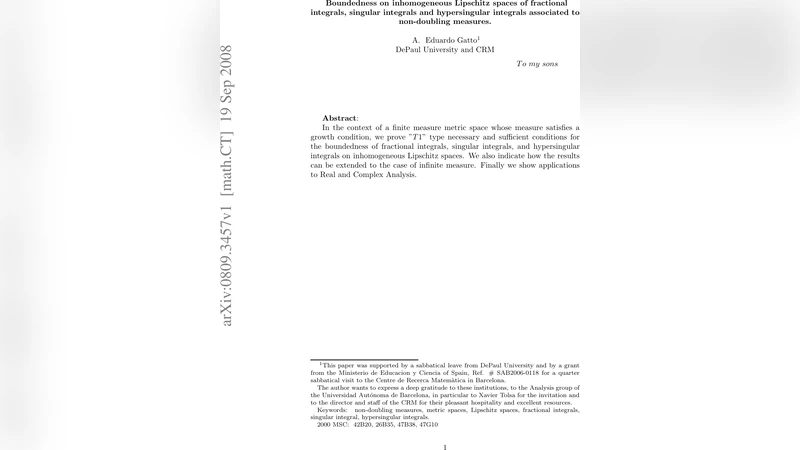
In the context of a finite measure metric space whose measure satisfies a growth condition, we prove “T1” type necessary and sufficient conditions for the boundedness of fractional integrals, singular integrals, and hypersingular integrals on inhomogeneous Lipschitz spaces. We also indicate how the results can be extended to the case of infinite measure. Finally we show applications to Real and Complex Analysis.
💡 Research Summary
The paper investigates the boundedness of three classes of integral operators—fractional integrals, singular integrals, and hypersingular integrals—on inhomogeneous Lipschitz spaces when the underlying measure is non‑doubling but satisfies a polynomial growth condition. Working on a metric space (X, d, μ) with a finite Borel measure μ that fulfills μ(B(x, r)) ≤ C rⁿ for all balls, the authors abandon the classical doubling hypothesis and instead develop a framework adapted to the “inhomogeneous” nature of the space.
First, they introduce the inhomogeneous Lipschitz space Λ^α(μ) (0 < α ≤ 1), defined via a pointwise Hölder condition relative to the local scale of μ and a normalization by local averages. The three operators are then defined: the fractional integral I_α with kernel K_α(x, y) ≈ d(x, y)^{α‑n}, a Calderón‑Zygmund singular integral T with a standard size and smoothness kernel, and the hypersingular operator D^β whose kernel behaves like d(x, y)^{‑(n+β)} for β > 0.
The central contribution is a family of “T1‑type” necessary and sufficient conditions for each operator to be bounded on Λ^α(μ) (or on a related space when the order of differentiation changes the Lipschitz exponent). Specifically, for I_α the condition is that both I_α 1 and its adjoint (I_α)^* 1 belong to Λ^α(μ); for T the analogous requirement is T 1, T^* 1 ∈ Λ^α(μ); and for D^β the condition is D^β 1, (D^β)^* 1 ∈ Λ^α(μ) when mapping Λ^{α+β}(μ) → Λ^α(μ). These criteria extend the celebrated T1 theorem of Nazarov‑Treil‑Volberg to the setting of inhomogeneous Lipschitz regularity and non‑doubling measures.
The proofs combine several sophisticated tools: a localized averaging operator adapted to the growth condition, precise kernel estimates that respect the non‑doubling geometry, a non‑homogeneous Calderón‑Zygmund decomposition, and a “good‑λ” argument linking L² bounds to Lipschitz bounds. The authors also treat the case μ(X)=∞ by partitioning the space into an increasing sequence of finite‑measure regions, inserting a suitable weight w(x) = (1+d(x, x₀))^{‑γ} to control contributions from infinity, and showing that the same T1 conditions remain sufficient.
Beyond the abstract theory, the paper presents concrete applications. In real analysis, the authors apply their results to Riesz transforms and higher‑order Riesz potentials, obtaining Sobolev‑type embedding theorems on non‑doubling spaces. In complex analysis, they construct a Cauchy‑type integral operator adapted to μ and prove its boundedness from a non‑homogeneous Hardy space H^p(μ) to BMO(μ), thereby extending classical Hardy–BMO duality to the non‑doubling context. The authors also hint at further extensions to nonlinear PDEs, anomalous diffusion models, and Markov semigroups where non‑doubling measures naturally arise.
In summary, the work delivers a comprehensive T1‑type characterization of boundedness for a broad class of integral operators on inhomogeneous Lipschitz spaces under minimal measure assumptions. It bridges a gap between non‑homogeneous harmonic analysis and Lipschitz regularity theory, provides a robust method for handling infinite measures, and showcases the relevance of the theory through applications in both real and complex analysis. The results open new avenues for research on non‑doubling geometries, especially in the study of singular integrals with variable smoothness and in the analysis of PDEs on irregular metric measure spaces.
Comments & Academic Discussion
Loading comments...
Leave a Comment