RCF1: Theories of PR Maps and Partial PR Maps
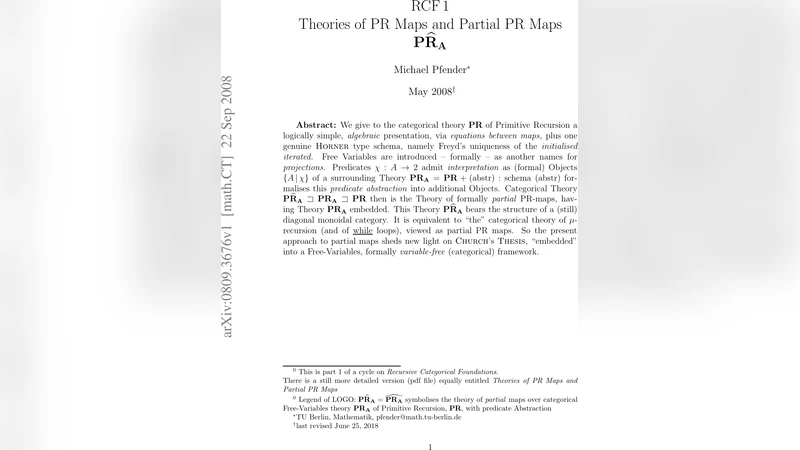
We give to the categorical theory PR of Primitive Recursion a logically simple, algebraic presentation, via equations between maps, plus one genuine Horner type schema, namely Freyd’s uniqueness of the initialised iterated. Free Variables are introduced - formally - as another names for projections. Predicates \chi: A -> 2 admit interpretation as (formal) Objects {A|\chi} of a surrounding Theory PRA = PR + (abstr) : schema (abstr) formalises this predicate abstraction into additional Objects. Categorical Theory P\hat{R}_A \sqsupset PR_A \sqsupset PR then is the Theory of formally partial PR-maps, having Theory PR_A embedded. This Theory P\hat{R}_A bears the structure of a (still) diagonal monoidal category. It is equivalent to “the” categorical theory of \mu-recursion (and of while loops), viewed as partial PR maps. So the present approach to partial maps sheds new light on Church’s Thesis, “embedded” into a Free-Variables, formally variable-free (categorical) framework.
💡 Research Summary
The paper presents a streamlined algebraic formulation of the categorical theory of Primitive Recursion (PR). Instead of the traditional, often cumbersome logical presentation, the author reduces PR to a system of equations between maps together with a single Horner‑type schema—Freyd’s uniqueness of the initialized iterated. This minimalistic core already captures the full computational power of PR while remaining syntactically simple.
A key innovation is the treatment of free variables. Rather than introducing a separate syntactic layer for variables, the paper identifies free variables with projection maps. In categorical terms, a projection π_i: A₁×…×A_n → A_i plays the role of a variable placeholder, allowing the whole framework to stay “variable‑free.” This approach yields a clean, purely diagrammatic language for defining recursive functions.
The second major contribution is the abstraction schema (abstr). Predicates χ : A → 2 are interpreted as formal objects {A | χ}. By adjoining these objects to the base PR theory, the author constructs an extended theory PRA = PR + (abstr). PRA thus incorporates logical predicates directly into the object level, turning statements about elements into new objects in the category. This move bridges the gap between algebraic recursion and logical specification.
Building on PRA, the paper defines a theory of formally partial PR maps, denoted P̂R_A. This theory contains PR_A as a sub‑theory but also admits maps that may be undefined on some inputs. To handle partiality coherently, the author equips P̂R_A with the structure of a diagonal monoidal category. The diagonal structure guarantees that the domain and codomain of a partial map can be aligned automatically, making composition of partial maps well‑behaved and preserving the categorical semantics of undefinedness.
A central theorem shows that P̂R_A is equivalent to the canonical categorical theory of μ‑recursion (minimal fixed‑point recursion) and, equivalently, to the categorical semantics of while‑loops. The paper provides explicit constructions translating any μ‑recursive function or while‑loop into a partial PR map and proves that these translations are isomorphisms in the category. Consequently, the expressive power of μ‑recursion and iterative programming constructs is fully captured by partial PR maps.
The final section revisits Church’s Thesis. Traditionally, Church’s Thesis equates effectively computable functions with Turing‑machine computable functions. Within the present framework, the thesis is reformulated: every effectively computable function can be represented as a partial PR map in the variable‑free, categorical setting. Because free variables are projections and predicates become objects, the entire notion of effective computability is internalized in the categorical structure without reference to external syntactic machines. This provides a new, algebraic perspective on the foundations of computability.
The paper is organized as follows. Section 1 motivates the need for a simpler PR presentation. Section 2 formalizes free variables as projections. Section 3 introduces the abstraction schema and builds PRA. Section 4 defines partial PR maps and the diagonal monoidal structure. Section 5 establishes the equivalence between P̂R_A, μ‑recursion, and while‑loops. Section 6 offers the categorical reformulation of Church’s Thesis. Section 7 discusses implications, potential extensions (e.g., to higher‑type recursion or dependent types), and open problems.
Overall, the work achieves a unification of three traditionally separate strands—primitive recursion, partial recursive computation, and logical predicate abstraction—within a single, elegant categorical framework. By doing so, it not only simplifies the foundations of recursive computation but also opens avenues for further categorical investigations into computability, program semantics, and the algebraic structure of algorithms.
Comments & Academic Discussion
Loading comments...
Leave a Comment