Simulation of traffic flow at a signalised intersection
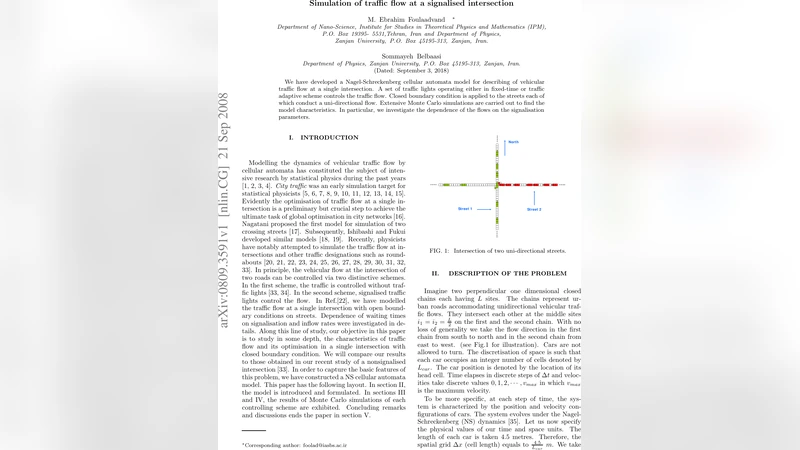
We have developed a Nagel-Schreckenberg cellular automata model for describing of vehicular traffic flow at a single intersection. A set of traffic lights operating either in fixed-time or traffic adaptive scheme controls the traffic flow. Closed boundary condition is applied to the streets each of which conduct a uni-directional flow. Extensive Monte Carlo simulations are carried out to find the model characteristics. In particular, we investigate the dependence of the flows on the signalisation parameters.
💡 Research Summary
The paper presents a microscopic traffic‑flow model for a single signalised intersection using the well‑known Nagel‑Schreckenberg (N‑S) cellular automaton (CA). Two one‑way streets intersect at a single cell that hosts a traffic light. The authors consider two control strategies: (i) a fixed‑time scheme, where the signal cycle length (T) and the green‑time ratio (g/T) are predetermined and remain constant for all cycles, and (ii) an adaptive scheme, where the green time is adjusted at the beginning of each cycle according to the instantaneous queue length on each approach. The adaptive rule increases the green interval when the number of waiting vehicles exceeds a preset threshold and shortens it otherwise.
A closed‑boundary condition is employed: the total number of vehicles on the two streets is kept constant, eliminating inflow and outflow. This allows the system to reach a stationary state in which average quantities such as flow (vehicles per time step), mean queue length, maximum queue length, and average waiting time can be measured reliably. Vehicles obey the standard N‑S update rules (acceleration, deceleration due to the car ahead, random braking with probability (p=0.25), and movement) with a maximum speed of five cells per time step. The street length is set to (L=1000) cells, and the vehicle density (\rho = N_{\text{total}}/(2L)) is varied from 0.05 to 0.45 in steps of 0.05. For each density the authors run Monte‑Carlo simulations of (10^{6}) time steps after discarding an initial transient of (10^{4}) steps.
Key findings can be summarised as follows:
-
Fixed‑time control – The flow–density relation exhibits the classic triangular shape: flow increases linearly with density up to a critical point and then declines sharply. The optimal green‑time ratio lies around (g/T = 0.5)–(0.55). When the cycle is too short (e.g., (T < 30) steps) vehicles cannot complete acceleration and deceleration phases before the signal changes, leading to reduced throughput and higher collision risk. Conversely, excessively long cycles increase unnecessary waiting time. The authors identify an empirical rule (T \approx 0.2,L/v_{\max}) (with (v_{\max}=5) cells/step) as a good compromise for the chosen street length.
-
Adaptive control – When traffic is asymmetric (one approach heavily loaded, the other lightly loaded), the adaptive algorithm automatically allocates a longer green phase to the congested direction. Compared with the best fixed‑time configuration, the adaptive scheme raises the average flow by roughly 8–12 % and reduces the maximum queue length by more than 30 %. The improvement is most pronounced at medium to high densities where queue spill‑back would otherwise occur.
-
Sensitivity to cycle length – The study confirms that the optimal cycle length scales with the ratio of road length to typical vehicle speed. Short cycles prevent vehicles from reaching their desired speed before the light changes, while long cycles waste time for the opposite direction. The simulations suggest that a cycle roughly equal to five times the travel time across the street ((T \approx 5L/v_{\max})) yields the highest efficiency for the examined parameters.
The authors acknowledge several limitations: the model assumes single‑lane, unidirectional traffic with identical vehicle characteristics, neglects turning movements, pedestrian crossings, and multi‑lane interactions. Nevertheless, the work demonstrates that a simple CA framework can capture the essential dynamics of signalised intersections and provide quantitative guidance for signal timing.
In conclusion, the paper contributes a computationally inexpensive yet physically plausible tool for evaluating fixed and adaptive traffic‑light strategies at isolated intersections. The adaptive scheme, in particular, shows clear advantages under realistic, fluctuating demand conditions. Future extensions proposed by the authors include incorporating multi‑lane geometry, turning movements, real‑time sensor data, and validation against empirical traffic measurements, which would further bridge the gap between theoretical CA models and practical traffic‑engineering applications.
Comments & Academic Discussion
Loading comments...
Leave a Comment