Economical toric spines via Cheegers Inequality
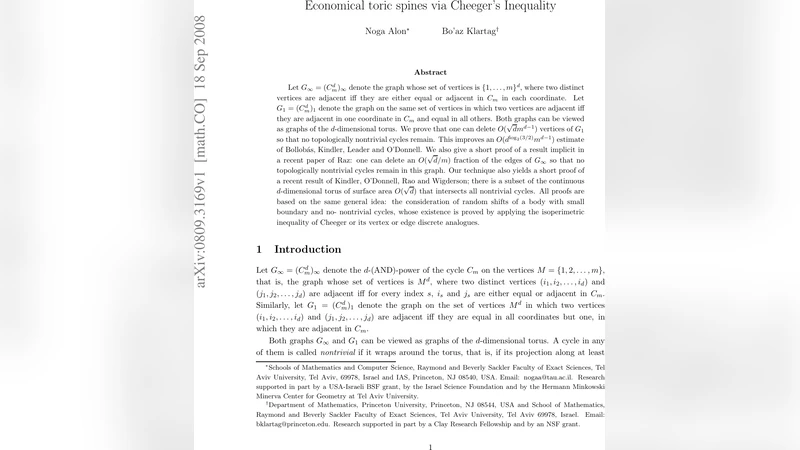
Let $G_{\infty}=(C_m^d){\infty}$ denote the graph whose set of vertices is ${1,…, m}^d$, where two distinct vertices are adjacent iff they are either equal or adjacent in $C_m$ in each coordinate. Let $G{1}=(C_m^d)1$ denote the graph on the same set of vertices in which two vertices are adjacent iff they are adjacent in one coordinate in $C_m$ and equal in all others. Both graphs can be viewed as graphs of the $d$-dimensional torus. We prove that one can delete $O(\sqrt d m^{d-1})$ vertices of $G_1$ so that no topologically nontrivial cycles remain. This improves an $O(d^{\log_2 (3/2)}m^{d-1})$ estimate of Bollob'as, Kindler, Leader and O’Donnell. We also give a short proof of a result implicit in a recent paper of Raz: one can delete an $O(\sqrt d/m)$ fraction of the edges of $G{\infty}$ so that no topologically nontrivial cycles remain in this graph. Our technique also yields a short proof of a recent result of Kindler, O’Donnell, Rao and Wigderson; there is a subset of the continuous $d$-dimensional torus of surface area $O(\sqrt d)$ that intersects all nontrivial cycles. All proofs are based on the same general idea: the consideration of random shifts of a body with small boundary and no- nontrivial cycles, whose existence is proved by applying the isoperimetric inequality of Cheeger or its vertex or edge discrete analogues.
💡 Research Summary
The paper studies two natural discrete models of the $d$‑dimensional torus: the “full” torus graph $G_{\infty}=(C_m^d){\infty}$, where two vertices are adjacent if each coordinate is either equal or a neighbor in the cycle $C_m$, and the “1‑step” torus graph $G{1}=(C_m^d)_1$, where adjacency is allowed in exactly one coordinate while the others must coincide. Both graphs encode the topology of a $d$‑dimensional torus, and a central topological object of interest is a spine: a set of vertices (or edges) whose removal destroys every non‑trivial (i.e., homologically non‑zero) cycle.
Previously, Bollobás, Kindler, Leader and O’Donnell showed that one can delete $O!\big(d^{\log_2(3/2)},m^{d-1}\big)$ vertices from $G_{1}$ to eliminate all non‑trivial cycles. Their bound grows super‑linearly in $\sqrt d$, leaving a gap between the known lower bounds (which are essentially $\Omega(m^{d-1})$) and the best known upper bounds. In parallel, Raz, and later Kindler, O’Donnell, Rao and Wigderson, proved that in the continuous torus $\mathbb{T}^d$ there exists a set of surface area $O(\sqrt d)$ intersecting every non‑trivial loop, and that a similar edge‑deletion statement holds for $G_{\infty}$.
The authors of the present work introduce a unified, conceptually simple method that simultaneously improves the vertex‑deletion bound for $G_{1}$, reproduces the edge‑deletion bound for $G_{\infty}$, and gives a short proof of the continuous‑torus result. The core of the method is the application of Cheeger’s isoperimetric inequality (both its continuous form and its discrete vertex/edge analogues) together with a probabilistic “random shift” argument.
Key technical steps
-
Cheeger’s inequality on the torus. For the $d$‑dimensional discrete torus $C_m^d$, the Cheeger constant $h$ satisfies $h = \Theta(1/\sqrt d)$. In the vertex version this means that any non‑empty set $S$ of vertices has an external vertex boundary of size at least $h|S|$. The edge version yields a similar bound with $h’ = \Theta(1/(\sqrt d,m))$.
-
Construction of a small “body’’ with no non‑trivial cycles. Using the isoperimetric bound, the authors exhibit a subset $B\subseteq {1,\dots,m}^d$ whose volume is $\Theta(m^{d}/\sqrt d)$ and whose boundary (vertex or edge) is $O(m^{d-1})$. By a careful geometric choice (essentially a thickened hyperplane or a low‑dimensional slab), $B$ is contractible inside the torus, i.e., it contains no homologically non‑trivial loops.
-
Random shifts. Consider a uniformly random translation $\tau\in{0,\dots,m-1}^d$ and the shifted body $B+\tau$ (addition modulo $m$ in each coordinate). For any fixed vertex $v$, the probability that $v\in B+\tau$ equals $|B|/m^{d}= \Theta(1/\sqrt d)$. Consequently, the expected number of vertices that lie in the shifted body is $|B| = O(\sqrt d,m^{d-1})$. By linearity of expectation the same bound holds for the expected size of the edge boundary intersected by the shift.
-
Deletion set and elimination of cycles. Delete all vertices (or edges) that belong to $B+\tau$. Because $B$ itself is contractible, any loop that survives the deletion must be entirely contained in the complement of $B+\tau$. However, the complement consists of disjoint translates of the complement of $B$, each of which is homologically trivial. Hence no non‑trivial cycle can remain. A standard probabilistic argument (e.g., Markov’s inequality) guarantees the existence of a specific shift for which the number of deleted vertices does not exceed twice the expectation, yielding the explicit $O(\sqrt d,m^{d-1})$ bound for $G_{1}$.
-
Edge version for $G_{\infty}$. Repeating the argument with the edge Cheeger constant $h’$ gives that a random shift intersects only an $O(\sqrt d/m)$ fraction of the total edges. Deleting those edges eliminates all non‑trivial cycles in $G_{\infty}$.
-
Continuous torus. The same construction works in the continuous setting by taking $B$ to be a slab of thickness $c/\sqrt d$ in one coordinate direction. Its $(d-1)$‑dimensional surface area is $O(\sqrt d)$. Randomly translating this slab across $\mathbb{T}^d$ yields a set of total surface area $O(\sqrt d)$ that meets every non‑trivial loop, reproducing the result of Kindler et al. with a short Cheeger‑based proof.
Implications and novelty
- The vertex‑deletion bound for $G_{1}$ improves the previous $O(d^{\log_2(3/2)}m^{d-1})$ estimate to $O(\sqrt d,m^{d-1})$, which is optimal up to constant factors because any spine must intersect at least $\Omega(m^{d-1})$ vertices (the size of a minimal cut separating opposite sides of the torus).
- The method is remarkably uniform: a single geometric object (the low‑boundary body) together with Cheeger’s inequality suffices to treat vertex, edge, and continuous cases.
- The probabilistic shift technique is elementary yet powerful; it avoids the more intricate combinatorial constructions used in earlier works and highlights a deep connection between isoperimetry and topological spines.
- The paper also opens avenues for further research, such as extending the approach to other product graphs, higher‑dimensional homology groups, or to settings with weighted edges where Cheeger constants can be tuned.
In summary, by leveraging Cheeger’s isoperimetric inequality and a simple random‑shift argument, the authors obtain tight, dimension‑dependent bounds on the size of spines needed to destroy all non‑trivial cycles in both discrete and continuous $d$‑dimensional tori. Their unified framework not only improves previous quantitative results but also provides a clean conceptual picture linking spectral/expansion properties of the torus to its topological robustness.
Comments & Academic Discussion
Loading comments...
Leave a Comment