D-branes and bivariant K-theory
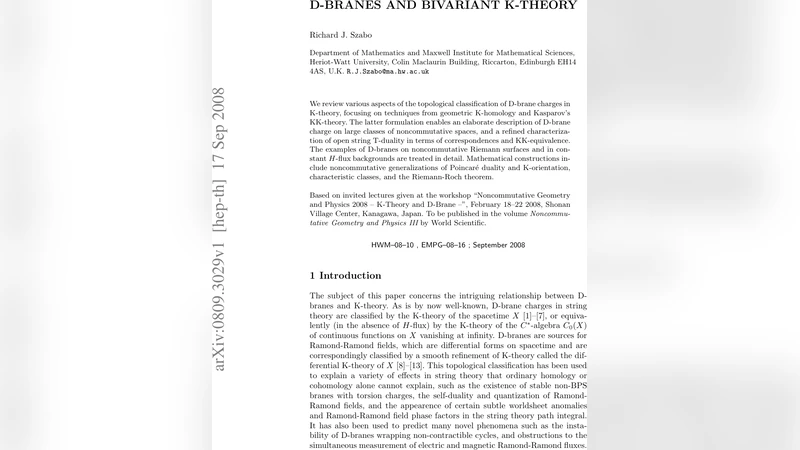
We review various aspects of the topological classification of D-brane charges in K-theory, focusing on techniques from geometric K-homology and Kasparov’s KK-theory. The latter formulation enables an elaborate description of D-brane charge on large classes of noncommutative spaces, and a refined characterization of open string T-duality in terms of correspondences and KK-equivalence. The examples of D-branes on noncommutative Riemann surfaces and in constant H-flux backgrounds are treated in detail. Mathematical constructions include noncommutative generalizations of Poincare duality and K-orientation, characteristic classes, and the Riemann-Roch theorem.
💡 Research Summary
The paper provides a comprehensive review of how D‑brane charges are classified topologically using K‑theory, and it extends this classification to a wide variety of non‑commutative spaces by employing geometric K‑homology and Kasparov’s bivariant K‑theory (KK‑theory). After recalling the standard picture—where D‑brane world‑volumes are spin^c submanifolds and their charges are elements of K‑homology—the authors introduce the notion of a K‑orientation, which guarantees charge conservation and enables a Poincaré duality between K‑homology and K‑theory.
The core of the work is the deployment of KK‑theory. A KK‑class between two C∗‑algebras A and B encodes a correspondence that, in string‑theoretic language, represents an open‑string sector linking two background geometries. This correspondence acts as a homomorphism on K‑theory groups, allowing one to transport D‑brane charge across different backgrounds. Crucially, KK‑equivalence captures the mathematical essence of open‑string T‑duality: two non‑commutative backgrounds are T‑dual precisely when they are KK‑equivalent, ensuring that the charge lattices are isomorphic.
The authors illustrate the formalism with two detailed examples. First, they treat non‑commutative Riemann surfaces obtained by deforming a two‑torus with a constant θ‑parameter. The K‑theory of the non‑commutative torus, K⁰(T²_θ) and K¹(T²_θ), depends on θ, yet a specific KK‑element implements an isomorphism with the ordinary torus, thereby realizing T‑duality at the level of charges. Second, they analyze backgrounds with a constant H‑flux (a closed three‑form). The presence of H twists the K‑theory to a twisted K‑group K⁎(X, H). The paper defines a twisted K‑orientation and constructs a twisted Chern character mapping twisted K‑theory to non‑commutative cyclic cohomology. Using these tools, a non‑commutative version of the Riemann‑Roch theorem is proved, showing how the Todd class must be modified in the presence of both non‑commutativity and H‑flux.
On the mathematical side, the authors develop a non‑commutative Poincaré duality: for a non‑commutative algebra A there exists a dualizing element D_A ∈ KK(A⊗Aᵒᵖ, ℂ) that yields a perfect pairing between K∗(A) and K∗(Aᵒᵖ). This duality underlies the definition of characteristic classes in the non‑commutative setting, obtained via Connes’ differential calculus and the non‑commutative Chern‑Weil construction. The paper also discusses how these characteristic classes enter the generalized Riemann‑Roch formula, providing a bridge between geometric index theory and string‑theoretic charge formulas.
In the concluding section, the authors outline future directions: the formulation of relative D‑brane charges using KK‑theory, connections with non‑commutative modular forms, and potential extensions to M‑theory where higher‑degree fluxes generate even richer non‑commutative geometries. Overall, the work demonstrates that KK‑theory supplies a robust and flexible framework for describing D‑brane charge on both commutative and non‑commutative spaces, and it clarifies the precise mathematical structure behind open‑string T‑duality.
Comments & Academic Discussion
Loading comments...
Leave a Comment