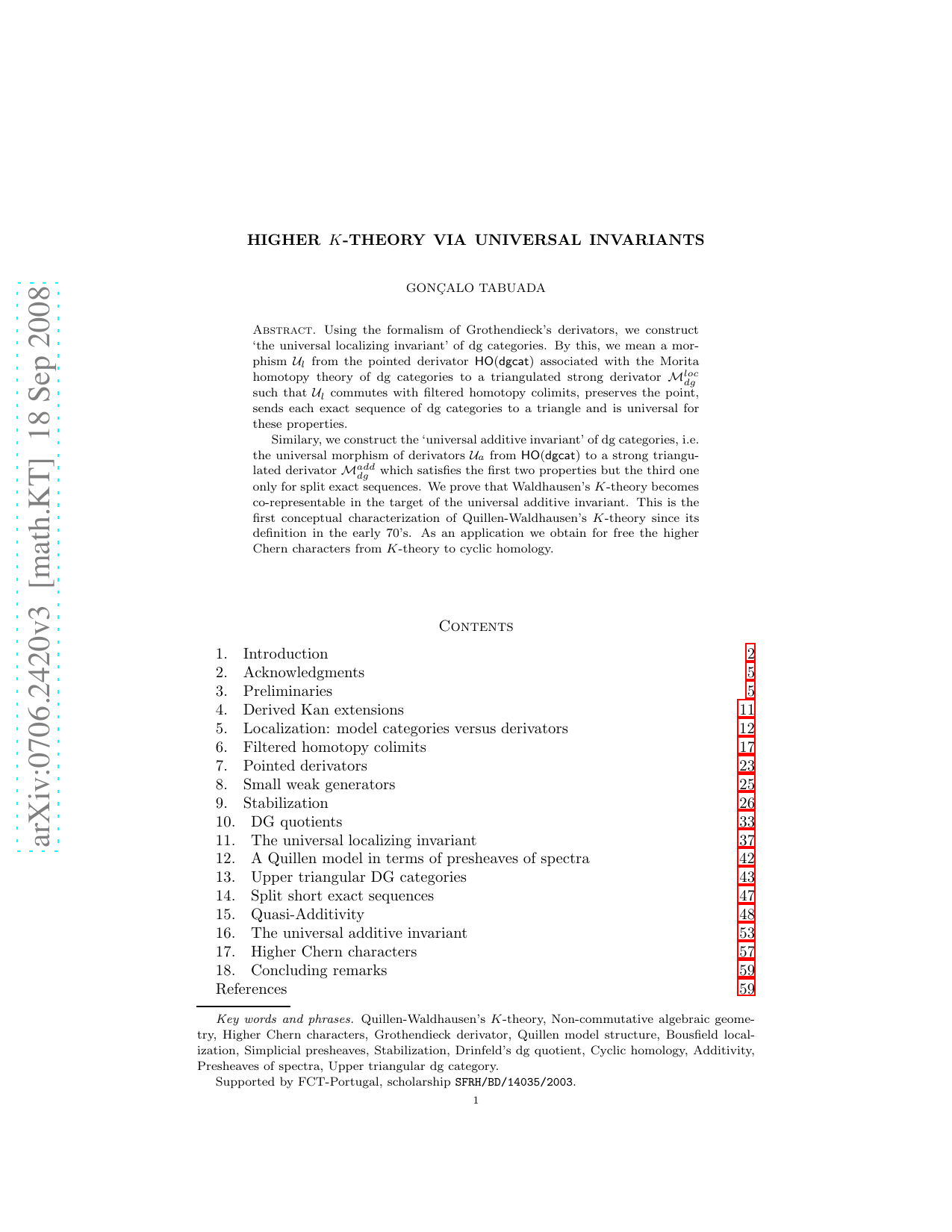
Using the formalism of Grothendieck's derivators, we construct `the universal localizing invariant of dg categories'. By this, we mean a morphism U_l from the pointed derivator associated with the Morita homotopy theory of dg categories to a triangulated strong derivator M^loc such that U_l commutes with filtered homotopy colimits, preserves the point, sends each exact sequence of dg categories to a triangle and is universal for these properties. Similary, we construct the `the universal additive invariant of dg categories', i.e. the universal morphism of derivators U_a to a strong triangulated derivator M^add which satisfies the first two properties but the third one only for split exact sequences. We prove that Waldhausen K-theory appears as a mapping space in the target of the universal additive invariant. This is the first conceptual characterization of Quillen-Waldhausen's K-theory since its definition in the early 70's. As an application we obtain for free the higher Chern characters from K-theory to cyclic homology.
Deep Dive into Higher K-theory via universal invariants.
Differential graded categories (=dg categories) enhance our understanding of triangulated categories appearing in algebra and geometry, see [19].
They are considered as non-commutative schemes by Drinfeld [9] [10] and Kontsevich [23] [24] in their program of non-commutative algebraic geometry, i.e. the study of dg categories and their homological invariants.
In this article, using the formalism of Grothendieck’s derivators, we construct ’the universal localizing invariant’ of dg categories cf. [21]. By this, we mean a morphism U l from the pointed derivator HO(dgcat) associated with the Morita homotopy theory of dg categories, see [37] [38] [39], to a triangulated strong derivator M loc dg such that U l commutes with filtered homotopy colimits, preserves the point, sends each exact sequence of dg categories to a triangle and is universal for these properties. Because of its universality property reminiscent of motives, see section 4.1 of Kontsevich’s preprint [25], we call M loc dg the (stable) localizing motivator of dg categories.
Similary, we construct ’the universal additive invariant’ of dg categories, i.e. the universal morphism of derivators U a from HO(dgcat) to a strong triangulated derivator M add dg which satisfies the first two properties but the third one only for split exact sequences. We call M add dg the additive motivator of dg categories. We prove that Waldhausen’s K-theory spectrum appears as a spectrum of morphisms in the base category M add dg (e) of the additive motivator. This shows us that Waldhausen’s K-theory is completely characterized by its additive property and ‘intuitively’ it is the universal construction with values in a stable context which satisfies additivity.
To the best of the author’s knowledge, this is the first conceptual characterization of Quillen-Waldhausen’s K-theory [34] [44] since its definition in the early 70’s. This result gives us a completely new way to think about algebraic K-theory and furnishes us for free the higher Chern characters from K-theory to cyclic homology [26].
The co-representation of K-theory as a spectrum of morphisms extends our results in [37] [38], where we co-represented K 0 using functors with values in additive categories rather than morphisms of derivators with values in strong triangulated derivators.
For example, the mixed complex construction [22], from which all variants of cyclic homology can be deduced, and the non-connective algebraic K-theory [35] are localizing invariants and factor through U l and through U a . The connective algebraic K-theory [44] is an example of an additive invariant which is not a localizing one. We prove that it becomes co-representable in M add dg , see theorem 16.10. Our construction is similar in spirit to those of Meyer-Nest [31], Cortiñas-Thom [8] and Garkusha [12]. It splits into several general steps and also offers some insight into the relationship between the theory of derivators [14] [13] [20] [29] [3] and the classical theory of Quillen model categories [33]. Derivators allow us to state and prove precise universal properties and to dispense with many of the technical problems one faces in using model categories.
In chapter 3 we recall the notion of Grothendieck derivator and point out its connexion with that of small homotopy theory in the sense of Heller [14]. In chapter 4, we recall Cisinski’s theory of derived Kan extensions [4] and in chapter 5, we develop his ideas on the Bousfield localization of derivators [7]. In particular, we characterize the derivator associated with a left Bousfield localization of a Quillen model category by a universal property, see theorem 5.4. This is based on a constructive description of the local weak equivalences.
In chapter 6, starting from a Quillen model category M satisfying some compactness conditions, we construct a morphism of prederivators
Rh -→ L Σ Hot M f which commutes with filtered homotopy colimits, has a derivator as target and is universal for these properties. In chapter 7 we study morphisms of pointed derivators and in chapter 8 we prove a general result which garantees that small weak generators are preserved under left Bousfield localizations. In chapter 9, we recall Heller’s stabilization construction [14] and we prove that this construction takes ‘finitely generated’ unstable theories to compactly generated stable ones. We establish the connection between Heller’s stabilization and Hovey/Schwede’s stabilization [17] [36] by proving that if we start with a pointed Quillen model category which satisfies some mild ‘generation’ hypotheses, then the two stabilization procedures yield equivalent results. This allows us to characterize Hovey/Schwede’s construction by a universal property and in particular to give a very simple characterisation of the classical category of spectra in the sense of Bousfield-Friedlander [2]. In chapter 10, by applying the general arguments of the previous chapters to the Morita homotopy theor
…(Full text truncated)…
This content is AI-processed based on ArXiv data.