First echoes of relativity in Argentine astronomy
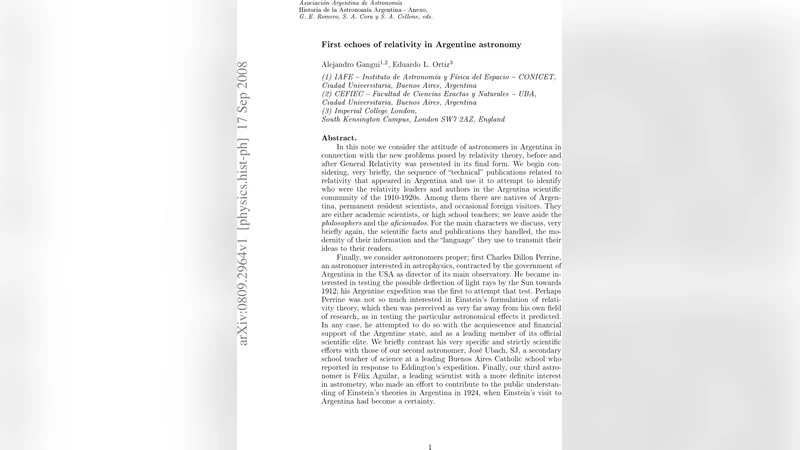
We consider the attitude of astronomers in Argentina in connection with the new problems posed by relativity theory, before and after GR was presented. We begin considering the sequence of “technical” publications that appeared and use it to attempt to identify who were the relativity leaders and authors in the Argentina scientific community of the 1910-1920s. Among them there are natives of Argentina, permanent resident scientists, and occasional foreign visitors. They are either academic scientists, or high school teachers; we leave aside the {\it philosophers} and the {\it aficionados}. We discuss the scientific facts and publications they handled, the modernity of their information and the “language” they use to transmit their ideas. Finally, we consider astronomers proper; first Charles Perrine, an astronomer interested in astrophysics, contracted by the government of Argentina in the USA as director of its main observatory. He became interested in testing the possible deflection of light rays by the Sun towards 1912; his Argentine expedition was the first to attempt that test. Perhaps Perrine was not so much interested in relativity as in testing the particular astronomical effects it predicted. In any case, he attempted the test with the acquiescence and financial support of the Argentine state, and as a leading member of its official scientific elite. We contrast his very specific and strictly scientific efforts with those of our second astronomer, Jos'e Ubach, SJ, a secondary school teacher of science at a leading Buenos Aires Catholic school who reported in response to Eddington’s expedition. Finally, our third astronomer is F'elix Aguilar, who made an effort to contribute to the public understanding of Einstein’s theories in 1924, when Einstein’s visit to Argentina had become a certainty. [abridged]
💡 Research Summary
The paper investigates how Argentine astronomers and science educators responded to the challenges posed by Einstein’s relativity theory during the decade spanning the pre‑ and post‑General Relativity (GR) era, roughly 1910‑1920. By first cataloguing the “technical” publications that appeared in Argentine scientific journals, the author maps the network of native scholars, resident foreign scientists, and occasional visitors who formed the country’s scientific elite. The study deliberately excludes philosophers and amateur enthusiasts, focusing instead on professional astronomers and teachers who directly engaged with the new physics. Three principal figures are examined in depth.
Charles Perrine, an American astronomer hired by the Argentine government to direct the National Observatory, is presented as the first to attempt an empirical test of light‑deflection by the Sun in 1912. Perrine’s motivation was primarily astrophysical: he sought to verify a specific astronomical effect predicted by the emerging theory, rather than to champion relativity itself. The paper details the instrumentation (fixed‑mount telescopes, photographic plates, timing devices), the logistical organization of the Argentine expedition, and the statistical treatment of the data. Perrine’s work illustrates how state‑funded observational programs could be mobilised to address cutting‑edge theoretical predictions, even when the underlying theory was still controversial.
The second case is José Ubach, SJ, a secondary‑school science teacher at a leading Catholic school in Buenos Aires. Following Eddington’s 1919 eclipse expedition, Ubach reported the results in local newspapers and communicated them to Argentine scientific circles. His writings translate the abstract notion of spacetime curvature into pedagogical language, using analogies and simplified mathematics suitable for students and the educated public. Ubach’s activity demonstrates the role of educators as intermediaries who bridge the gap between professional research and popular understanding, and it highlights the early diffusion of relativistic ideas through the school system and the press.
The third figure, Félix Aguilar, emerges in the mid‑1920s as a public‑facing astronomer eager to prepare the Argentine audience for Einstein’s imminent visit in 1924. Aguilar authored popular articles, delivered public lectures, and linked contemporary observational findings—such as stellar red‑shift and early hints of cosmic expansion—to Einstein’s theory. His efforts represent a deliberate attempt to frame relativity not merely as a scientific curiosity but as a cornerstone of modern cosmology, thereby enhancing the cultural prestige of Argentine science.
Through comparative analysis of these three careers, the paper argues that Argentina’s scientific community displayed a layered response to relativity: a technically rigorous, state‑supported test by an institutional astronomer; a pedagogical translation by a schoolteacher; and a public‑engagement campaign by a popularizer. The study also examines the linguistic strategies employed—technical jargon in journal articles, didactic analogies in textbooks, and accessible metaphors in newspaper columns—to show how the same scientific content was adapted for distinct audiences.
Finally, the author situates these developments within broader national policies that promoted scientific modernization, foreign expertise, and cultural prestige. Government funding enabled Perrine’s expedition; educational reforms supported Ubach’s curriculum integration; and diplomatic initiatives facilitated Einstein’s visit, providing a platform for Aguilar’s outreach. The paper concludes that the early Argentine encounters with relativity were not merely intellectual curiosities but integral components of a nation‑building project that sought to align Argentina with the forefront of contemporary physics and to cultivate a modern scientific identity.
Comments & Academic Discussion
Loading comments...
Leave a Comment