A Cartan-Eilenberg approach to Homotopical Algebra
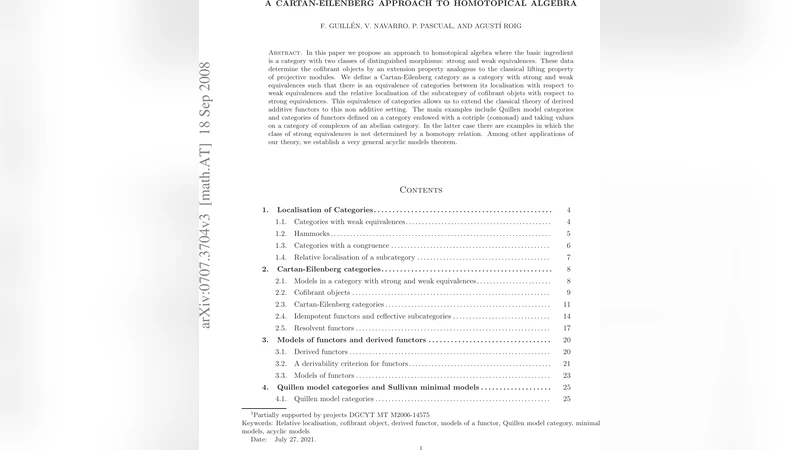
In this paper we propose an approach to homotopical algebra where the basic ingredient is a category with two classes of distinguished morphisms: strong and weak equivalences. These data determine the cofibrant objects by an extension property analogous to the classical lifting property of projective modules. We define a Cartan-Eilenberg category as a category with strong and weak equivalences such that there is an equivalence between its localization with respect to weak equivalences and the localised category of cofibrant objets with respect to strong equivalences. This equivalence allows us to extend the classical theory of derived additive functors to this non additive setting. The main examples include Quillen model categories and functor categories with a triple, in the last case we find examples in which the class of strong equivalences is not determined by a homotopy relation. Among other applications, we prove the existence of filtered minimal models for \emph{cdg} algebras over a zero-characteristic field and we formulate an acyclic models theorem for non additive functors.
💡 Research Summary
The paper introduces a novel categorical framework for homotopical algebra based on a category equipped with two distinguished classes of morphisms: strong equivalences and weak equivalences. Strong equivalences are not required to arise from an explicit homotopy relation; they are simply a class of morphisms that satisfy an “extension property” reminiscent of the lifting property of projective modules. Weak equivalences form a broader notion of homotopical sameness. Using the extension property, the authors define cofibrant objects: an object X is cofibrant if for every strong equivalence p : Y → Z and every morphism f : X → Z there exists a morphism g : X → Y with p ∘ g = f. This mirrors the classical projective lifting condition but works in any category with the two distinguished classes.
A “Cartan‑Eilenberg category” is then defined as a triple (C, S, W) where S is the class of strong equivalences and W the class of weak equivalences, satisfying two key conditions. First, the localization of C with respect to weak equivalences, C
Comments & Academic Discussion
Loading comments...
Leave a Comment