On the vertices of the k-addiive core
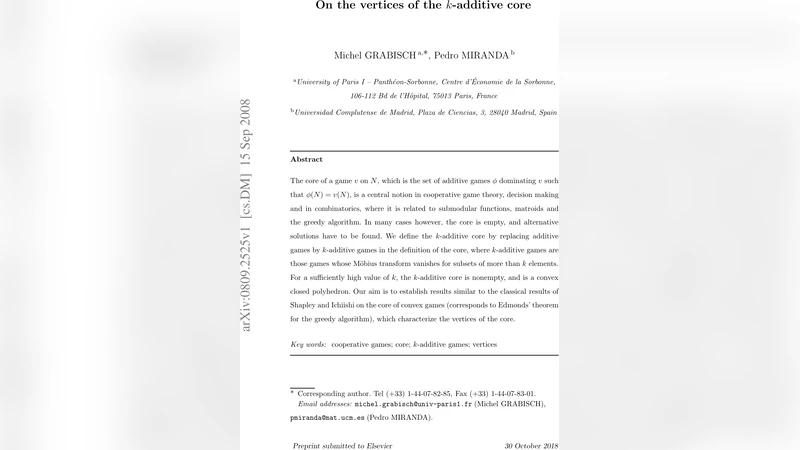
The core of a game $v$ on $N$, which is the set of additive games $\phi$ dominating $v$ such that $\phi(N)=v(N)$, is a central notion in cooperative game theory, decision making and in combinatorics, where it is related to submodular functions, matroids and the greedy algorithm. In many cases however, the core is empty, and alternative solutions have to be found. We define the $k$-additive core by replacing additive games by $k$-additive games in the definition of the core, where $k$-additive games are those games whose M"obius transform vanishes for subsets of more than $k$ elements. For a sufficiently high value of $k$, the $k$-additive core is nonempty, and is a convex closed polyhedron. Our aim is to establish results similar to the classical results of Shapley and Ichiishi on the core of convex games (corresponds to Edmonds’ theorem for the greedy algorithm), which characterize the vertices of the core.
💡 Research Summary
The paper addresses a fundamental limitation of the classical core in cooperative game theory: for many games the set of additive allocations that dominate the worth of every coalition and exactly distribute the grand coalition’s value is empty. To overcome this, the authors replace additive games with k‑additive games, i.e., games whose Möbius transform (the Harsanyi dividends) vanishes for all subsets larger than k. The resulting object, the k‑additive core Cₖ(v), consists of all k‑additive allocations φ that satisfy φ(S) ≥ v(S) for every coalition S ⊂ N and φ(N) = v(N).
First, the authors prove that for sufficiently large k (in particular k ≥ |N| − 1) the k‑additive core is never empty. This follows from the fact that the linear system defining Cₖ(v) has enough degrees of freedom when the Möbius coefficients of order > k are forced to zero, guaranteeing a feasible solution. Consequently, Cₖ(v) is a closed, convex polyhedron, just like the classical core.
The central contribution is a complete characterization of the extreme points (vertices) of Cₖ(v). In the classical setting, Shapley and Ichiishi showed that for convex (sub‑modular) games the core’s vertices are precisely the allocations obtained by ordering the players and taking cumulative marginal contributions (the “Shapley‑Ichiishi” vertices). The authors generalize this result: they define k‑additive marginal contributions as the Möbius coefficients m_v(S) for |S| ≤ k, and prove that every vertex of Cₖ(v) can be written as
φ_T = ∑{S⊆T, |S|≤k} m_v(S)·𝟙{σ(S)⊆T}
for some permutation σ of the player set. In words, a vertex is obtained by fixing an ordering of the players, then for each coalition T accumulating all k‑additive dividends whose “support” (the set of players involved in the dividend) appears earlier in the ordering.
The paper further establishes necessary and sufficient conditions for such an allocation to be an extreme point. The key condition is that, relative to the chosen permutation, the sequence of k‑additive marginal contributions must be non‑decreasing. This mirrors the monotonicity requirement in the Shapley‑Ichiishi theorem and ensures that the corresponding set of active constraints (the coalitions for which φ(S)=v(S)) defines a full‑dimensional face of the polyhedron.
From an algorithmic perspective, the vertex description yields a constructive method: enumerate permutations (or a suitable subset thereof), compute the cumulative k‑additive dividends, and test the monotonicity condition. For small k the number of possible vertices is modest, allowing exact enumeration; for larger k the problem remains tractable via linear programming because the polyhedron is defined by a polynomial‑size system of inequalities. Moreover, the authors note that the greedy algorithm underlying Edmonds’ theorem for sub‑modular optimization naturally emerges from the permutation‑based construction, providing a bridge between cooperative game theory and combinatorial optimization.
The paper also discusses how the k‑additive core interpolates between known solution concepts. When k = 1, the k‑additive core coincides with the classical additive core; when k = |N| it collapses to the ordinary core (if non‑empty). Thus the framework offers a continuum of increasingly expressive cores, preserving convexity while gradually relaxing the additivity restriction. The authors compare this to the Bayesian core and Pareto‑efficient allocations, highlighting that the k‑additive core retains a linear structure absent in many alternative concepts.
In conclusion, the authors provide a rigorous extension of the Shapley‑Ichiishi vertex theorem to the k‑additive setting, prove non‑emptiness and convexity of the resulting core, and elucidate its combinatorial structure through permutations and k‑additive dividends. This work not only enriches the theoretical landscape of cooperative game theory but also opens avenues for applications in sub‑modular optimization, matroid theory, and the design of fair allocation mechanisms where traditional cores fail to exist.