On consistency of determinants on cubic lattices
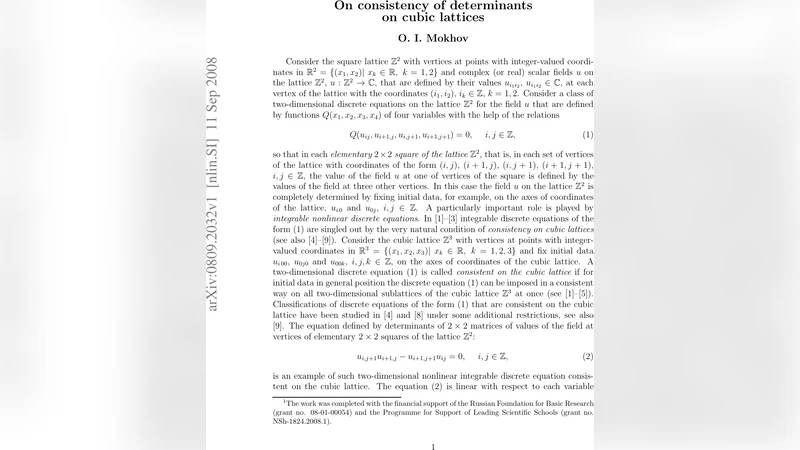
We propose a modified condition of consistency on cubic lattices for some special classes of two-dimensional discrete equations and prove that the discrete nonlinear equations defined by determinants of matrices of orders N > 2 are consistent on cubic lattices in this sense.
💡 Research Summary
The paper investigates the notion of three‑dimensional (3‑D) consistency for discrete nonlinear equations defined on a square lattice ℤ² by means of determinants of matrices built from the field values at the vertices of elementary squares. The classical consistency condition, introduced in the integrable‑discrete‑equation literature, requires that a given 2‑D equation can be imposed simultaneously on all 2‑D coordinate planes of the cubic lattice ℤ³ without contradiction. For the simplest case, the 2×2 determinant equation
u_{i,j+1} u_{i+1,j} − u_{i+1,j+1} u_{i,j}=0 (2)
this condition holds, and the equation is linearizable by a logarithmic transformation, which explains its integrability.
When the determinant order is increased to N > 2, the standard 3‑D consistency fails. In a unit cube the three faces meeting at the corner (2,2,2) each give a different expression for the value at that corner, leading to an over‑determined system. The authors therefore propose a modified consistency requirement: the equation must be satisfied not only on each flat 2‑D sub‑lattice but also on any union of two intersecting 2‑D sub‑lattices, i.e., on “bent” elementary 3×3 squares that turn a right angle from one plane to another. This relaxed condition still captures the essential idea that the equation can be extended consistently throughout the 3‑D lattice while allowing more flexibility.
The paper first treats the N = 3 case, where the discrete equation is given by the vanishing of the 3×3 determinant (equation 4). This equation is linear in each variable and invariant under the full symmetry group of the 3×3 vertex configuration. By prescribing initial data on 12 lattice points (e.g., u_{i00}, u_{i01}, u_{2j0}, u_{2j1}, u_{10k}, u_{20k}, u_{110}, u_{112}) and propagating the values along the faces of a unit cube, the authors show that the value at the opposite corner u_{222} obtained from two different faces coincides. Hence the 3×3 determinant equation satisfies the new “two‑plane‑intersection” consistency; this is formalized as Theorem 1.
The main contribution is Theorem 2, which extends the result to arbitrary determinant order N. The proof proceeds by induction on N, exploiting two key properties of determinant‑type equations: (i) linearity in each field variable, and (ii) full symmetry under permutations of the vertices of an N×N elementary square. Assuming the consistency holds for order N − 1, the authors demonstrate that the additional row and column introduced at order N do not create contradictions when the equation is imposed on any pair of intersecting planes. Consequently, for any integer N ≥ 2, the discrete nonlinear equation defined by the vanishing of the N×N determinant of the field values is consistent on the cubic lattice in the modified sense.
The significance of these results lies in showing that the classical 3‑D consistency condition is overly restrictive for determinant‑type equations of higher order, while the proposed weakened condition still guarantees a robust form of multidimensional compatibility. This opens the way to a broader class of integrable (or at least multidimensionally compatible) discrete equations, extending the known classification of “consistent‑around‑the‑cube” systems. Moreover, the determinant equations retain useful algebraic features—linearity, full symmetry, and logarithmic linearizability—that make them attractive for further study, such as constructing Lax pairs, exploring reductions to known integrable maps, or applying them to physical lattice models (e.g., discrete Laplace equations, lattice gauge theories). The paper concludes by suggesting that the new consistency framework could serve as a foundation for systematic classification of higher‑order determinant equations and for uncovering novel integrable structures in multidimensional discrete geometry.
Comments & Academic Discussion
Loading comments...
Leave a Comment