Abstract numeration systems on bounded languages and multiplication by a constant
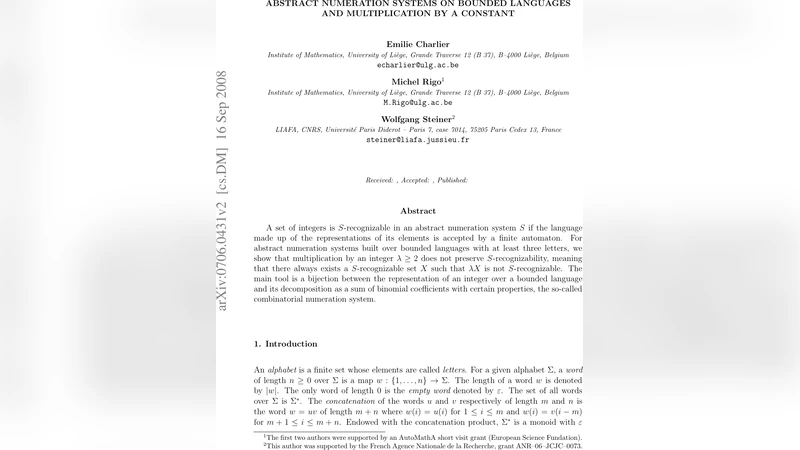
A set of integers is $S$-recognizable in an abstract numeration system $S$ if the language made up of the representations of its elements is accepted by a finite automaton. For abstract numeration systems built over bounded languages with at least three letters, we show that multiplication by an integer $\lambda\ge2$ does not preserve $S$-recognizability, meaning that there always exists a $S$-recognizable set $X$ such that $\lambda X$ is not $S$-recognizable. The main tool is a bijection between the representation of an integer over a bounded language and its decomposition as a sum of binomial coefficients with certain properties, the so-called combinatorial numeration system.
💡 Research Summary
The paper investigates the preservation of recognizability under multiplication in abstract numeration systems built on bounded languages. An abstract numeration system S = (L, Σ, <) consists of an infinite regular language L over a totally ordered alphabet Σ; the (n + 1)‑st word of L in genealogical order (first by length, then lexicographically) is denoted rep_S(n), and its inverse val_S maps a word to the integer it represents. When L = B_ℓ = a₁* a₂* … a_ℓ* (the bounded language over ℓ letters), the system is denoted S_ℓ and the representation map rep_ℓ is a bijection between ℕ and B_ℓ.
The authors first recall known results: any arithmetic progression is S‑recognizable; for regular languages whose word‑count function u_L(n) grows like Θ(n^k), multiplication by λ can preserve recognizability only if λ = β^{k+1} for some β ∈ ℕ. Bounded languages have polynomial growth u_{B_ℓ}(n) = C(n+ℓ‑1, ℓ‑1) = Θ(n^{ℓ‑1}), so only λ of the form β^{ℓ} are potential candidates.
A central technical tool is the “combinatorial numeration system”. By analyzing the structure of B_ℓ, the authors prove that for a word w = a₁^{n₁} a₂^{n₂} … a_ℓ^{n_ℓ} the integer value is
val_ℓ(w) = Σ_{i=1}^{ℓ} C(n_i + … + n_ℓ + ℓ – i, ℓ – i + 1).
Conversely, every n ≥ 0 can be uniquely written as a sum of binomial coefficients
n = C(z_ℓ, ℓ) + C(z_{ℓ‑1}, ℓ‑1) + … + C(z₁, 1)
with strictly decreasing indices z_ℓ > … > z₁ ≥ 0. This representation is in bijection with the B_ℓ‑representation of n. An O(ℓ log n) algorithm (Algorithm 1) computes the sequence (z_ℓ,…,z₁) from n.
Using this bijection, regular subsets of B_ℓ are characterized as semi‑linear sets in ℕ^ℓ; consequently, an S_ℓ‑recognizable set X ⊆ ℕ corresponds to a finite union of arithmetic progressions after applying val_ℓ⁻¹. For slender languages (bounded word‑count per length) recognizability is always preserved under any λ, but bounded languages with ℓ ≥ 2 are not slender.
The main result (Theorem 5) states: for ℓ ≥ 3 and any integer λ ≥ 2, there exists an S_ℓ‑recognizable set X such that λX is not S_ℓ‑recognizable. The proof selects X whose combinatorial representation has a highest‑order binomial term z_ℓ following a simple arithmetic progression. Multiplying by λ transforms the representation to λ·C(z_ℓ, ℓ) + …; the new highest term becomes roughly β·z_ℓ (with λ = β^{ℓ}) plus a bounded error that depends on lower‑order terms. This error destroys the eventual periodicity of the set of highest terms, which is necessary for regularity (by the semi‑linear characterization). Hence λX cannot be regular, establishing the non‑preservation.
The paper also treats the exceptional cases. When ℓ = 1 (single‑letter language), multiplication merely scales word length, so recognizability is trivially preserved. For ℓ = 2 (the language a* b*), previous work shows that multiplication preserves recognizability iff λ is an odd square; this aligns with the general condition λ = β^{ℓ} (here β²) together with an additional parity constraint.
Finally, the authors discuss structural consequences: the mapping f_λ : B_ℓ → B_ℓ induced by multiplication can be described explicitly in terms of the combinatorial expansion, and its effect on regular subsets is highly non‑trivial for ℓ ≥ 3. The paper thus provides a complete classification of when multiplication by a constant preserves recognizability in bounded‑language abstract numeration systems, highlighting a sharp dichotomy between the binary case and higher‑dimensional bounded languages.
Comments & Academic Discussion
Loading comments...
Leave a Comment