The complexity of counting solutions to Generalised Satisfiability Problems modulo k
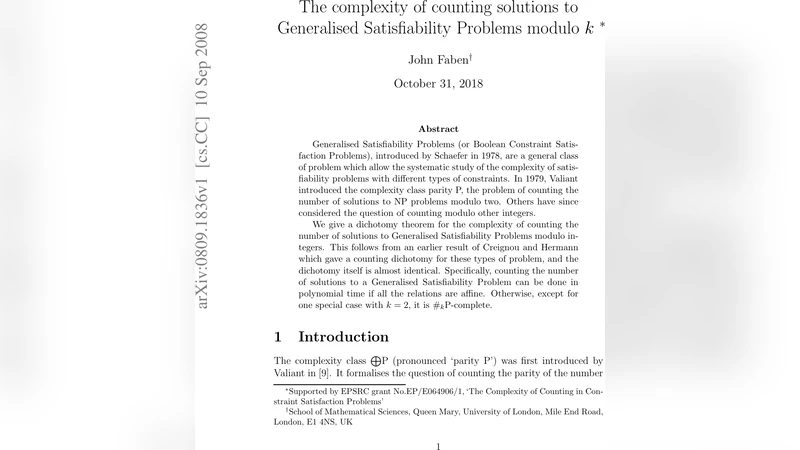
Generalised Satisfiability Problems (or Boolean Constraint Satisfaction Problems), introduced by Schaefer in 1978, are a general class of problem which allow the systematic study of the complexity of satisfiability problems with different types of constraints. In 1979, Valiant introduced the complexity class parity P, the problem of counting the number of solutions to NP problems modulo two. Others have since considered the question of counting modulo other integers. We give a dichotomy theorem for the complexity of counting the number of solutions to Generalised Satisfiability Problems modulo integers. This follows from an earlier result of Creignou and Hermann which gave a counting dichotomy for these types of problem, and the dichotomy itself is almost identical. Specifically, counting the number of solutions to a Generalised Satisfiability Problem can be done in polynomial time if all the relations are affine. Otherwise, except for one special case with k = 2, it is #_kP-complete.
💡 Research Summary
The paper investigates the computational complexity of counting the number of solutions to Generalised Satisfiability Problems (GSPs) modulo an arbitrary positive integer k. GSPs, introduced by Schaefer in 1978, are a broad class of Boolean constraint satisfaction problems where each constraint is a relation from a fixed set Γ applied to a subset of variables. The authors extend Valiant’s 1979 notion of parity‑P (counting solutions modulo 2) to a family of classes #_kP, defined as the set of problems that ask for the number of accepting paths of a nondeterministic Turing machine modulo k. The central result is a dichotomy theorem: if every relation in Γ is affine (i.e., can be expressed as a system of linear equations over GF(2) using XOR, constants, and possibly negated variables), then the solution‑count modulo k can be computed in polynomial time; otherwise, the problem is #_kP‑complete, with a single exceptional case when k = 2 and all relations are of a very restricted affine type (essentially only constants and single‑variable negations).
The tractable side relies on the observation that affine constraints define a linear subspace of the Boolean hypercube. By performing Gaussian elimination one can determine the dimension d of this subspace; the total number of solutions is exactly 2^d, and the remainder of 2^d modulo k can be obtained efficiently using modular exponentiation. This yields a deterministic polynomial‑time algorithm for any k when Γ is affine.
For the intractable side, the authors construct polynomial‑time parsimonious reductions from known #_kP‑complete problems such as #_kSAT (counting satisfying assignments of a 3‑CNF formula modulo k) or from the counting version of Not‑All‑Equal‑SAT. The reductions preserve the modulo‑k count by carefully replicating variables and adding auxiliary constraints that enforce the required arithmetic relationships without altering the remainder. When k ≥ 3 (or when k = 2 but the constraint set is not in the special affine class), these reductions prove #_kP‑hardness. The paper also shows that the hardness persists even when the input formula is restricted to use only relations from Γ, establishing that the dichotomy depends solely on the algebraic nature of Γ.
The authors note that this dichotomy mirrors the earlier counting dichotomy of Creignou and Hermann (1996), which classified the exact counting problem (#P) for GSPs into polynomial‑time versus #P‑complete based on the same affine criterion. By extending the analysis to modular counting, the present work demonstrates that the affine/non‑affine boundary remains the decisive factor for all moduli, except for the unique k = 2 exception.
Beyond the theoretical classification, the paper discusses implications for areas where modular solution counts are relevant. In cryptography, the hardness of computing solution counts modulo a composite k can be leveraged for constructing one‑way functions or commitment schemes. In statistical physics, the partition function of certain spin systems reduces to counting Boolean assignments modulo k, and the dichotomy indicates when such partition functions can be evaluated efficiently.
Finally, the authors outline open directions: refining the classification for specific families of moduli (prime versus composite), exploring analogous dichotomies for constraint languages over larger domains (e.g., ternary or q‑ary CSPs), and investigating parameterised versions where the number of non‑affine constraints is bounded. The paper thus provides a comprehensive and elegant extension of Schaefer’s framework to the modular counting realm, establishing a clear and robust boundary between tractable and intractable cases.
Comments & Academic Discussion
Loading comments...
Leave a Comment