Pedestrian Flow at Bottlenecks - Validation and Calibration of Vissims Social Force Model of Pedestrian Traffic and its Empirical Foundations
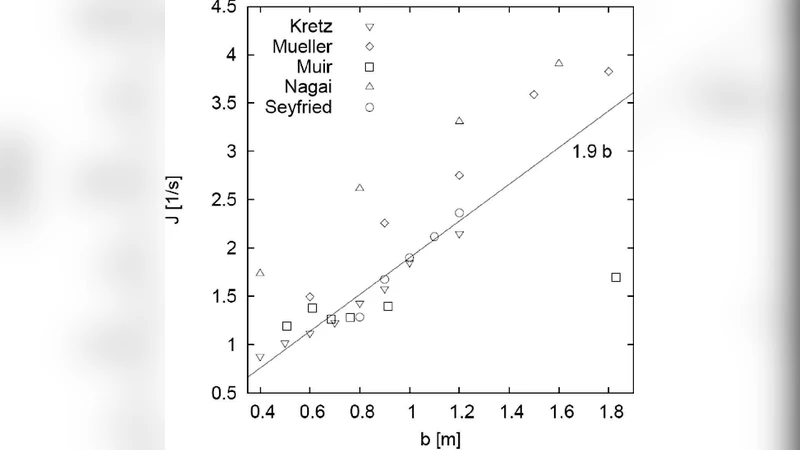
In this contribution first results of experiments on pedestrian flow through bottlenecks are presented and then compared to simulation results obtained with the Social Force Model in the Vissim simulation framework. Concerning the experiments it is argued that the basic dependence between flow and bottleneck width is not a step function but that it is linear and modified by the effect of a psychological phenomenon. The simulation results as well show a linear dependence and the parameters can be calibrated such that the absolute values for flow and time fit to range of experimental results.
💡 Research Summary
The paper presents a systematic study of pedestrian flow through bottlenecks, combining new experimental measurements with simulations based on the Helbing‑Molnár Social Force Model implemented in the Vissim traffic simulation platform. The experimental campaign involved six bottleneck widths (40 cm, 50 cm, 60 cm, 70 cm, 80 cm, and 100 cm). For each width, 100 participants were released with the same initial density and spacing as in earlier studies. The total evacuation time was recorded, scaled to a hypothetical 100‑person run, and used to compute both the overall flow (persons per second) and the specific flow (flow divided by bottleneck width). The data clearly contradict the long‑standing “step‑wise” hypothesis that flow jumps discretely as the width accommodates an additional lane. Instead, flow increases almost linearly with width, but a pronounced dip appears around 70 cm. The authors attribute this dip to a psychological/perceptual effect: when two pedestrians simultaneously approach a bottleneck that is just wide enough for one, they must negotiate a passing order, temporarily reducing throughput. This phenomenon had been reported in earlier evacuation experiments and is interpreted as a non‑trivial cognitive component superimposed on the physical interaction forces.
On the simulation side, the Social Force Model was integrated into Vissim and calibrated using a baseline parameter set (P0). Seven additional parameter sets (P1–P7) were generated by varying a single parameter each: the isotropic component of the social force, the magnitude of the repulsive term, the pedestrian radius, the maximum number of pedestrians, and the strength of the social acceleration term. In each simulation, 100 agents traversed the same six bottlenecks under identical initial conditions, and the time for the last agent to exit was measured. All parameter variations produced a linear flow‑width relationship, with the slope scaled by a constant factor. A minimum specific flow was observed for five of the eight parameter sets at approximately 60–70 cm, mirroring the experimental dip. One configuration (P3) yielded unrealistically high flows because the social force magnitude was set too large, illustrating the sensitivity of the model to parameter magnitude and the need for physically plausible values. The simulated minimum occurring at a slightly smaller width than in the experiments is explained by the use of a 15 cm pedestrian radius, which underestimates the true shoulder width (~20 cm) of human subjects.
Comparing the two data sources, the authors find good qualitative agreement: both exhibit a linear baseline and a local minimum in specific flow. Quantitatively, the baseline (P0) already falls within the experimental range, and modest adjustments to the social force coefficients can align the simulated absolute flow values with measured ones. The study thus validates the Social Force Model for bottleneck scenarios, demonstrates its capacity to capture subtle psychological effects through appropriate parameterization, and highlights the importance of accurate geometric representation of pedestrians.
The paper concludes that (1) pedestrian flow through bottlenecks is fundamentally linear, with deviations caused by perception‑driven negotiation at critical widths; (2) the Social Force Model, when calibrated, reproduces these features and can be used for realistic crowd‑management simulations; (3) careful calibration of pedestrian size and force parameters is essential to avoid systematic biases; and (4) future work should extend the validation to multi‑bottleneck layouts, higher densities, and heterogeneous pedestrian populations (different ages, motivations, and walking speeds) to further strengthen the model’s applicability in safety‑critical planning.
Comments & Academic Discussion
Loading comments...
Leave a Comment