Representation theory of mv-algebras
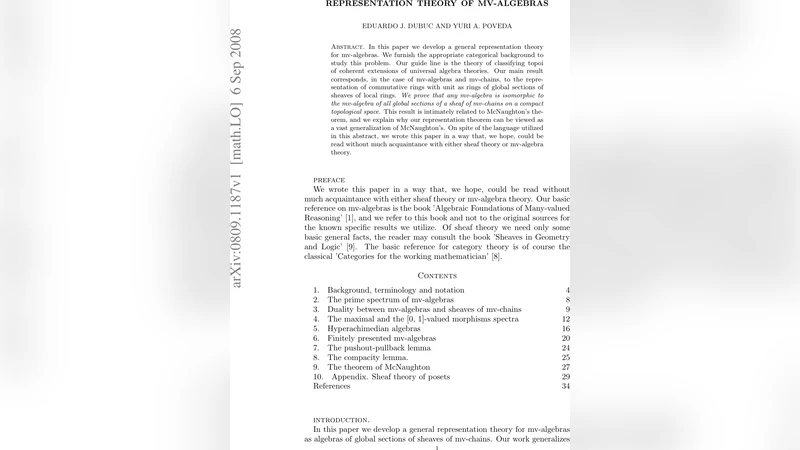
In this paper we develop a general representation theory for mv-algebras. We furnish the appropriate categorical background to study this problem. Our guide line is the theory of classifying topoi of coherent extensions of universal algebra theories. Our main result corresponds, in the case of mv-algebras and mv-chains, to the representation of commutative rings with unit as rings of global sections of sheaves of local rings. \emph{We prove that any mv-algebra is isomorphic to the mv-algebra of all global sections of a sheaf of mv-chains on a compact topological space}. This result is intimately related to McNaughton’s theorem, and we explain why our representation theorem can be viewed as a vast generalization of McNaughton’s. On spite of the language utilized in this abstract, we wrote this paper in a way that, we hope, could be read without much acquaintance with either sheaf theory or mv-algebra theory.
💡 Research Summary
The paper develops a comprehensive representation theory for MV‑algebras by embedding them into the framework of sheaf theory and classifying topoi. After recalling the basic algebraic structure of MV‑algebras and MV‑chains, the author introduces the categorical background needed to treat universal algebraic theories as coherent extensions, which in turn admit classifying topoi. Within this setting, the spectrum of an MV‑algebra A is defined as the set of its prime MV‑ideals equipped with a Zariski‑like topology; this space, denoted X, is shown to be compact.
On X the author constructs a sheaf 𝔖 whose stalk at each point p∈X is the quotient MV‑algebra A/p, which is an MV‑chain. The sheafification of the natural presheaf of these quotients yields a genuine sheaf of MV‑chains. The central theorem—called the Representation Theorem—states that A is naturally isomorphic to the MV‑algebra of global sections Γ(X,𝔖). The proof proceeds by assigning to each element a∈A a global section s_a defined pointwise by s_a(p)=
Comments & Academic Discussion
Loading comments...
Leave a Comment