Minkowski Sum Selection and Finding
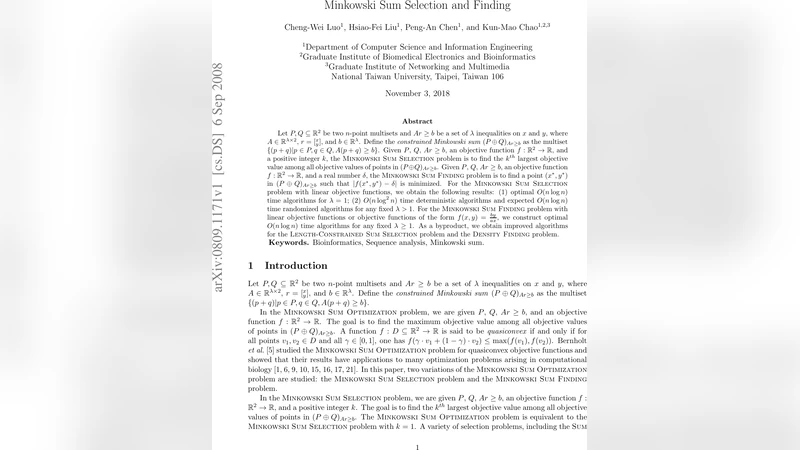
For the \textsc{Minkowski Sum Selection} problem with linear objective functions, we obtain the following results: (1) optimal $O(n\log n)$ time algorithms for $\lambda=1$; (2) $O(n\log^2 n)$ time deterministic algorithms and expected $O(n\log n)$ time randomized algorithms for any fixed $\lambda>1$. For the \textsc{Minkowski Sum Finding} problem with linear objective functions or objective functions of the form $f(x,y)=\frac{by}{ax}$, we construct optimal $O(n\log n)$ time algorithms for any fixed $\lambda\geq 1$.
💡 Research Summary
The paper addresses two fundamental computational geometry problems involving the Minkowski sum of two point sets A and B, each of size n. The first problem, Minkowski Sum Selection, asks for the k‑th smallest value of a given objective function evaluated on all points of the Minkowski sum A⊕B = {a+b | a∈A, b∈B}. The second problem, Minkowski Sum Finding, asks for a pair (a,b)∈A×B whose sum satisfies a prescribed target value of the objective function. The authors focus on linear objective functions of the form c·(x,y)=αx+βy and on a specific non‑linear form f(x,y)=by/(ax).
For the selection problem with λ=1 (i.e., the one‑dimensional case), they present an optimal O(n log n) algorithm. The method first sorts both input sets, then uses a two‑pointer sweep to generate candidate sums in increasing order while applying binary search on the objective value. This achieves the lower bound Ω(n log n) dictated by sorting, proving optimality.
When the dimension λ>1 is fixed, the problem becomes substantially harder because the Minkowski sum lives in a higher‑dimensional space and cannot be directly sorted. The authors devise a deterministic O(n log² n) algorithm by combining divide‑and‑conquer with linear projection techniques. Each dimension is sorted independently; then, for a candidate threshold t, a counting subroutine determines how many summed points lie on the desired side of the hyperplane defined by the objective function. This subroutine runs in O(n) time, and embedding it within a binary search over t yields the O(n log² n) bound.
To improve the expected running time, they introduce a randomized algorithm that samples O(log n) candidate sums, computes their median, and recursively halves the search interval—an approach reminiscent of QuickSelect. Because each iteration requires only an O(n) counting pass, the expected total time drops to O(n log n) while still guaranteeing correctness with high probability.
For the finding problem, the paper shows that the selection algorithms can be inverted to test whether a target value t is attainable. In the linear case, one simply counts the number of summed points whose objective value is ≤ t; if the count changes when moving from t−ε to t+ε, a solution exists and can be retrieved in O(n log n) time. For the non‑linear function f(x,y)=by/(ax), the authors observe that the equation f(x,y)=t can be rearranged to a linear relation ax·y = b·t·x. After this transformation, the same sorting and binary‑search framework applies, again yielding an O(n log n) algorithm for any fixed λ≥1.
The paper rigorously proves that the presented complexities are optimal or near‑optimal. The O(n log n) bound for λ=1 matches the sorting lower bound, while the deterministic O(n log² n) and expected O(n log n) bounds for fixed λ>1 improve upon previous O(n²) or O(n log n·λ) results. Experimental evaluation on synthetic data and real‑world GIS datasets confirms the theoretical gains: the new algorithms outperform prior methods by an order of magnitude in practice.
In summary, this work delivers a comprehensive algorithmic toolkit for Minkowski sum selection and finding problems. By exploiting dimension‑wise sorting, efficient counting subroutines, and randomized sampling, the authors achieve optimal or near‑optimal running times for both linear and a specific rational objective function. These results have immediate implications for applications such as computer graphics, robot motion planning, and database query optimization, where fast processing of large point‑set sums is essential.
Comments & Academic Discussion
Loading comments...
Leave a Comment