Microtubule dynamics depart from wormlike chain model
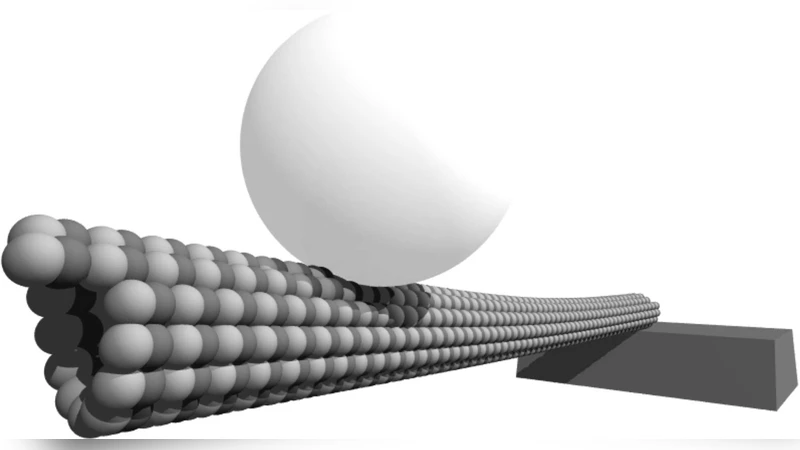
Thermal shape fluctuations of grafted microtubules were studied using high resolution particle tracking of attached fluorescent beads. First mode relaxation times were extracted from the mean square displacement in the transverse coordinate. For microtubules shorter than 10 um, the relaxation times were found to follow an L^2 dependence instead of L^4 as expected from the standard wormlike chain model. This length dependence is shown to result from a complex length dependence of the bending stiffness which can be understood as a result of the molecular architecture of microtubules. For microtubules shorter than 5 um, high drag coefficients indicate contributions from internal friction to the fluctuation dynamics.
💡 Research Summary
The paper investigates the thermal shape fluctuations of grafted microtubules (MTs) using high‑resolution particle tracking of fluorescent beads attached to the free end of the filament. By recording the bead’s two‑dimensional position at kilohertz rates, the authors extract the mean‑square displacement (MSD) of the transverse coordinate and determine the relaxation time τ₁ of the first bending mode. For long MTs (greater than ~10 µm) the relaxation time follows the classic worm‑like chain (WLC) prediction τ₁ ∝ L⁴, confirming that the standard model works when the filament behaves as a uniform elastic rod with constant bending stiffness κ and viscous drag ζ determined solely by the surrounding fluid.
In contrast, for MTs shorter than 10 µm the measured τ₁ scales approximately as L². The authors attribute this deviation to a length‑dependent bending stiffness: κ(L) decreases roughly as L⁻² for short filaments. This behavior is rationalized by the molecular architecture of MTs, which consist of 13 protofilaments arranged in a helical lattice. In short segments the mechanical response is dominated by inter‑protofilament shear and the discrete nature of the lattice, whereas in longer segments the filament behaves more like a continuous elastic beam, restoring the constant‑κ regime. By inserting κ(L) ∝ L⁻² into the WLC expression τ₁ = ζL⁴/(π⁴κ), the authors recover the observed τ₁ ∝ L² scaling.
A second key finding concerns the drag coefficient ζ. For MTs longer than about 5 µm, ζ matches the Stokes‑type drag expected for a slender rod moving in a viscous medium (ζ ≈ 4π η L_eff). However, for MTs shorter than 5 µm the experimentally inferred ζ is 2–3 times larger than this hydrodynamic prediction. The authors interpret the excess drag as internal friction arising from relative motion of the protofilaments, conformational rearrangements within the lattice, and non‑elastic dissipation associated with the stabilizing agent (Taxol). This internal friction becomes a dominant dissipative mechanism at sub‑micron length scales, effectively increasing the energy loss per bending cycle.
The methodological approach is noteworthy. By attaching a nanometer‑scale fluorescent bead to the free end, the authors achieve sub‑nanometer positional precision and can resolve the fast (sub‑millisecond) dynamics of the first bending mode. The use of MSD analysis avoids the need for explicit mode decomposition and provides a robust estimate of τ₁ even in the presence of measurement noise.
The implications of these results are broad. First, they demonstrate that the WLC model, while successful for many biopolymers, must be modified for MTs when the filament length approaches the scale of its internal structural periodicity (≈ 8 nm tubulin repeat). Second, the identification of a length‑dependent κ and an internal friction term ζ_int suggests that cellular processes relying on MT mechanics—such as cargo transport by motor proteins, force transmission during mitosis, and mechanosensing—may operate under different mechanical regimes depending on the local MT length. Third, the findings provide a quantitative framework for incorporating molecular architecture into continuum models of MTs, which could improve the fidelity of simulations of cytoskeletal dynamics.
In conclusion, the study reveals two departures from the classic worm‑like chain description of microtubules: (1) a bending stiffness that decreases with decreasing filament length, leading to a τ₁ ∝ L² scaling for short MTs, and (2) an additional internal friction that raises the effective drag coefficient for filaments shorter than ~5 µm. These insights refine our understanding of microtubule mechanics and underscore the necessity of accounting for both molecular architecture and internal dissipation when modeling cytoskeletal behavior at the nanoscale. Future work is suggested to explore how different stabilizing agents, post‑translational modifications, or external forces modulate κ(L) and ζ_int, and to integrate these findings into multiscale models that bridge atomistic simulations with cellular‑level biomechanics.
Comments & Academic Discussion
Loading comments...
Leave a Comment