Distance Geometry in Quasihypermetric Spaces. III
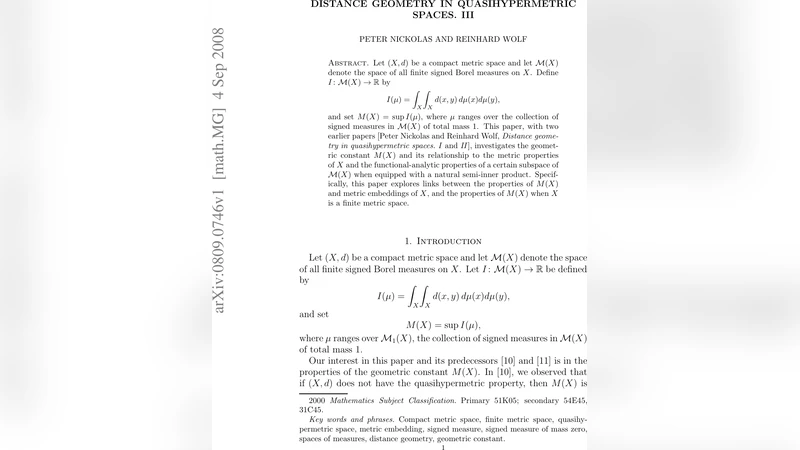
Let $(X, d)$ be a compact metric space and let $\mathcal{M}(X)$ denote the space of all finite signed Borel measures on $X$. Define $I \colon \mathcal{M}(X) \to \R$ by [ I(\mu) = \int_X \int_X d(x,y) d\mu(x) d\mu(y), ] and set $M(X) = \sup I(\mu)$, where $\mu$ ranges over the collection of signed measures in $\mathcal{M}(X)$ of total mass 1. This paper, with two earlier papers [Peter Nickolas and Reinhard Wolf, Distance geometry in quasihypermetric spaces. I and II], investigates the geometric constant $M(X)$ and its relationship to the metric properties of $X$ and the functional-analytic properties of a certain subspace of $\mathcal{M}(X)$ when equipped with a natural semi-inner product. Specifically, this paper explores links between the properties of $M(X)$ and metric embeddings of $X$, and the properties of $M(X)$ when $X$ is a finite metric space.
💡 Research Summary
The paper continues the series “Distance geometry in quasihypermetric spaces” by focusing on a geometric constant
\
Comments & Academic Discussion
Loading comments...
Leave a Comment