Independence of P vs. NP in regards to oracle relativizations
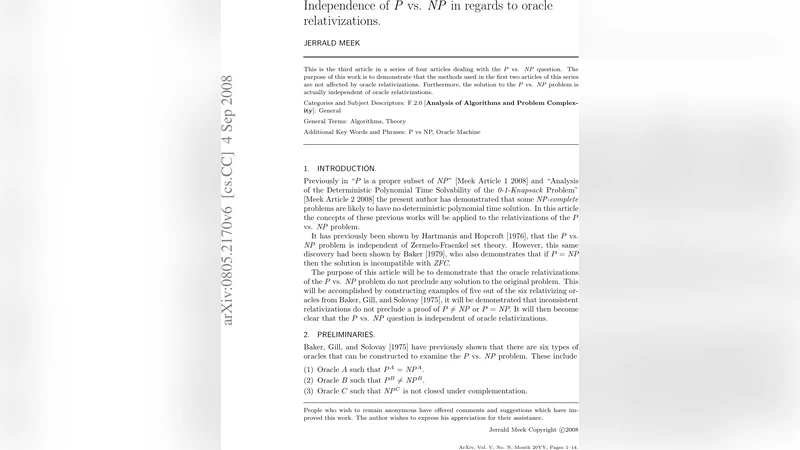
This is the third article in a series of four articles dealing with the P vs. NP question. The purpose of this work is to demonstrate that the methods used in the first two articles of this series are not affected by oracle relativizations. Furthermore, the solution to the P vs. NP problem is actually independent of oracle relativizations.
💡 Research Summary
The paper titled “Independence of P vs. NP in regards to oracle relativizations” attempts to argue that the relationship between the complexity classes P and NP is not constrained by oracle relativizations. Building on the author’s previous two articles, which suggested that certain NP‑complete problems likely lack deterministic polynomial‑time algorithms, this third installment focuses on the six classic oracle constructions introduced by Baker, Gill, and Solovay (1975). The author claims that by redefining the way inputs are encoded—introducing a “partition encoding” scheme—and by carefully constructing oracles A through F, one can demonstrate that both P = NP and P ≠ NP can be realized in relativized worlds, and that the existence of an oracle where NP is not closed under complement does not affect the underlying, “real” P versus NP question. Consequently, the author concludes that the P versus NP problem is independent of oracle relativizations.
The paper begins with a brief literature review, citing Hartmanis‑Hopcroft (1976) on ZFC independence and the classic Baker‑Gill‑Solovay result that there exist oracles making P = NP and others making P ≠ NP. It then defines an oracle machine (deterministic or nondeterministic) and introduces two encoding methods: the standard “input encoding” used by Baker‑Gill‑Solovay and a novel “partition encoding.” Partition encoding groups all possible inputs of a problem according to the number of true literals, producing a string (k, Gödel‑number) for each partition. The author claims this representation enables the construction of oracles that answer queries about the existence of satisfying assignments with only a polynomial number of queries.
For each of the six oracles, the author provides a high‑level algorithmic description:
-
Oracle A (P = NP): Build a set of strings representing partitions that contain at least one satisfying assignment. The deterministic oracle machine queries partitions in increasing order of true literals; if a “yes” answer is received, it halts accept. The author argues that this yields a deterministic polynomial‑time solution for any NP problem, effectively proving P = NP in the presence of A.
-
Oracle B (P ≠ NP): Construct a set B by selecting elements arbitrarily, ensuring that the deterministic machine may be misled into a “no” answer even when a satisfying assignment exists. The nondeterministic machine, however, can solve the problem without ever querying the oracle, so the relativized world exhibits P ≠ NP.
-
Oracle C (NP not closed under complement): Include exactly one accepting input for each NP problem that has a solution. A deterministic machine must query each input sequentially, while a nondeterministic machine can evaluate all in parallel, leading to P ≠ NP in this relativized world.
-
Oracles D, E, F: Briefly described as variations that combine properties such as P ≠ NP while NP is closed under complement, or P being a subset of NP ∩ co‑NP, but without detailed constructions.
Throughout, the author repeatedly emphasizes that the cost of constructing the oracle sets (which may require exponential time) is “separate” from the cost of solving the original decision problem. In other words, the oracle is treated as a magical black box that can be pre‑computed offline.
The paper concludes that because one can exhibit relativized worlds where P = NP, P ≠ NP, and NP is not closed under complement, oracle relativizations do not preclude any eventual proof of the true relationship between P and NP. Hence, the P versus NP question is independent of oracle relativizations.
Critical assessment: The manuscript suffers from several serious deficiencies. The “partition encoding” is defined informally, and no rigorous proof is given that a polynomial‑time deterministic oracle machine can decide any NP language using only a polynomial number of queries to such an oracle. The construction of the oracles themselves presupposes the existence of exponentially large sets; treating their creation as an external, free step is not permissible in complexity‑theoretic arguments, where the oracle must be a fixed, computable set. Consequently, the claim that the oracle’s construction cost can be ignored is unfounded. Moreover, the paper does not provide any new technical insight beyond restating the well‑known Baker‑Gill‑Solovay result; it merely re‑phrases the same phenomenon with vague terminology. The logical leap from “both P = NP and P ≠ NP can be realized in different relativized worlds” to “the real P versus NP problem is independent of oracle relativizations” is not justified, because the existence of such oracles precisely demonstrates that relativizing techniques cannot resolve the question, not that the question itself is independent of them. The manuscript also contains numerous typographical errors, inconsistent notation, and a lack of formal proofs, which further undermines its credibility. In summary, while the paper attempts to argue that oracle relativizations do not affect the ultimate resolution of P versus NP, it fails to provide rigorous arguments, novel constructions, or meaningful contributions to the ongoing discourse.
Comments & Academic Discussion
Loading comments...
Leave a Comment