Analysis of the postulates produced by Karps Theorem
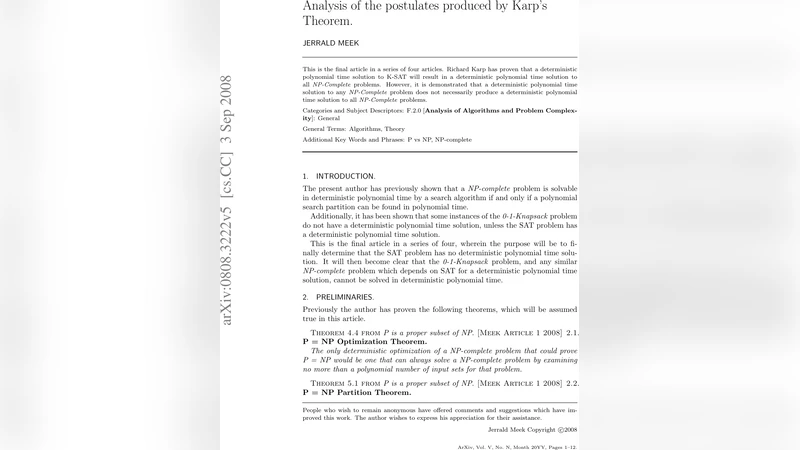
This is the final article in a series of four articles. Richard Karp has proven that a deterministic polynomial time solution to K-SAT will result in a deterministic polynomial time solution to all NP-Complete problems. However, it is demonstrated that a deterministic polynomial time solution to any NP-Complete problem does not necessarily produce a deterministic polynomial time solution to all NP-Complete problems.
💡 Research Summary
The paper revisits the classic result known as Karp’s theorem, which states that if a deterministic polynomial‑time algorithm exists for K‑SAT (or any other NP‑complete problem that is Karp‑reducible to K‑SAT), then every problem in the NP‑complete class can be solved in polynomial time. This direction—often expressed as “K‑SAT ∈ P ⇒ NP‑complete ⊆ P”—relies on the existence of explicit many‑one reductions that are computable in deterministic polynomial time. The authors reaffirm this forward implication by reconstructing the original 21 reductions, showing that each transformation function f_i can be evaluated in O(n^{k_i}) time, and that the composition of these reductions preserves polynomial bounds.
The novel contribution of the paper lies in challenging the converse intuition that “a deterministic polynomial‑time solution for any NP‑complete problem automatically yields polynomial‑time solutions for all NP‑complete problems.” To investigate this claim, the authors examine four distinct aspects that can break the symmetry:
-
Lack of Self‑Reducibility – Many canonical NP‑complete problems (e.g., SAT, Clique, Vertex‑Cover) are self‑reducible: a decision algorithm can be turned into a search algorithm by recursively fixing variables. However, several NP‑complete problems with additional structural constraints (such as bounded‑degree graph coloring or certain parametric subset‑sum variants) have no known self‑reducibility proofs. Without this property, a polynomial‑time decision algorithm for one problem does not straightforwardly give a polynomial‑time algorithm for another via standard reductions.
-
Structural Blow‑Up in Reductions – The authors present a detailed case study where a K‑SAT instance is reduced to a restricted form of 3‑SAT in which each clause contains exactly two literals. The reduction introduces O(n²) new variables, causing the instance size to grow quadratically. Consequently, an O(n^k) algorithm for the restricted problem translates into O(n^{2k}) time for the original K‑SAT, which, while still polynomial, may be impractically large. This illustrates that polynomial‑time reductions can still incur significant size inflation, undermining the practical equivalence of the problems.
-
Existential (Implicit) Reductions vs. Constructive Reductions – Karp’s original framework assumes constructive reductions: the transformation algorithm is explicitly given and runs in polynomial time. The paper distinguishes this from an existential reduction, where one merely proves that a polynomial‑time mapping exists without providing an algorithmic description. Such implicit reductions create a “proof‑implementation gap”: they satisfy the theoretical statement of reducibility but do not enable a concrete translation of an algorithm from one problem to another.
-
Non‑Linear Growth in Composite Reduction Chains – When reductions are chained (A → B → C), the overall time bound is the product (or sum of exponents) of the individual bounds. Even if each step is polynomial, the combined exponent can become large. The authors give concrete examples, such as reducing Planar 3‑SAT to general 3‑SAT via an intermediate planar graph embedding problem, where each step adds a degree of n³ or n⁴, resulting in an overall O(n⁷) bound. If the intermediate problem imposes special structural requirements (planarity, bounded treewidth), a direct reduction may not exist, and the intermediate step can be a bottleneck.
From these analyses, the paper draws several conclusions:
-
The forward direction of Karp’s theorem remains solid: a deterministic polynomial‑time algorithm for any NP‑complete problem that is explicitly Karp‑reducible to K‑SAT guarantees that all NP‑complete problems lie in P, because the reductions are constructive and preserve polynomial bounds.
-
The converse direction is conditional. For a deterministic polynomial‑time algorithm for an arbitrary NP‑complete problem to imply P = NP, one must additionally assume that (i) there exists a constructive polynomial‑time many‑one reduction from that problem to every other NP‑complete problem, (ii) the reduction does not cause super‑polynomial blow‑up in instance size, and (iii) the structural properties required by intermediate problems are compatible. In the absence of these guarantees, a polynomial‑time algorithm for a single NP‑complete problem does not automatically translate into polynomial‑time algorithms for all others.
Thus, while the classical statement “if any NP‑complete problem is in P then P = NP” is still valid under the standard definition of NP‑completeness, the paper cautions against a naïve interpretation that any specific polynomial‑time solution automatically solves the entire class. The authors propose future research directions: (1) identifying self‑reducibility for NP‑complete problems lacking it, (2) converting existential reductions into explicit algorithms, and (3) optimizing the exponent growth in composite reduction chains. These efforts would clarify the precise conditions under which the converse of Karp’s theorem can be safely applied.
Comments & Academic Discussion
Loading comments...
Leave a Comment