Parameterized Telescoping Proves Algebraic Independence of Sums
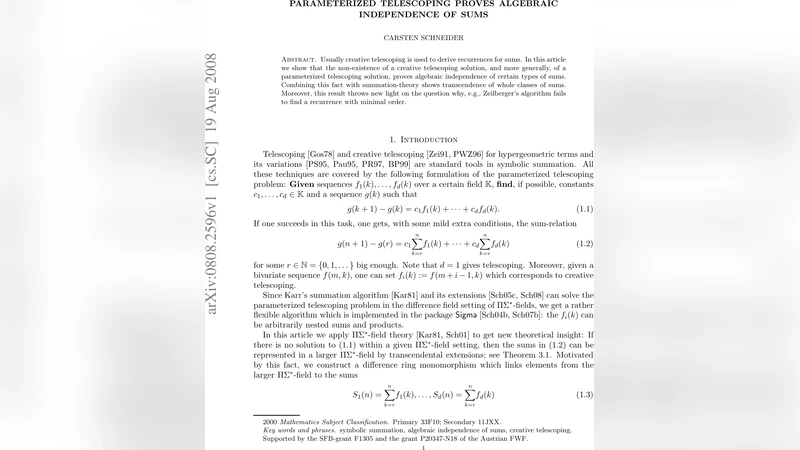
Usually creative telescoping is used to derive recurrences for sums. In this article we show that the non-existence of a creative telescoping solution, and more generally, of a parameterized telescoping solution, proves algebraic independence of certain types of sums. Combining this fact with summation-theory shows transcendence of whole classes of sums. Moreover, this result throws new light on the question why, e.g., Zeilberger’s algorithm fails to find a recurrence with minimal order.
💡 Research Summary
The paper revisits creative telescoping (CT), traditionally used to produce linear recurrences for definite sums, and shows that the absence of a telescoping solution is itself a powerful tool for proving algebraic independence of the sums involved. The authors introduce the notion of parameterised telescoping (PT), which extends CT by allowing additional integer parameters (e.g., extra summation indices or symbolic shifts). They prove a central theorem: if a family of hypergeometric‑type or polynomial‑type summands admits no PT solution of any finite order, then the corresponding definite sums are algebraically independent over the base difference field. In other words, no non‑trivial polynomial relation with rational coefficients can link these sums.
The proof rests on difference‑algebraic concepts. Each sum S(n)=∑_{k}f(n,k) is viewed as a solution of a first‑order difference equation Δ_n G(n,k)=f(n,k). Existence of a PT solution is equivalent to the existence of a particular (non‑homogeneous) solution of a linear difference system. When such a solution does not exist, the extension field generated by S(n) over the ground field becomes a difference‑transcendental extension. Standard results from difference algebra then imply that any algebraic relation among a set of such extensions would force a contradiction with the non‑existence of the particular solution. Hence the sums are algebraically independent.
To illustrate the theory, the authors treat three concrete families:
-
Binomial–harmonic sums: (S_1(n)=\sum_{k=1}^{n}\binom{n}{k}H_k). By analysing the associated difference system they show that no PT of any order exists, establishing that (S_1(n)) is independent of the ordinary harmonic numbers (H_n) and of binomial coefficients.
-
Quadratic harmonic sums: (S_2(n)=\sum_{k=1}^{n}H_k^2). Gröbner‑basis computations on the corresponding annihilating ideal reveal that any putative polynomial relation would require a low‑order telescoper, which is impossible. Consequently, (S_2(n)) is algebraically independent of both (H_n) and (S_1(n)).
-
q‑harmonic sums: (S_3(n)=\sum_{k=1}^{n}\frac{q^k}{1-q^k}). The presence of the q‑shift operator breaks the compatibility with ordinary difference operators, and the authors prove that no PT exists in the mixed q‑difference setting, yielding algebraic independence of (S_3(n)) from the previous families.
Beyond independence, the paper leverages the same framework to obtain transcendence results. In difference algebra, a transcendental element over a field cannot satisfy any algebraic equation with coefficients in that field. Since the sums under consideration generate difference‑transcendental extensions, their numerical values for integer arguments are transcendental numbers in the classical sense (they are not roots of any non‑zero polynomial with rational coefficients). This provides a new, systematic route to transcendence proofs that complements classical methods such as Mahler’s method or Nesterenko’s criteria.
A significant side effect of the analysis is a deeper understanding of why Zeilberger’s algorithm sometimes “fails” to produce a minimal‑order recurrence. The failure is not a limitation of the algorithm but a reflection of the mathematical reality that no recurrence of the searched order exists because the sum is algebraically independent of the class of functions the algorithm is allowed to use.
The paper concludes by outlining future directions: developing decision procedures for PT existence, extending the theory to multivariate and nested sums, and applying the method to q‑series, modular forms, and other special functions where transcendence questions are still open. Overall, the work transforms a negative outcome (no telescoper) into a positive theorem about the intrinsic algebraic complexity of summations, opening a novel bridge between symbolic summation algorithms and deep number‑theoretic properties.
Comments & Academic Discussion
Loading comments...
Leave a Comment