Near ML detection using Dijkstras algorithm with bounded list size over MIMO channels
We propose Dijkstra's algorithm with bounded list size after QR decomposition for decreasing the computational complexity of near maximum-likelihood (ML) detection of signals over multiple-input-multiple-output (MIMO) channels. After that, we compare…
Authors: ** - Atsushi Okawado (오카와도 아츠시) – 도쿄공업대학 통신·통합시스템학부 - Ryutaroh Matsumoto (마쓰모토 류타로) – 도쿄공업대학 통신·통합시스템학부 - Tomohiko Uyematsu (우에마쓰 토모히코) – 도쿄공업대학 통신·통합시스템학부 **
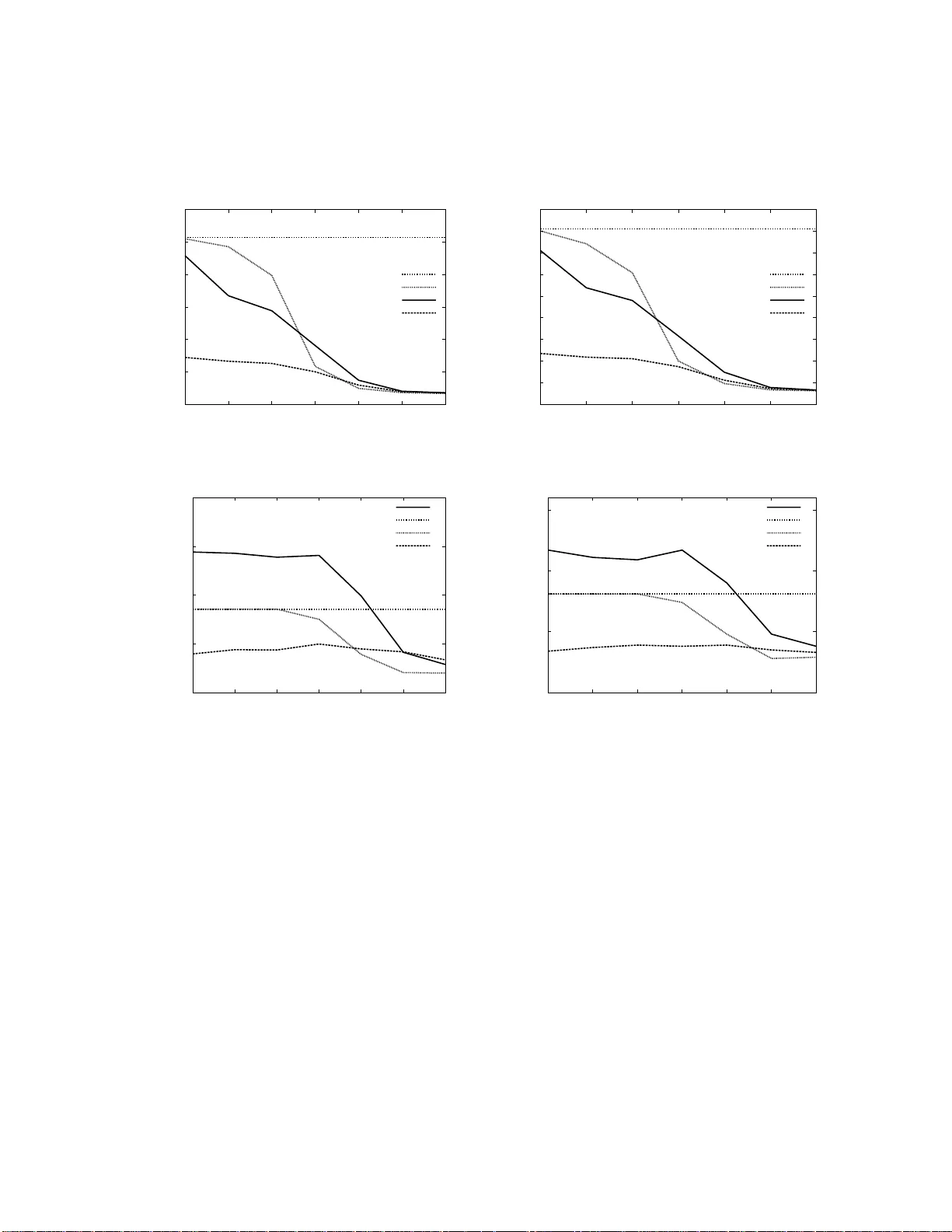
Near ML detection using Dijkstra’ s algorithm with b ounded list size o v er MIMO c hannels A tsushi OKA W ADO, Ry utaroh MA TSUMOTO and T omohiko UYE MA TSU Dept. of Comm unications and Integrated Systems T oky o Institute of T ec hnology , 152-8550 Japa n F ebruary 13, 2008 Abstract W e prop ose Dijkstra’s algorithm with b ounded list size after QR decomp osition for decreasing the computational complexity of near maximum- likelihoo d (ML) detection of signals ov er m ultiple- input-m ultiple-output (MIMO) c hannels. After that, we compare the p erfor mances of prop osed algo rithm, QR decomp osition M-alg o rithm (QRD-MLD), and its improv ement. When the list size is set to achiev e the almost sa me symbol error rate (SER) as the QRD-MLD, the pr op osed algorithm has smaller av- erage co mputational co mplexity . 1 In tro duction The c hannel capacity of mu ltiple-input-multiple- output (MIMO) channels linear ly increases with the nu mber of antennas [1, 2]. Maximum-lik eliho o d (ML) detection provides the minimum error rate. How ever, the computational complexity of the simple ML de- tection alg orithm grows exp onentially with the num - ber of tra nsmit antennas. Thu s, we need an effi- cient algorithm that achiev es s imila r err or rate to the ML detection. The Q R decomp osition M-a lgorithm (QRD-MLD) [5, 6] and spher e deco ding (SD) [3] are po ssibly the mo st promising a lgorithms. In [10], to reduce the computational complexity , Dijkstra ’s al- gorithm is applied to SD which achiev es same error rate a s ML detection. Both the Q RD-MLD and Di- jkstra’s alg o rithm a re tr ee search based alg orithms. Dijkstra’s a lgorithm uses the lis t of unlimited size to keep detection candidates. Ho wev er, the computa- tional complexities of the QRD-MLD and Dijkstra’s algorithm a re still high. T o reduce the co mputa- tional complexity , we prop os e Dijkstra ’s a lgorithm with bounded list size . When prop osed alg orithm’s list size is se t to a chiev e the a lmost sa me s y m b ol er- ror rate (SE R) as the QRD-MLD, the computatio nal complexity of pro p o sed algorithm is low er than the QRD-MLD. This paper is org anized as follows. In Section 2, we intro duce the system mo del o f MIMO channels. In Section 3, w e review the QRD-MLD and its im- prov ement, then prop ose Dijkstra’s algo rithm with bo unded list size. In Section 4, we show the com- parison betw een the computationa l complexity of the QRD-MLDs and prop osed a lgorithm by c omputer simulations. Fina lly , we give the co nclusion in sec- tion 5. 2 System mo del W e co nsider the unco ded s ystem with t transmit an- tennas and r receive a nt ennas, and we assume r ≥ t . W e assume that the noise a t each r eceive antenna is the additive white Gauss ian noise (A W GN). L et x be a t × 1 vector consisting of c o mplex en velopes of transmitted sig nals with the signal co ns tellation S , H an r × t fading ma trix whose ( k , j ) entry is a complex 1 fading co e fficient b etw een j - th tr ansmit a ntenna and k -th receive antenna, z an r × 1 c o mplex vector whose comp onent is no is e a t each r eceive antenna, a nd y an r × 1 co mplex vector who se comp onent is the received signal comp onent at each receive antenna. The mo del of this channel is written as y = Hx + z . (1) W e a ssume that the receiver knows the channel state information H p erfectly . In this ca se, the ML detection of the tra nsmitted signal over the channel (1) ca n b e formulated as find- ing ˆ x ml = ar g min x ∈ S t || y − Hx || 2 . (2) 3 Near ML detection algorithm In this section, we pro po se the new near ML detec- tion algorithm. First, to calcula te (2 ) efficiently , we explain how to find the ML signal b y tree search al- gorithm in Sectio n 3 .1. Then, we rev iew near ML detection alg orithms ca lled QRD-MLD [5, 6] a nd its improv ement [8] in Section 3.2. Finally , w e pro p o se Dijkstra’s a lgorithm with b ounded list size in Section 3.3. 3.1 QR decomp osition T o ca lculate (2) efficiently , we compute a QR deco m- po sition of H and obtain an upper triangula r matrix R and a unitary matrix Q with H = QR . Since Q is unitary , || y − Hx || 2 = || Q ∗ y − Q ∗ Hx || 2 = || Q ∗ y − Rx || 2 . (3) Let ξ = Q ∗ y = ( ξ 1 , · · · , ξ r ) T . The ML detection prob- lem (2 ) ca n b e refor mulated as finding ˆ x ml = arg min x ∈ S t || ξ − Rx || 2 = arg min x ∈ S t t X j =1 | ξ j − t X i = j R j,i x i | 2 + r X k = t | ξ k | 2 = arg min x ∈ S t t X j =1 | ξ j − t X i = j R j,i x i | 2 . (4) The s econd equa lity ab ov e follows as the second term in the se c ond equatio n is irr elev an t to x . T o calculate (4) efficiently , we consider a weighted directed graph as follows. The decisions on x i con- struct a tree where no des at k -th depth are corr e- sp ond to the candidate of x t − k +1 [4], and the ro ot no de is placed at depth 0. Then, the metric v alue, which is the w eight o f branch, b et ween a no de ˆ x i that has ˆ x t , · · · , ˆ x i +1 ( ˆ x k ∈ S , i + 1 ≤ k ≤ t ) as ances to r no des from the ro ot no de to its parent no de is defined by m i = | ξ i − R i,i ˆ x i − t X j = i +1 R i,j ˆ x j | 2 . The distance of each no de fro m the ro o t no de, which is called the accum ulated metric v alue in this pap er, is equal to the sum of the metric v alues of branches from the ro ot node to the node itself. The a c c um u- lated metric v alue fro m the ro ot no de to the b ottom no de whose depth is t is t X i =1 m i = t X j =1 | ξ j − t X i = j R j,i ˆ x i | 2 . (5) Because ˆ x tha t ma kes (5) minimum is e qual to ˆ x ml of (4), the shortest path from the r o ot no de to the bo ttom no de co rresp onds to the ML signal [4 ]. 3.2 QRD-MLD The QRD-MLD [5 , 6], which is a br eadth-first tree search based algor ithm, finds a near ML s ig nal. The QRD-MLD keeps only M no des at each depth with the sma llest accumulated metric v alues [7], instea d of testing all the ca ndidate in S t according to (4). At each depth, only M nodes make their c hild no des. W e ca ll a no de that ma kes its child no de detectio n no de in this pa pe r . An improv ement to Q RD-MLD pr op osed in [8] re- duces the n umber of detection no des from the o riginal QRD-MLD. This improv ed QRD-MLD has threshold v alue a t each de pth. The depth i ’s threshold v alue ∆ i is defined by ∆ i = E i,min + X φ 2 , (6) 2 where E i,min is the smallest accumulated metric v alue of the no de at i -th depth in the no des whose parent no de is a detection no de. X is a fixed co nstant nu mber, and φ 2 is the noise v ariance. At each depth, select the no des that have smaller a ccumulated met- ric v alue than threshold v alue ∆ i . If the n umber of selected no des is more than M , only M no des with smallest a ccumulated metric v alues are selected. Note that both algor ithms do not alw ays find the ML signal. F or s mall to medium M v alues, the c om- plexity is substantially low er than the simple ML de- tection algo rithm. How ev er, the final r esult is no longer g ua ranteed to b e the ML s ignal. 3.3 Prop osed a lgorithm: Dijkstra’s algorithm with b ounded list size Dijkstra’s algor ithm is an efficient a lgorithm to find the shortest path fr o m a point to a destination in a weigh ted gra ph [9]. Dijkstra’s a lg orithm uses the list of unlimited size to keep candidate no des. If w e use Dijkstra’s algorithm to find the shortest path from the r o ot to one of no des at the b ottom depth, we can get the no de with minimum || y − H ˆ x || 2 among all no des a t the b ottom depth and it co rresp onds to the ML estimate [10]. How ev er, this algo rithm still has high computational co mplexity . T o reduce the co m- putational co mplxit y , we prop ose a modified version of Dijkstra ’s algor ithm whos e list keeps only L no des with the smallest accumulated metric v alues in the list. W e show Dijkstra ’s alg o rithm with b ounded list size. 1. Create an empty list for no des. 2. Insert a ll no de s at the first level int o the list. 3. Select the no de A having smallest accumulated metric v alue in the list and remov e it fro m the list. If the depth of A is t , then output the no de A and its ancestor no des as the ML signal a nd finish this a lgorithm. 4. Insert a ll A’s child no des into the list. 5. Arrange the no de s in the list ac c ording to the ac- cum ulated metric v alue by the quick sor t. If the 1e-006 1e-005 0.0001 0.001 0.01 0.1 1 0 5 10 15 20 25 30 SER SNR at single receive antenna [dB] QRD-MLD:X=2 Proposed:L=5 original QRD-MLD Proposed:L=16 ML Figure 1 : (4 × 4) s ymbol er ror rate list has more than L no des , select the L node s with the smallest a ccumulated metric v a lues in the lis t, a nd disc ard other no des from the list. 6. Go back to Step 3. The no de w ho se child no des are inserted into the list is called detection no de in this pap e r . Bec ause the discarded no des, which a re decided a t Step 5, and their descenda n t no des a re not exa mined, the pro- po sed algo rithm do se not examine all the candidate in S t according to (4). Thus, the prop os ed alg orithm dose no t a lwa ys find the ML signal. When we use LDPC co des [12] or turb o co de s [13] after detection, we have to co mpute N mo st likely signals [11]. Such signals can b e computed by this algorithm’s mo dification that is finished after out- put N signa ls with the smallest accumulated metric v alue. 4 Computer sim ulation In this sectio n, we compare the computationa l com- plexity , the num be r of detection no des and the num- ber of comparis o ns of real num b ers amo ng the pro- po sed algorithm and the QRD-MLDs. Throug hout the simulations, w e consider the following s ystem mo del. 3 0 500 1000 1500 2000 2500 0 5 10 15 20 25 30 average computational complexity SNR at single receive antenna [dB] original QRD-MLD QRD-MLD:X=2 Proposed:L=16 Proposed:L=5 Figure 2 : (4 × 4) av era ge co mputational co mplexity 0 1000 2000 3000 4000 5000 0 5 10 15 20 25 30 maximum computational complexity SNR at single receive antenna [dB] Proposed:L=16 original QRD-MLD QRD-MLD:X=2 Proposed:L=5 Figure 3: (4 × 4) maximum computationa l complexity • W e do tw o simulations. In the first simulation, the num b er of trans mit a ntennas t = 4, and the nu mber of receive antennas r = 4. In the s econd simulation, the num be r of transmit antennas t = 6, and the num b er o f r eceive antennas r = 6. • The signal constella tion at each transmit a n- tenna is 16- Q AM and all signals ar e drawn ac- cording to the uniform i.i.d. distr ibutio n. • The fading co efficients ob ey the C N (0 , 1) distri- bution, a nd the receiver knows it p erfectly . • The noise a t each recieve antenna o b e y s the 0 5 10 15 20 25 30 35 40 45 50 55 0 5 10 15 20 25 30 average number of detection nodes SNR at single receive antenna [dB] original QRD-MLD QRD-MLD:X=2 Proposed:L=16 Proposed:L=5 Figure 4 : (4 × 4) average num be r of detection no des 0 10 20 30 40 50 60 70 80 90 100 0 5 10 15 20 25 30 maximum number of detection nodes SNR at single receive antenna [dB] Proposed:L=16 original QRD-MLD QRD-MLD:X=2 Proposed:L=5 Figure 5: (4 × 4) max im um n umber o f detection no des C N (0 , φ ) distribution. φ is caluculated by φ 2 = tE s × 10 ( − S N R/ 10) , where E s is the average sym- bo l energy . • W e transmit 100 000 sig nals, which is 400 000 symbols if the num b er of transmit antennas is 4 and 600 000 sy m b ols if the num b er of tra nsmit antennas is 6, a nd every 100 signals, change the fading matrix. If M = 1 6 is used and the signal co nstellation is 16-QAM, QRD-MLD has symbol er ror ra te (SER) near to the ML detection [7]. So, we us e M = 1 6. In QRD-MLD’s improv ement, we use X = 2 in (6) 4 0 1000 2000 3000 4000 5000 6000 7000 8000 0 5 10 15 20 25 30 average number of comparisons of real numbers SNR at single receive antenna [dB] original QRD-MLD QRD-MLD:X=2 Proposed:L=16 Proposed:L=5 Figure 6: (4 × 4 ) a verage num be r of comparis ons o f real num b ers 0 1000 2000 3000 4000 5000 6000 7000 8000 9000 10000 0 5 10 15 20 25 30 maximum number of comparisons of real numbers SNR at single receive antenna [dB] Proposed:L=16 original QRD-MLD QRD-MLD:X=2 Proposed:L=5 Figure 7: (4 × 4) maximum nu mber of co mpa risons of real num b e rs as used in [8]. In order for the prop osed alg orithm to hav e the similar SE R to Q RD-MLD and its im- prov ement, we use t wo versions of prop os ed algorithm whose list sizes are L = 16 and L = 5. Fig ures 1 and 8 show that the prop osed alg orithm with L = 1 6, the original QRD-MLD and the ML a lgorithm hav e almost the same SER througho ut this simulations. The pro p o sed algorithm with L = 5 and QRD-MLD’s improv ement also hav e s imila r SER throug hout this simulations. 1e-007 1e-006 1e-005 0.0001 0.001 0.01 0.1 1 0 5 10 15 20 25 30 SER SNR at single receive antenna [dB] QRD-MLD:X=2 Proposed:L=5 original QRD-MLD Proposed:L=16 ML Figure 8 : (6 × 6) s ymbol er ror rate W e count the n umber of m ultiplications and divi- sions of co mplex num b ers as the computational com- plexity . Since the part of QR decompo s ition is the common par t of all c ompared alg o rithms, we do not include tha t pa rt in compar ison of complexity . In QRD-MLDs, we use the quick so rt to arra nge the no des and decide M no des with the smallest a c - cum ulated metric v a lue a t each depth. Because the QRD-MLD keeps M no des at e ach depth, the n umber o f detection no de s and the com- putational co mplexity are completely determined b y M . How ever, in the prop osed a lgorithm and QRD- MLD’s improvemen t, the num be r of detection no des and the computational complexity are not fixed. Figures 1–7 a re the results of first simulation w ho se nu mber of transmit antennas and receive antennas are 4. Figures 8– 14 are the r esults of second simula- tion whose num b er of transmit antennas and receive antennas are 6. A t first, we discuss the res ult of first s im ulation. According to Figures 2, 4 and 6, the prop ose alg o- rithm with L = 1 6 reduece the av erag e computational complexity , av er age num b er of detectio n no des a nd av erage nu mber of compar isons of real nu mbers from the orig ina l QRD-MLD. Mor eov er, in the ca se of high SNR, although the pro p o s ed algo rithm with L = 16 has muc h s ma ller SER than QRD-MLD’s improv e- men t ac cording to Figure 1 , the average computa- 5 0 1000 2000 3000 4000 5000 6000 0 5 10 15 20 25 30 average computational complexity SNR at single receive antenna [dB] original QRD-MLD QRD-MLD:X=2 Proposed:L=16 Proposed:L=5 Figure 9 : (6 × 6) av era ge co mputational co mplexity 0 3000 6000 9000 12000 0 5 10 15 20 25 30 maximum computational complexity SNR at single receive antenna [dB] Proposed:L=16 original QRD-MLD QRD-MLD:X=2 Proposed:L=5 Figure 10: (6 × 6) ma ximum computational co mplex- it y tional complexity of pro po sed algo rithm with L = 1 6 is almost the s ame as Q RD-MLD’s improv ement. In the ca se of low SNR, the av erage computational co m- plexity , average num b er of detection no des and aver- age num b er o f co mparisons of real num b ers o f the prop osed a lg orithm with L = 5 are lower than QRD- MLD’s improv ement. In the case of high SNR, the av- erage computational complexity , average num b er of detection nodes and av era ge num b er of co mparisons of r eal n umbers of prop osed alg orithm with L = 5 are almos t same as QRD-MLD’s improv ement while the prop ose d algo rithm ha s smaller SER accor ding 0 10 20 30 40 50 60 70 80 90 0 5 10 15 20 25 30 average number of detection nodes SNR at single receive antenna [dB] original QRD-MLD QRD-MLD:X=2 Proposed:L=16 Proposed:L=5 Figure 11 : (6 × 6 ) average num b er o f detection no des 0 50 100 150 0 5 10 15 20 25 30 maximum number of detection nodes SNR at single receive antenna [dB] Proposed:L=16 original QRD-MLD QRD-MLD:X=2 Proposed:L=5 Figure 12 : (6 × 6) maximum num b er o f detection no des to Fig ure 1. According to Figure s 3, 5 and 7, in the ca se of low SNR, maximum computational co m- plexity , maximum nu mber of detection no des and the maximum num b er of compar isons of real num b er s of the prop os e d algo rithm with L = 16 ar e higher tha n QRD-MLDs. How ever, b e cause the average compu- tational complexity , the average n umber of detection no des and the av erage num b er of co mparisons of re al nu mber of the prop ose d algorithm with L = 16 are low er than QRD-MLDs, we find tha t the pro po sed algorithm ra rely g e ts high co mputational complex- it y , larg e num b er o f detectio n no des or large num be r 6 0 3000 6000 9000 12000 15000 0 5 10 15 20 25 30 average number of comparisons of real numbers SNR at single receive antenna [dB] original QRD-MLD QRD-MLD:X=2 Proposed:L=16 Proposed:L=5 Figure 13: (6 × 6) av erag e num b er o f compar isons of real num b ers 0 5000 10000 15000 0 5 10 15 20 25 30 maximum number of comparisons of real numbers SNR at single receive antenna [dB] Proposed:L=16 original QRD-MLD QRD-MLD:X=2 Proposed:L=5 Figure 14: (6 × 6) maximum num b e r of comparis ons of real num b e rs of compariso ns of re al num b ers . According to Figure 8–1 4, which is the r e sult of second sim ulation, the c haracter istic of propo s ed al- gorithm dose not c hange with the num b er of anten- nas. 5 Conclusion In this pap er , we prop os e a near ML detection a l- gorithm. When the list s ize is adjusted so that the prop osed algorithm has the almost same symbol er- ror rate (SER) as the or ig inal QRD-MLD, the aver- age of the computational c o mplexity and the n umber of detec tio n no des are reduced. When the list size is adjusted so that the pro p o s ed algo rithm has the almost same symbo l erro r rate (SE R) as the QRD- MLD’s impr ovemen t, in the case of low SNR, b oth the average computational complexity and av era ge nu mber of detec tio n no des a re reduced and in the case of high SNR, the co mputational complexity and av erage num b er of detection no des of prop osed algo - rithm is a lmost sa me a s QRD-MLD’s improv ement while SER of the prop osed algor ithm b ecomes smaller than QRD-MLD’s improv ement. Ac kno wledgmen t W e would like to thank Prof. Kiyomichi Araki for drawing our atten tion to the refer ence [6]. This re - search is pa rtly supp orted by the International Com- m unications F o undation. References [1] E. T elatar , ” Capacity of multi-an tenna Gaussian channels,” Eur o p. T rans. T elecommun., vol.10, pp.585–5 95, Nov. 1 999. [2] G. J. F os chini, ” Lay ered spa ce-time architecture for wir eless communication in a fading environ- men t when using m ulti-element antennas,” B e ll Labs T ech. J ., vol.1, pp.41 –59, 19 96. [3] M. O. Damen, A. Chkeif a nd J. C. Belfiore , ”Lat- tice co de decoder for space-time co des,” IEEE Commun. Lett., vol.36, no.5, pp.1 6 6–16 8, Ja n. 2000. [4] B. Hassibi and H. Vik alo, ”On the spher e- deco ding algorithm I. Ex pected complexity ,” IEEE T rans. Signal P ro c., vol.53, no.8 , pp.28 0 6– 2818, Aug . 200 5. [5] K. J. Kim, and R. A. Iltis, ”Joint detec- tion and channel estimation alg orithms fo r QS- CDMA signals ov er time-v ar ying c hannels,” 7 IEEE T rans. Co mmun., vol. 50 , pp. 8 45–8 5 5, May 200 2. [6] J. Y ue, K. J. Kim, G. D. Gibson, and R. A. Iltis, ”Channel estimation a nd data detection for MIMO-OFDM systems,” P ro c. IEEE GLOBE- COM, vol.2, pp.581– 585, Dec. 2003 . [7] Y. Dai, S. Sun, and Z . Lei, ” A compara tive study of Q RD-M detection a nd spher e deco ding for MIMO-OFDM systems,” Pro c. IEEE P IMRC, vol.1, pp.18 6–190 , Sept. 200 5. [8] H. Kaw ai, K. Hig uchi, N. Maeda, a nd M. Sawa- hashi, ” Adaptive co n trol of surviving symbol replica ca ndidates in Q RM-MLD for OFDM MIMO multiplexing,” IEEE JSAC, v ol. 24, no. 6, pp.11 30–11 40 June 200 6. [9] A. V. Aho, J. E. Hop coft, a nd J . D. Ullman, Data Structures and Alg orithms, Chapter 6 .3, Addison-W esley , Rea ding, MA, 198 3. [10] T. F uk ata ni, R. Matsumoto, and T. Uyematsu, ”Two methods for decr easing the computationa l complexity of the MIMO ML deco der,” IE- ICE T r ans. F undamentals, vol. E8 7-A, no.10 , pp.2571– 2576, Oct. 20 04. [11] B. M. Ho ch wald and S. ten Br ink, ”Achieving near-capa city on a mult iple-antenna Channel,” IEEE T r ans. Co mm un., v ol. 51, v ol.51, no.3, pp.389–3 99, Mar . 200 3. [12] R. G. Galla ger, ”Low densit y par ity c heck co des,” MIT Pr ess, Cambridge, MA, 196 3 . [13] C. Berrou and A. Gla vieux, ” Nea r optim um error corr ecting co ding and deco ding: T ur bo - co des,” IEEE T r ans. Commun., vol.44, no.10, pp.1261– 1271, Oct 19 96. 8
Original Paper
Loading high-quality paper...
Comments & Academic Discussion
Loading comments...
Leave a Comment