G is a Koenig-Egervary graph provided alpha(G)+ mu(G)=|V(G)|, where mu(G) is the size of a maximum matching and alpha(G) is the cardinality of a maximum stable set. S is a local maximum stable set of G if S is a maximum stable set of the closed neighborhood of S. Nemhauser and Trotter Jr. proved that any local maximum stable set is a subset of a maximum stable set of G. In this paper we demonstrate that if S is a local maximum stable set, the subgraph H induced by the closed neighborhood of S is a Koenig-Egervary graph, and M is a maximum matching in H, then M is a local maximum stable set in the line graph of G.
Deep Dive into On Duality between Local Maximum Stable Sets of a Graph and its Line-Graph.
G is a Koenig-Egervary graph provided alpha(G)+ mu(G)=|V(G)|, where mu(G) is the size of a maximum matching and alpha(G) is the cardinality of a maximum stable set. S is a local maximum stable set of G if S is a maximum stable set of the closed neighborhood of S. Nemhauser and Trotter Jr. proved that any local maximum stable set is a subset of a maximum stable set of G. In this paper we demonstrate that if S is a local maximum stable set, the subgraph H induced by the closed neighborhood of S is a Koenig-Egervary graph, and M is a maximum matching in H, then M is a local maximum stable set in the line graph of G.
Throughout this paper G = (V, E) is a simple (i.e., a finite, undirected, loopless and without multiple edges) graph with vertex set V = V (G) and edge set E = E(G). If X ⊂ V , then G[X] is the subgraph of G spanned by X. By G -W we mean the subgraph G[V -W ], if W ⊂ V (G). We also denote by G -F the partial subgraph of G obtained by deleting the edges of F , for F ⊂ E(G), and we write shortly Ge, whenever F = {e}. If A, B ⊂ V are disjoint and non-empty, then by (A, B) we mean the set {ab : ab ∈ E, a ∈ A, b ∈ B}.
The neighborhood of a vertex v ∈ V is the set N (v) = {w : w ∈ V and vw ∈ E}. If |N (v)| = 1, then v is a pendant vertex. We denote the neighborhood of A ⊂ V by N G (A) = {v ∈ V -A : N (v) ∩ A = ∅} and its closed neighborhood by N G [A] = A ∪ N (A), or shortly, N (A) and N [A], if no ambiguity.
K n , C n denote respectively, the complete graph on n ≥ 1 vertices, and the chordless cycle on n ≥ 3 vertices. A graph having no K 3 as a subgraph is a triangle-free graph.
A stable set in G is a set of pairwise non-adjacent vertices. A stable set of maximum size will be referred to as a maximum stable set of G, and the stability number of G, denoted by α(G), is the cardinality of a maximum stable set in G. In the sequel, by Ω(G) we denote the set of all maximum stable sets of the graph G. [12]. Let Ψ(G) stand for the set of all local maximum stable sets of G.
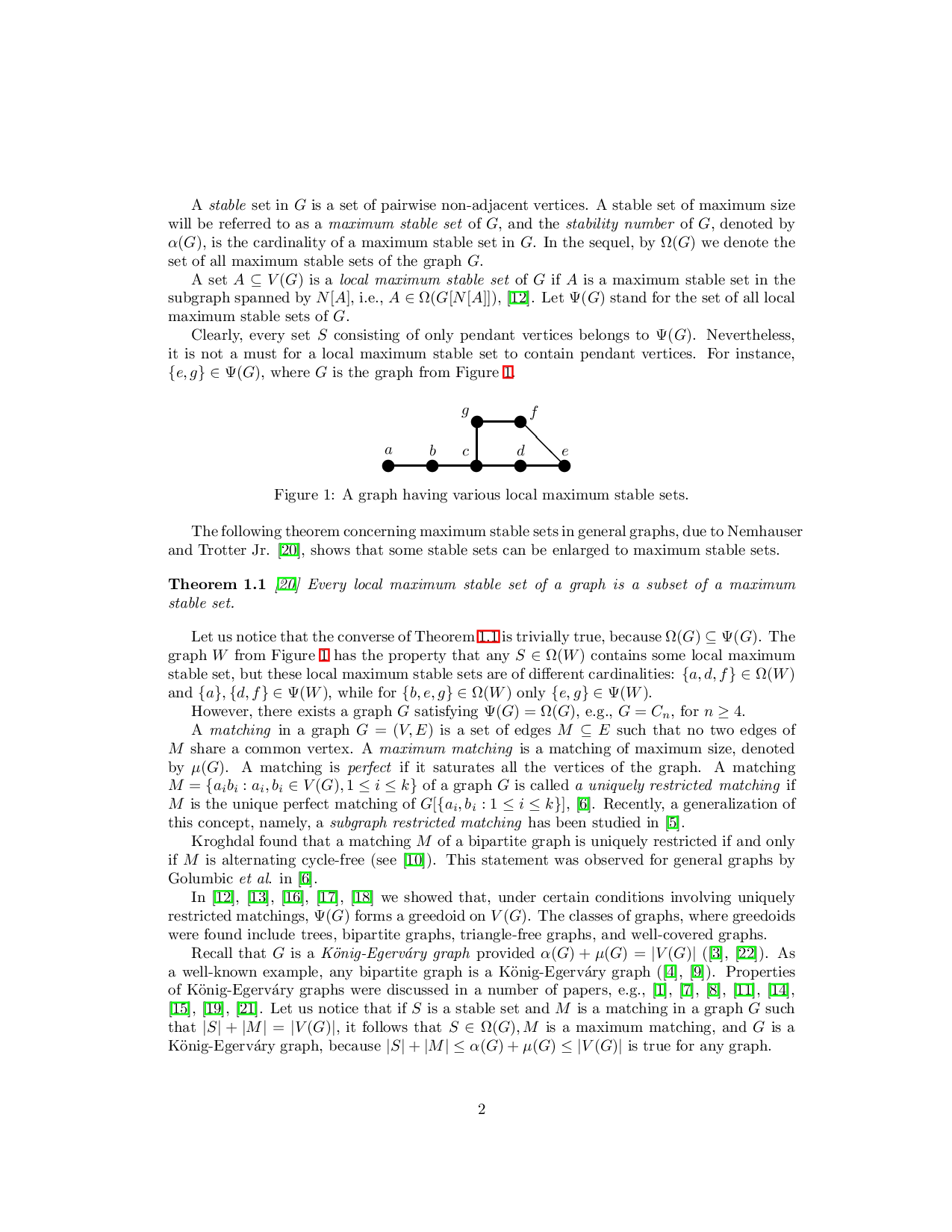
Clearly, every set S consisting of only pendant vertices belongs to Ψ(G). Nevertheless, it is not a must for a local maximum stable set to contain pendant vertices. For instance, {e, g} ∈ Ψ(G), where G is the graph from Figure 1. The following theorem concerning maximum stable sets in general graphs, due to Nemhauser and Trotter Jr. [20], shows that some stable sets can be enlarged to maximum stable sets.
Theorem 1.1 [20] Every local maximum stable set of a graph is a subset of a maximum stable set.
Let us notice that the converse of Theorem 1.1 is trivially true, because Ω(G) ⊆ Ψ(G). The graph W from Figure 1 has the property that any S ∈ Ω(W ) contains some local maximum stable set, but these local maximum stable sets are of different cardinalities: {a, d, f } ∈ Ω(W ) and {a}, {d, f } ∈ Ψ(W ), while for {b, e, g} ∈ Ω(W ) only {e, g} ∈ Ψ(W ).
However, there exists a graph G satisfying Ψ(G) = Ω(G), e.g., G = C n , for n ≥ 4.
A matching in a graph G = (V, E) is a set of edges M ⊆ E such that no two edges of M share a common vertex. A maximum matching is a matching of maximum size, denoted by µ(G). A matching is perfect if it saturates all the vertices of the graph. A matching [6]. Recently, a generalization of this concept, namely, a subgraph restricted matching has been studied in [5].
Kroghdal found that a matching M of a bipartite graph is uniquely restricted if and only if M is alternating cycle-free (see [10]). This statement was observed for general graphs by Golumbic et al. in [6].
In [12], [13], [16], [17], [18] we showed that, under certain conditions involving uniquely restricted matchings, Ψ(G) forms a greedoid on V (G). The classes of graphs, where greedoids were found include trees, bipartite graphs, triangle-free graphs, and well-covered graphs.
Recall that G is a König-Egerváry graph provided α(G) [22]). As a well-known example, any bipartite graph is a König-Egerváry graph ( [4], [9]). Properties of König-Egerváry graphs were discussed in a number of papers, e.g., [1], [7], [8], [11], [14], [15], [19], [21]. Let us notice that if S is a stable set and M is a matching in a graph G such that
The line graph of a graph G = (V, E) is the graph L(G) = (E, U ), where e i e j ∈ U if e i , e j have a common endpoint in G.
In this paper we give a sufficient condition in terms of subgraphs of G that ensure that its line graph L(G) has proper local maximum stable sets. In other words, we demonstrate that if: S ∈ Ψ(G), the subgraph H induced by S ∪ N (S) is a König-Egerváry graph, and M is a maximum matching in H, then M is a local maximum stable set in the line graph of G. It turns out that this is also a sufficient condition for a matching of G to be extendable to a maximum matching.
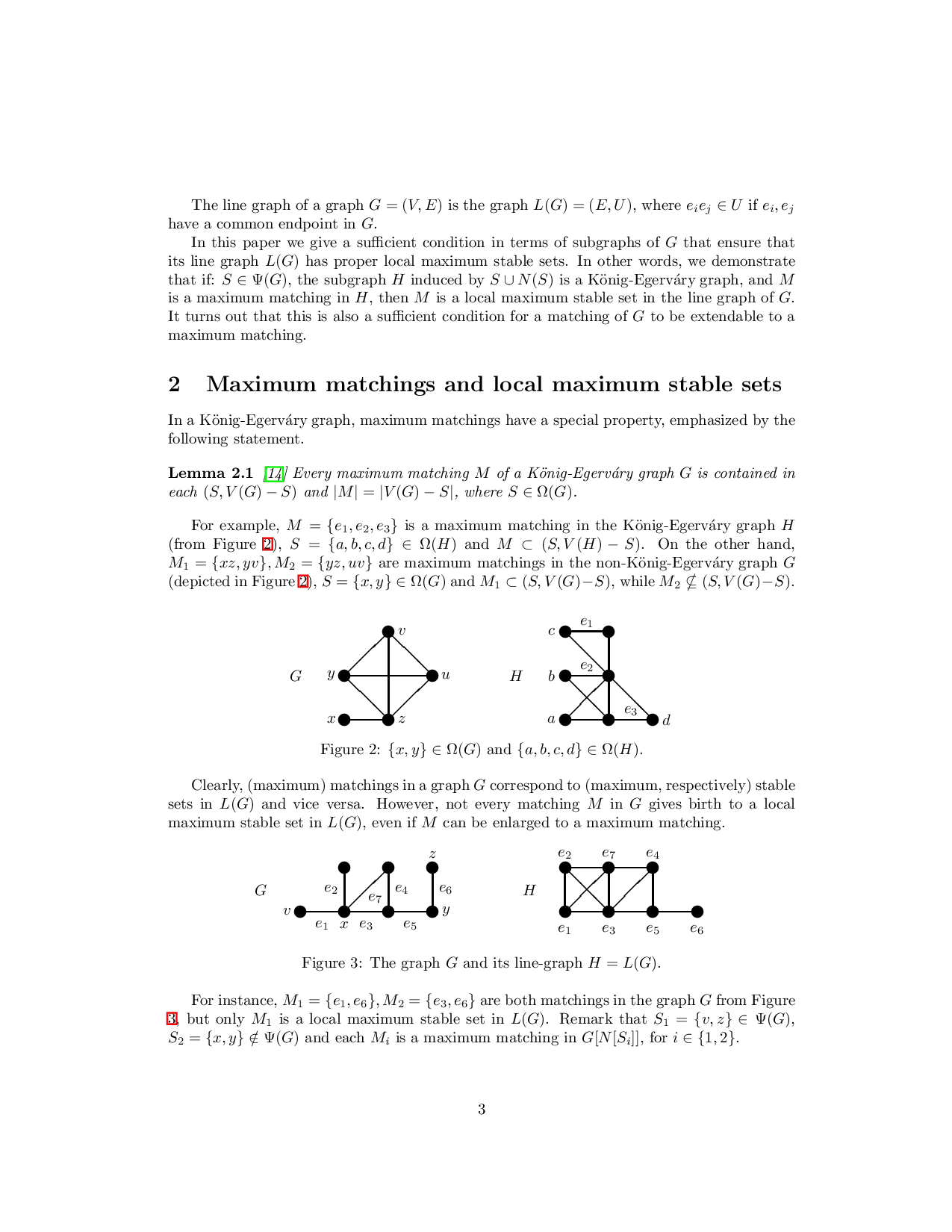
In a König-Egerváry graph, maximum matchings have a special property, emphasized by the following statement. For example, M = {e 1 , e 2 , e 3 } is a maximum matching in the König-Egerváry graph H (from Figure 2), S = {a, b, c, d} ∈ Ω(H) and M ⊂ (S, V (H) -S). On the other hand, M 1 = {xz, yv}, M 2 = {yz, uv} are maximum matchings in the non-König-Egerváry graph G (depicted in Figure 2), S = {x, y} ∈ Ω(G) and Clearly, (maximum) matchings in a graph G correspond to (maximum, respectively) stable sets in L(G) and vice versa. However, not every matching M in G gives birth to a local maximum stable set in L(G), even if M can be enlarged to a maximum matching. For instance, M 1 = {e 1 , e 6 }, M 2 = {e 3 , e 6 } are both matchings in the graph G from Figure 3, but only M 1 is a local maximum stable set in L(G). Remark that
] is a König-Egerváry graph, and M
…(Full text truncated)…
This content is AI-processed based on ArXiv data.