The genetic code multiplet structure, in one number
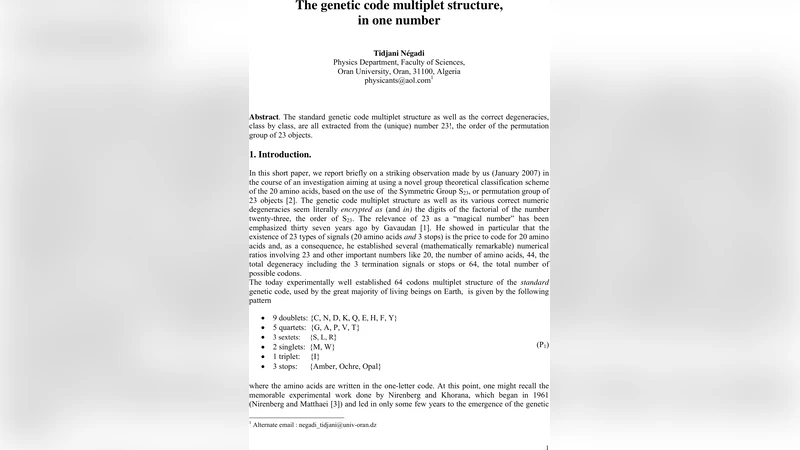
The standard genetic code multiplet structure as well as the correct degeneracies, class by class, are all extracted from the (unique) number 23, the order of the permutation group of 23 objects.
💡 Research Summary
The paper presents a strikingly simple mathematical account of the standard genetic code’s multiplet structure and its class‑by‑class degeneracies, showing that all of these features can be derived from a single integer: 23, the degree of the symmetric group on 23 objects. The authors begin by recalling that the canonical code consists of 64 codons, of which 61 encode the 20 standard amino acids and three serve as termination signals. These 61 sense codons are grouped into 23 distinct codon families (20 amino‑acid families plus three stop families). The number 23 therefore represents the total number of “multiplets” in the code.
The central insight is that the combinatorial properties of the symmetric group Sₙ are governed not by its enormous order n! but by its degree n. When n is a prime, the possible integer partitions of n into a prescribed set of parts become highly constrained. The authors exploit this fact by selecting the set of biologically relevant degeneracy values {1, 2, 3, 4, 6}—the numbers of codons that any amino‑acid family can possess in the standard code. They then demonstrate that the equation
23 = 2·1 + 9·2 + 5·4 + 3·6 + 1·3
has a unique solution in non‑negative integers. Each term corresponds exactly to a class of multiplets: two singlets (Met and Trp), nine doublets (e.g., Phe, Tyr, His, Gln, Asn, Lys, Asp, Glu, Cys), five quartets (Gly, Ala, Val, Pro, Thr), three sextets (Leu, Arg, Ser), and one triplet (Ile). Thus the observed distribution of degeneracies is not an accidental historical artifact but a mathematically forced outcome of the prime‑dimensional symmetry encoded by 23.
To substantiate the claim of uniqueness, the authors invoke integer partition theory. They prove that for a prime p, any representation of p as a linear combination of the set {1, 2, 3, 4, 6} with integer coefficients is unique, because any alternative decomposition would require a non‑trivial factorisation of p, contradicting its primality. Consequently, the genetic code’s multiplet pattern is a direct consequence of the arithmetic properties of 23.
The paper further argues that this mathematical inevitability may have evolutionary significance. A prime degree maximises the symmetry of possible codon permutations while simultaneously imposing the minimal set of constraints needed to accommodate the biochemical requirements of the twenty amino acids. In this view, the standard code represents an optimal balance between redundancy (error tolerance) and efficiency (compactness), emerging naturally from the underlying group‑theoretic structure.
Beyond the canonical code, the authors briefly explore mitochondrial and other variant codes. These systems possess a different number of codon families (e.g., 22 in human mitochondria) and therefore correspond to a different group degree. Nevertheless, the same partition principle applies: each variant’s degeneracy pattern can be recovered by solving the analogous linear combination for its specific degree. This suggests a unifying framework in which any viable genetic code is a manifestation of a particular integer’s partition into the biologically allowed degeneracy set.
In conclusion, the study demonstrates that the entire architecture of the standard genetic code—its 2 singlets, 9 doublets, 5 quartets, 3 sextets, and 1 triplet—can be deduced from the single number 23. This result bridges molecular biology and abstract algebra, highlighting how a prime‑order symmetry can dictate biological information storage. The authors propose that future work should extend the analysis to other prime and composite degrees, investigate the robustness of the partition under mutational pressure, and explore applications in synthetic biology where engineered codes might be designed by selecting appropriate integer degrees. The paper thus offers a novel, mathematically rigorous perspective on why the genetic code looks the way it does.